
GuideSkills & Training
How TEEI Connects DataCamp Learning with Live Teaching
DataCamp is a learning platform of its own and a key resource in Skills Academy. How TEEI builds live teaching, conversation and mentoring around it.
The programme
On this page
- How it fits together
- Learning on DataCamp: courses, practice, tracks, projects and certifications
- Live learning in Skills Academy: what she learned, with a professional in the room
- Language: explaining the method out loud
- Mentoring: choosing what to learn, and showing what you can do
- What one learner and the group report
- How TEEI organises the connection
- What partners add, and how to contribute
- Frequently asked questions
DataCamp is a learning platform of its own, outside TEEI. There, a learner in TEEI’s group studies Python, SQL, Power BI, AI, statistics and more, in courses, tracks and projects DataCamp builds. TEEI gives her the access through DataCamp Donates, and we organise the people around it: professionals who teach live, conversation partners and mentors.
She is an illustration, not a named participant. Her route is one of many through TEEI’s learning environment, and each programme on it can be used on its own.
Skills Academy is TEEI’s learning environment for professional skills. It holds self-paced study, on DataCamp and on other resources, and live learning with professionals in five formats. DataCamp is an important resource inside it, not another name for it. Alongside the Academy sit TEEI Language, TEEI Language Courses and TEEI Mentorship.
A learner can use them at the same time, in any order, or not at all. Skills Academy is open to people from Ukraine and to women from the Americas, the United States and Canada included.
Between 26 September and 14 October 2026, 164 of the 2,406 DataCamp learners we invited answered TEEI’s learner survey, 6.8 percent. The answers are self-reported by those who chose to answer, not an estimate for everyone invited.
Of the 157 who answered the questions on skills, 137 say they can use their main skill better than when they started (87 percent). Eighty-one have used what they learned in their job (52 percent). Without the free access through TEEI, 105 say similar learning in this period would have been unlikely (67 percent).
How it fits together
The figure below follows her through the connection, step by step. She asks for DataCamp access in Skills Academy and studies on DataCamp’s own platform. Back in Skills Academy, she registers for a session with a professional and joins a live session in TEEI’s video room. Two more sit alongside, in any order: talking her work through in English in TEEI Language, and choosing what to learn next with a mentor.

The first step is one click under Learning Resources in her Skills Academy account. A person on the TEEI team adds her to the group on DataCamp, and the invitation comes from DataCamp. The second screen is DataCamp’s own page for an exercise in its Introduction to Python course, outside TEEI. The third screen is a Skills Academy workshop, and the fourth is the door to a webinar, another live format, in TEEI’s own video room.
Nothing on the second row is a step. A conversation in TEEI Language and a session with a mentor can come before the course, during it or after it. TEEI Language Courses, teacher-led with their own sign-up, and Practice Companion, not open to learners yet, sit alongside in the same way. The rest of this article takes each part in turn.
Learning on DataCamp: courses, practice, tracks, projects and certifications
DataCamp is a separate learning platform, with its own courses, code editor, exercises, tracks, projects and certifications. DataCamp builds and runs all of it. This section describes the platform the way DataCamp’s help centre does.
A course is built in chapters, and a chapter alternates between short video lessons and exercises. Some video lessons have a side panel with a transcript and a summary. In a coding exercise, the learner writes code in DataCamp’s editor and submits it. If she is stuck, she can take a hint or show the answer, and she then earns less XP, or none.
Not every course is code. Introduction to Statistics involves no coding; its chapters mix videos with multiple-choice and drag-and-drop questions. Introduction to Power BI has the learner working in Power BI itself, through a remote desktop in the browser. In the courses we looked at, exercises outnumber videos.
Practice is a separate part of the platform. DataCamp uses AI to generate practice exercises from the course content, usually five to a workout, with instant feedback. They are fill-in-the-blanks, multiple-choice questions and coding challenges. Practice makes up three in four of the completed items in TEEI’s group.
A track is a sequence of courses DataCamp has put together to build complementary skills step by step. There are two kinds, skill tracks and career tracks. When she finishes a course or a track, she receives a Statement of Accomplishment from DataCamp.
In a project, she applies what she has learned to a real-world scenario with a dataset. In a guided project, she works through step-by-step tasks. In an unguided project, she solves an open-ended problem without those steps. Many projects can be shared in DataLab, DataCamp’s online notebook, which DataCamp Donates partners have premium access to.
She can check her level in DataCamp’s adaptive assessment, which takes about ten minutes. She then sees her score, her strengths and her gaps. A DataCamp Certification is different: timed exams and a practical case study, for a role such as data analyst or a technology such as SQL. It is not based on any one course, and DataCamp sets its requirements.
All of this comes through DataCamp Donates. DataCamp gives the learners in TEEI’s group the full curriculum, including new courses as they are added, and the certifications. DataCamp built the content and opens it to the group. We bring the learners, the learning environment and the support around it.
Asked what had been most useful toward their goal, 130 of the 157 who answered the survey named the free access. After it came learning at their own pace (103), a clear course sequence or track (78) and the practical exercises (69).
The Data Connector export DataCamp provides to TEEI begins on 31 October 2023. By 12 October 2026, learners in the group had completed 2,830 projects and 193 certifications in that window, as the export counts them.
In the same window, 1,576 learners completed 15,979 courses between them, each course counted once per learner. By DataCamp’s own topics, data manipulation and programming lead, followed by AI, data visualisation, data engineering and data preparation. By tool, Python and SQL lead, then courses taught without one, then Power BI, Tableau, Excel, ChatGPT, Google Sheets and R. The courses completed by the most learners are Introduction to SQL (890), Intermediate SQL (697) and Introduction to Python (532).

Tracks and certifications show the same breadth. In the export, 218 learners completed a career track and 293 a skill track. The career tracks completed most often are Associate Data Analyst in SQL, Data Analyst in Python and Associate Data Engineer in SQL. The 193 certifications went to 121 learners, from Data Analyst Associate and SQL Associate to AI Fundamentals and Data Literacy.

DataCamp’s dashboard gives the group’s numbers. On 7 October 2026 at 17:20 GMT+2, the dashboard read 77,374 hours on the platform, 2,428 of them in the previous 30 days. Learners in the group had completed 264,847 items, which DataCamp’s dashboard groups as learn, practice, apply and assess, and three in four were practice. DataCamp counts from March 2022, when TEEI joined DataCamp Donates; the group passed 75,000 hours by 15 September 2026.

Live learning in Skills Academy: what she learned, with a professional in the room
On DataCamp, the learner finds out whether her answer is correct. In a clinic she can discuss her own work with a professional and hear how they would approach the same task. That is what the live side of Skills Academy is for. Self-paced study and live learning sit in the same environment, and work moves between them in both directions.
We asked what would make learning on DataCamp easier. Of the 56 who answered, 38 named more time and 10 courses in their own language. Seventeen named a clearer link to their goal and 9 someone to ask when they are stuck. A professional in the room can give the last two.
Skills Academy runs five live formats, and a learner chooses by what she needs, not by level. A workshop is one session built around one task, done in the room. A clinic is open time where she brings her own problem: a script that fails, or a chart that does not say what she means.
An expert Q&A puts a professional in front of a group, with questions prepared in advance. A webinar is a professional showing how they use a skill in their own work. A class is a short run of two to six weekly sessions, with materials, tasks and feedback between them.
Whatever its subject, a workshop looks like the sample workshop in the figure below. The session page carries a preparation note, so she knows what to bring, what she will leave with, and who teaches it. On the instructor’s side, the same session shows how many are registered, the preparation steps and the sessions after it.

The instructor is a professional who uses the skill at work, and that is the point of the live side. On DataCamp she learns the method. In the room she hears how a professional uses it at work, what it is for and what colleagues ask about the result. What she learned on DataCamp is shown the way it is used in real work, by someone who uses it.
A professional can also come through their employer, when a company lets its employees teach, mentor or hold conversations. The company sees the sessions and hours recorded in Evenhall. How corporate volunteering works at TEEI describes that side step by step.
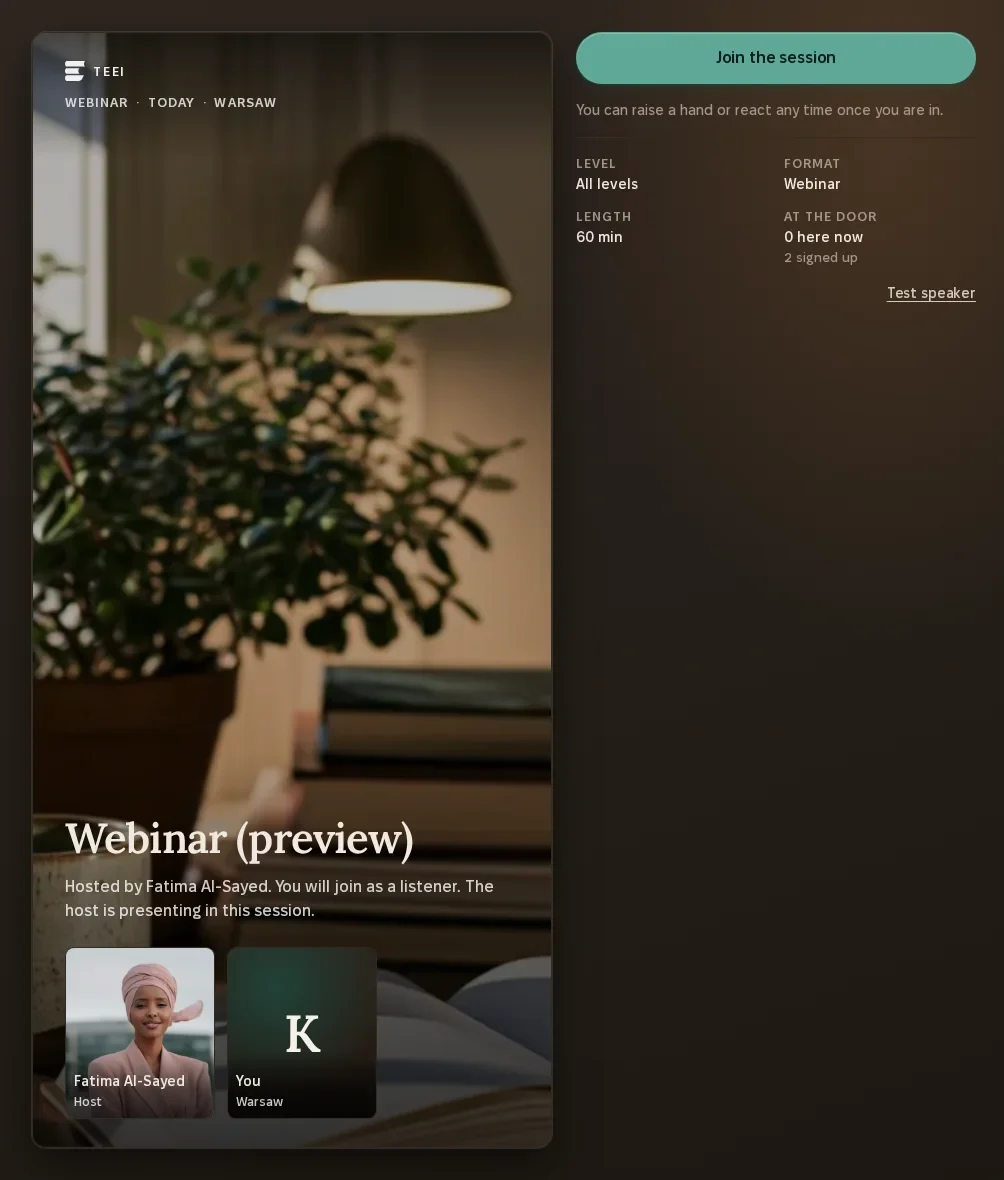
A live session takes place in TEEI’s own video room. A webinar, and an expert Q&A unless the host opens it up, seats her as a listener, and the host invites her up to speak. A class runs as a conversation by default, so everyone speaks from the start. The room below is TEEI’s test room with demo personas, as a listener in a Skills Academy webinar sees it.
One press
You are in the webinar as a listener, with a hand to raise.
Enter the webinar as a listener as the host
Opens for reviewers who came in through the link TEEI sends. Open the host in one tab and a listener in another to see both sides.
In the webinar
- The host presents. You hear and see her from the moment you are in.
- You can raise a hand or react at any time, and the host can invite you up to speak.
- The host decides who is heard. A listener is muted until the host invites her up.
- A class runs as a conversation by default: everyone speaks from the start.
- 1The room. The host is Fatima Al-Sayed, a demo persona; the tile beside hers is you, as a listener.
- 2You join with one press. Who may enter is decided before the room opens.
- 3What the door shows for every Skills Academy session: level, format, length, and who is here and signed up.
Three Skills Academy rooms, one press each
The whole test room, all twelve roomseveryone speakslisteners are invited up
Skills Academy
Webinar
Invited up to speak the host decides
Skills Academy
Class
Everyone speaks
Skills Academy
Expert Q&A
Invited up to speak the host decides
Each button opens the room in a new tab, in that role, for reviewers who came in through the link TEEI sends. The rooms hold demo personas only. If a room is not available at that moment, you land on the overview and can try again a little later.
A class ends with a confirmation. When the teaching team confirms that she attended and completed the work, she receives a certificate issued by TEEI for that class. It says something different from a Statement of Accomplishment. The learning provider issues its own statement for its course; TEEI issues the certificate for the class.
Instructors who apply on their own are approved before they teach. A colleague a company sends creates and teaches classes, workshops and other learning activities on topics they choose. Instructors teach in any field, not only data. TEEI runs the room, the sign-up and the follow-up, and the instructor brings the subject.
Language: explaining the method out loud
A result is one thing. Explaining to a colleague, in English, how she got there is another. In TEEI Language, a learner practises exactly that with a person.
She can book a one-to-one conversation with a volunteer and bring her own topic, such as walking through the project she has just finished. She can join a group session, such as a Speaking Club, where a host sets the topic and a short preparation. TEEI Language is conversation practice, not a course, and the volunteer needs no teaching qualification. What the learner needs is a reason to talk, and a finished project is a good one.

TEEI Language Courses are a separate offer. A teacher leads a group online, two to three sessions a week for two to three months. Materials, assignments and progress are kept in itslearning, and lessons take place in TEEI’s own video room. The content comes from Babbel and Oxford University Press.
The courses are for people from Ukraine and for women from Latin America and the Caribbean, and a learner is placed when there is capacity.
Practice Companion is AI-supported language practice in TEEI Language, between and alongside conversations with people. On the days in between, a learner has four rooms: Write, Listen, Say it and the level conversation. Her level and the situation she is practising for stay on record there, and every room has a way back to a person. It is not open to learners yet.
Before the rooms open, we are tuning prompts and model settings so that learners get the best possible experience. We are also finishing the production setup of the voice path and deploying the level judgement behind TEEI Language’s own certification gate. How it corrects one sentence at a time is described in its own article.
Mentoring: choosing what to learn, and showing what you can do
A mentor in TEEI Mentorship is a professional with experience in the field a learner is moving towards. She browses the approved mentors, reads what each one offers, and books a session with the one who fits.

Mentoring is useful before the learning starts, to decide what to learn. It is useful during it, when she weighs a career track towards one role against building one skill at a time. It is useful after it too, when she has to present what she can now do.
Nothing has to be finished first. A learner does not need a course, a certificate or a class behind her to book a mentor. The guidance is about direction, applications, interviews and how a field works from the inside. It is guidance, not a job.
None of this is a ladder. Nobody has to pass through TEEI Language to reach a course, or finish a course to reach a mentor. We asked what they had mainly wanted when they received DataCamp access. Of 164 respondents, 54 wanted skills for their current work, 56 wanted to change fields, and 17 wanted to prepare for a first job.
The remaining 37 named studies, a return to an earlier field, a personal interest or something else. Seventy of the 164 were balancing learning with work or family, and 35 were adjusting to life in a new place or country. The environment has to hold all of them at once.
The survey’s last screen had buttons to TEEI Mentorship, TEEI Language and Google Professional Certificates, and one for not now. Of the 62 who pressed a button, 28 pressed Google Professional Certificates, 11 TEEI Mentorship and 7 TEEI Language.
What one learner and the group report
The learner above is an illustration. Artem, a learner in TEEI’s group on DataCamp, is not.
They used DataCamp as their main platform to learn SQL, statistics and Power BI. When they shared their story, they had completed nine courses in 41 hours there. They say it helped them into their first operational role, and then into a job as a junior data analyst at a financial company. The account is their own.
In the survey the learners also gave their own view. Below are their answers to four of its questions, as read on 16 October 2026. The learners say what they found useful and where they used it, not what TEEI caused.

Of the 137 who say they can use their main skill better than when they started, 97 say much better.
Outside DataCamp, 81 have used the skills in their job and 67 in a personal project or portfolio. Sixty-one have used them in their studies, and 47 in a job application or technical interview. Twenty-six have not used them outside DataCamp yet.
Asked which milestones they had reached since they got access, 49 of the 157 who answered ticked “Started a job”. Fifty-eight ticked “A job interview or technical assessment”, and 54 ticked none of these yet. The ticks are not a count of jobs, and not a result TEEI or DataCamp caused.
Of the 52 who answered how much DataCamp had helped them return to learning, 34 said a lot.
The group has recorded learning time in every month since November 2023. From the Data Connector export, TEEI aggregates learning hours per month for the whole group. September 2026 held 2,510 hours from 543 learners with learning time that month. The busiest month so far was February 2025, with 3,687 hours.

The export counts learning time from 31 October 2023 to 12 October 2026, 75,806 hours in all. The dashboard read 77,374 hours on 7 October 2026, counting from March 2022 on a different measure. The two use different windows and measures, so they are not added.
How TEEI organises the connection
A learner asks for DataCamp access from her Skills Academy account, under Learning Resources, with one click. She can see where the request stands: requested, invited, accepted.

A member of the TEEI team adds her email address to the group on DataCamp, and DataCamp sends her the invitation. From then on she studies on DataCamp. Her TEEI account does not sign her in to DataCamp, and her progress there does not appear in her TEEI account.
What TEEI organises is the sessions, the people and the follow-up around that. We keep the list of learning resources and the sign-up, and we run the waiting lists when a class is full. Learners meet approved instructors, conversation partners and mentors.
A session in Skills Academy carries its preparation note, its agenda and up to five links to materials. It takes place in TEEI’s own video room. A class carries its tasks, with submission and feedback, and the teaching team confirms completion.
Her learning history stays in one place, under My Academy: the sessions she joined, the classes she completed and the certificates TEEI issued. DataCamp records what she does on DataCamp.
As the group’s administrator, TEEI can see each member’s activity in the daily Data Connector export DataCamp provides. From the export, TEEI publishes only the group’s totals. The group figures in this article are aggregates, and the individual accounts are the learners’ own.
What partners add, and how to contribute
DataCamp contributes the content and the access, through DataCamp Donates, for every learner in TEEI’s group. That is the full curriculum, the practice, the tracks, the projects and the certifications. TEEI contributes the environment around it: the live sessions, the conversation practice, the language courses and the mentoring. Around all of them sits the follow-up that helps her present what she has learned.
- A professional can teach in Skills Academy: a workshop, a clinic, an expert Q&A, a webinar or a class, in their own field.
- A company can let its employees teach, mentor or hold conversations, and see the sessions and hours recorded in Evenhall. How corporate volunteering works at TEEI describes it step by step.
- A provider of learning content or tools can make it available to TEEI’s learners, the way DataCamp has.
- Anyone with time for a conversation can become a conversation partner in TEEI Language.
DataCamp gives a learner the courses, tracks, projects and certifications. TEEI gives her the room, the people and the follow-up around them. That is the connection, and it has room for other partners.
Frequently asked questions
Is Skills Academy the same as DataCamp?
No. Skills Academy is TEEI’s learning environment for professional skills, with self-paced study and live learning with professionals. DataCamp is an important resource inside it, through DataCamp Donates, and the study itself happens on DataCamp.
What can learners study on DataCamp through TEEI?
The whole DataCamp catalogue, through DataCamp Donates: courses, practice, skill and career tracks, projects, assessments and certifications. In TEEI’s group, the most completed courses are in data manipulation, programming, AI and data visualisation. By tool, Python and SQL lead.
Does a learner have to finish a course before joining a live session or booking a mentor?
No. Workshops, clinics, expert Q&As, webinars, classes, conversation practice and mentoring can be used in any order, at the same time, or on their own.
What does a finished DataCamp course give?
A Statement of Accomplishment from DataCamp, and the same for a finished track. A DataCamp Certification is separate: timed exams and a practical case study, not tied to one course. A completed Skills Academy class, once the teaching team confirms it, gives a certificate issued by TEEI. None of these is a condition for the others.
Does TEEI see what each learner does on DataCamp?
Yes, in the daily Data Connector export DataCamp provides to the group’s administrator. A learner’s TEEI account does not sign her in to DataCamp, and her progress does not appear in it. From the export, TEEI publishes only the group’s totals.
How can a professional or a company contribute?
A professional can apply to teach in Skills Academy in their own field. A company can let employees teach, mentor or hold conversations, with sessions and hours recorded in Evenhall. A provider can make learning content or tools available to TEEI’s learners.