
GuideVolunteering & Partnerships
Inside TEEI Network Partners: From Community Reach to Real Participation
Organisations can share TEEI's programmes, contribute their own people, or both, and follow what happened in one workspace with an AI assistant.
The programme
On this page
- An invitation is only the beginning
- The missing connection between knowing people and serving them
- Share, contribute or do both
- Three programmes, several reasons to participate
- Starting with a real need
- Sharing that leads to the right place
- Attribution that respects each person
- Two views of the same network: participation and contribution
- Asking for a class and offering to teach are different jobs
- The assistant works inside the workspace
- A history group, from one sentence to a usable activity
- The assistant knows what is on the page
- From a language model’s suggestion to an application action
- A saved task is more valuable than a long conversation
- Recovery is part of the experience
- Reporting begins with definitions
- A person’s journey can cross programmes in any order
- What this looks like for a university
- What this looks like for a senior community
- What this looks like for a local service or community organisation
- When several organisations contribute to one useful activity
- Shared infrastructure is what makes the breadth practical
- Accessibility belongs in the ordinary workflow
- Growing capacity means connecting demand with something deliverable
- The economics of coordination
- A foundation for organisations to do more together
- The real unit of progress
- Sources and editorial basis
- Frequently asked questions
How TEEI connects community organisations, universities, senior communities and local services with language practice, mentoring, skills and the people who make those opportunities possible.
The platforms Network Partners runs on are live today; the full assistant journey is what we are building next.
An invitation is only the beginning
Imagine a community coordinator with a practical problem. Her organisation knows people who would benefit from language practice, professional advice and opportunities to meet others. It also knows people who could help: a retired teacher, a university student, an accountant willing to mentor someone and a member who would enjoy hosting a conversation group.
She needs a way to connect those intentions with something that actually happens.
An invitation needs to lead to a relevant programme. A person who registers needs to find an activity. Someone who offers their expertise needs a workable role. A group needs a host, a time, a room and a reason to return. The organisation needs to understand what followed its introduction, while the people it introduced keep their own lives and accounts.
That is the space TEEI Network Partners occupies.
It connects organisations and their communities with TEEI Language, TEEI Mentorship and TEEI Skills Academy. The organisation can introduce people to opportunities, contribute people and expertise, or do both. TEEI Network Workspace brings those activities into one organisational view. An integrated AI assistant helps the coordinator understand the options, prepare the work and carry out supported actions inside the platform.
The point is to make a useful next step easier to take, and to keep the chain intact afterwards.
For the person joining, that might mean a first language conversation. For an experienced professional, it might mean becoming a mentor. For a university, it might mean connecting students and educators with practical teaching opportunities. For a senior association, it might mean turning a member’s interest in history into a discussion group that other people can join.
These are different activities. They share one operational need: willingness has to be organised.
Network Partners gives that willingness somewhere to go.
The missing connection between knowing people and serving them
A local organisation knows things a large platform has to learn: who is likely to respond to an invitation, which language makes the offer understandable, where people already gather and what makes an opportunity feel relevant.
A programme operator knows something different: how the activity works, how participants join, how volunteers contribute, how sessions are delivered and how participation is recorded.
The Network Partners model connects those forms of knowledge, and each organisation stays what it is.
A community group helps its members practise a language with TEEI’s booking system. A university connects experienced alumni with people who need professional guidance through TEEI Mentorship. A library introduces suitable learning opportunities, and TEEI supplies the video platform, attendance records and certificates.
TEEI, in turn, works alongside the local organisation. The relationships that make that organisation trusted stay with it. A coordinator’s knowledge of a community stays the coordinator’s, and the platform is built to put it to work.
The division of work is clear. The organisation brings context, relationships and relevant contributions. TEEI supplies connected programmes and the infrastructure around them. Participants keep their own choices.
This is why the model is more than a directory. A directory points somewhere. Network Partners connects the introduction to programme participation, connects contributions to delivery and gives the organisation a way to see what followed.
Every organisation starts where it is. Some want to share one opportunity in a newsletter. Others want to coordinate several activities over time. Some have specialist instructors and need an audience. Others have an audience and need teaching capacity. Network Partners accommodates each of those starting points.
The entry point can be small. The continuity behind it can be large.
Share, contribute or do both
The central design choice is simple: an organisation can be on the receiving side, the giving side or both, and can move between them.
It can share suitable TEEI opportunities with the people it reaches. It can bring conversation partners, mentors, instructors and group hosts into the programmes. It can combine those activities within the same organisational relationship.[1]

Consider a university. Some students may want to volunteer as conversation partners. An educator may want to teach a workshop. Alumni may have professional experience to contribute through mentoring. Eligible members of the university community may also want language practice or skills opportunities themselves. Network Partners captures all of that involvement.
A senior community presents the same pattern. Some members want regular conversation or a new learning opportunity. Others want a practical way to use experience accumulated over decades. Many want both. The retired teacher who hosts a group may also join a class on a subject she has never studied.
A community organisation working with displaced people may begin by sharing language practice. Later, a participant with relevant professional experience may become a mentor or instructor. The person’s role changes, and the organisation’s relationship with TEEI carries straight on.
The workspace therefore holds two complementary perspectives: participation introduced through the organisation, and contributions made through it. Each stands on its own, and both can grow together.
Free opportunities are open to every organisation’s community, whether or not it provides volunteers. Everyone has a place in a class, whether or not they teach one. Reciprocity is an opportunity that people take up when they want to.
That sets the tone of the entire product. The public invitation stays direct: here is something useful you can join. It opens with the opportunity itself.
Network Partners is the framework behind the relationship. The public invitation stays focused on the opportunity, while the organisational framework does its work behind it.
Three programmes, several reasons to participate
The organisational route connects to three distinct programmes, each with its own activities.
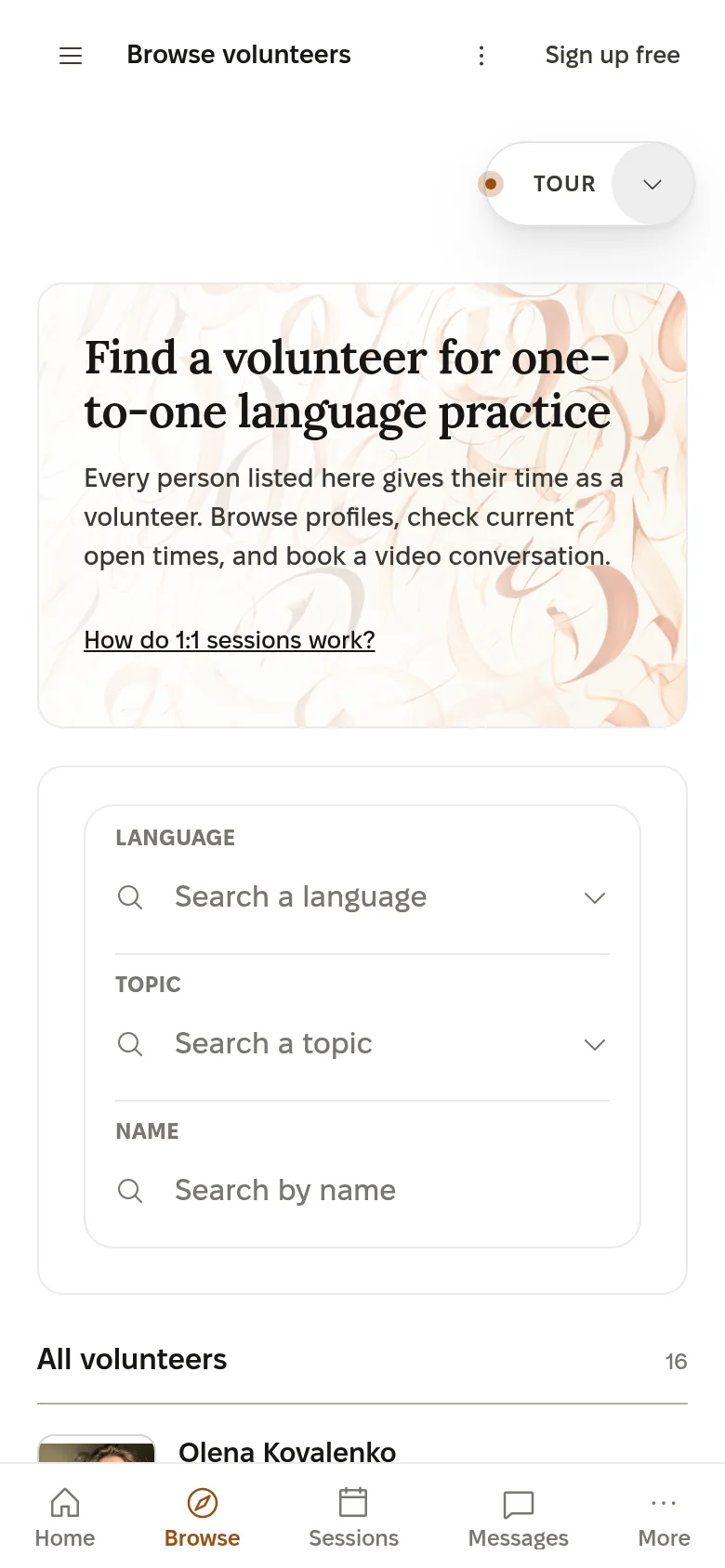
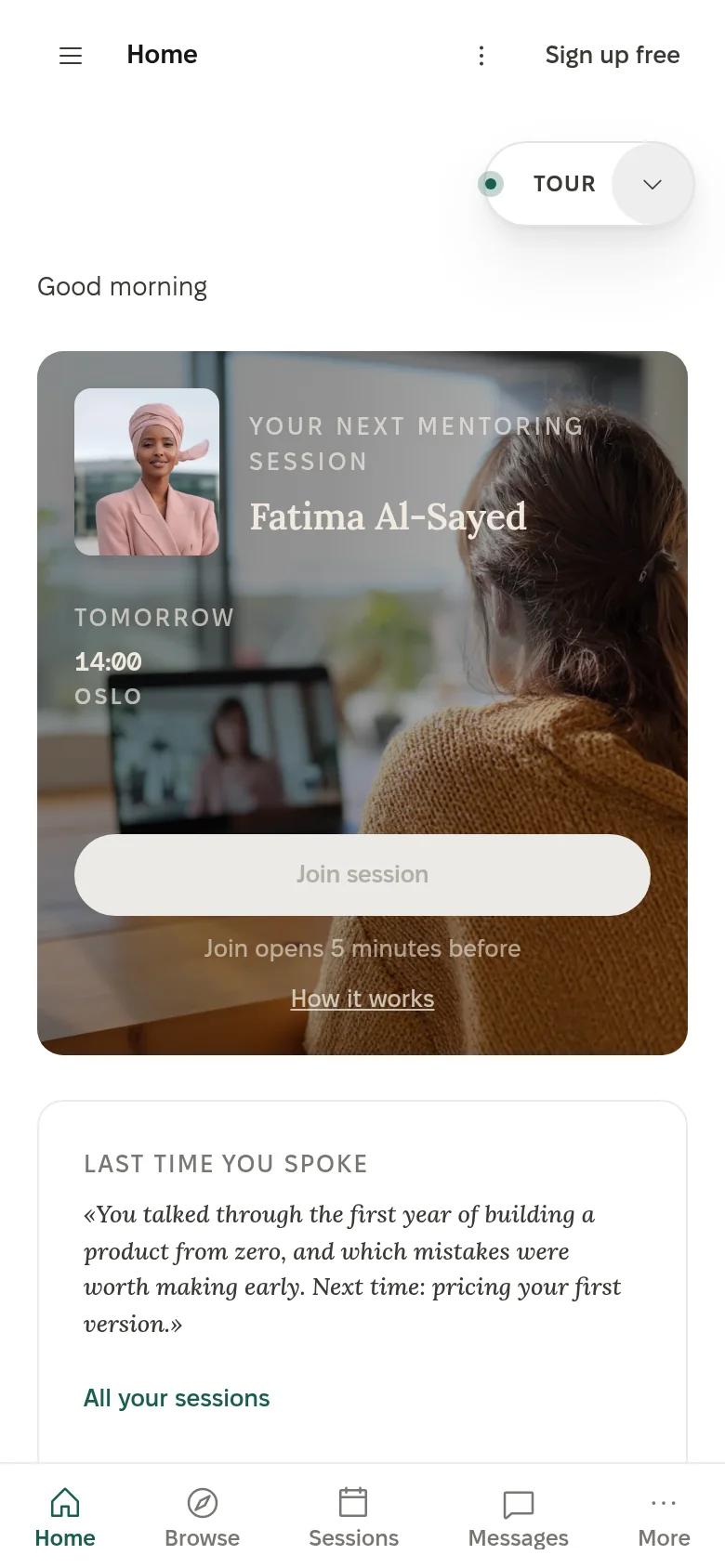
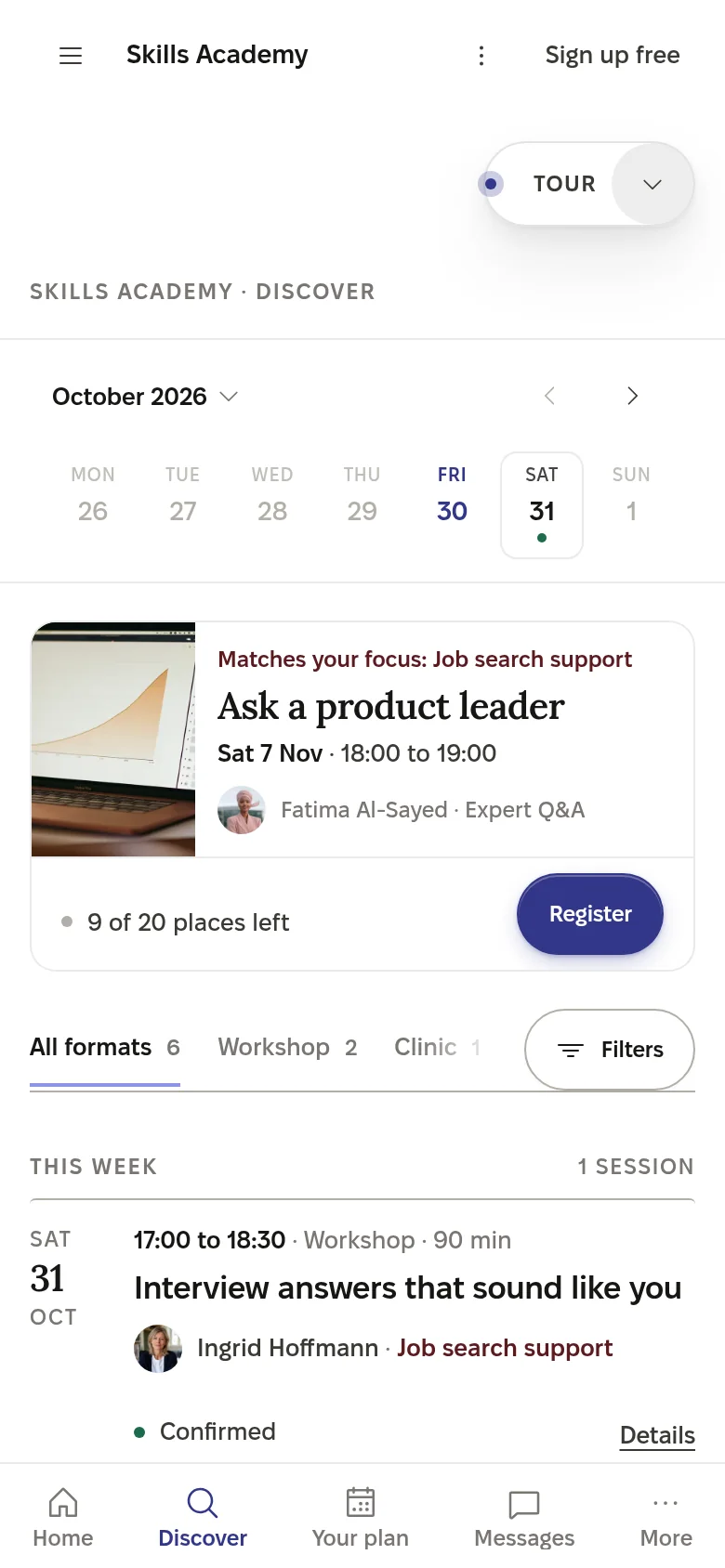
Language: practice with another person
TEEI Language gives people ways to practise through one-to-one conversations, Speaking Cafés and other group formats. The immediate goal may be a specific language task: speaking at work, preparing for a conversation, understanding everyday expressions or becoming more comfortable using a language in front of another person.
There is also a social dimension. A recurring conversation gives people a reason to meet again. A group can bring together people around an interest as well as a language. The language activity is real; so is the contact between the people taking part.
Conversation partners and hosts arrive through individual volunteering, companies, universities, senior communities and other organisations. Network Partners makes those routes visible, and every volunteer has the same standing.
For an organisation, the practical question goes beyond whether its members want to learn a language. Would they prefer a one-to-one conversation, an existing group or a shared activity organised around a particular interest? The workspace and assistant make that distinction understandable.
Mentorship: experience applied to a specific situation
TEEI Mentorship connects people with relevant professional experience. A useful mentoring conversation is concrete. It may focus on a CV, an interview, a professional transition, a decision about further learning or how to explain experience in a new employment context.
A mentor may be working, retired or between roles. What matters is the relevance of the experience and the requirements of the role.
The organisation can introduce the opportunity and help someone understand it. The mentee chooses whom to approach. The organisation makes the connection possible, and the person decides.
Skills Academy: learning with resources and people
TEEI Skills Academy combines opportunities for structured learning with live contributions from people who know a subject. Those contributions take the form of workshops, classes, clinics and expert question-and-answer sessions. Instructors come from companies, universities, senior communities, other organisations or individual volunteering.[1]
A person may want to learn a practical spreadsheet technique, understand a digital tool, discuss a professional problem or work through a more substantial course. DataCamp and Google Career Certificates on Coursera provide structured learning routes within TEEI’s wider offering. Live sessions and study activity create additional opportunities to ask questions and apply what has been learned.
The distinctions stay visible. Joining a workshop, attending it, completing a class and earning a credential from an external learning provider are four separate events, and each is recorded as itself.
Each programme keeps its own eligibility and role requirements. A shared organisational entry point makes the choices easier to navigate, and every programme’s audience and every volunteer role keep their definitions.
Starting with a real need
The first useful question in Network Workspace is “What are you trying to make possible?”
A coordinator might want to introduce language practice to a community. A faculty member might want to organise a contribution from students. A senior association might have people interested in both joining and hosting activities. A library might want a shareable explanation that visitors understand on their own.
Those are different starting points. The workspace presents the relevant programmes, sharing tools, class routes, participant records and reports in one place, and the coordinator enters through the task that matters now.
The assistant interprets that intention. We have members who want to practise English and two people who would like to host a group contains two jobs. The first concerns access to existing activities. The second concerns a contribution. The assistant separates them and helps with each.
It shows the relevant programme, opens the contribution route and prepares the parts of a draft already established in the conversation. It asks for information that is genuinely missing. Details the coordinator has already given, such as the organisation’s name, carry straight into the next form.
The normal interface is available throughout. A person who prefers browsing uses it directly. A person who wants help asks. The assistant is an additional way to operate the product, and every page works on its own.
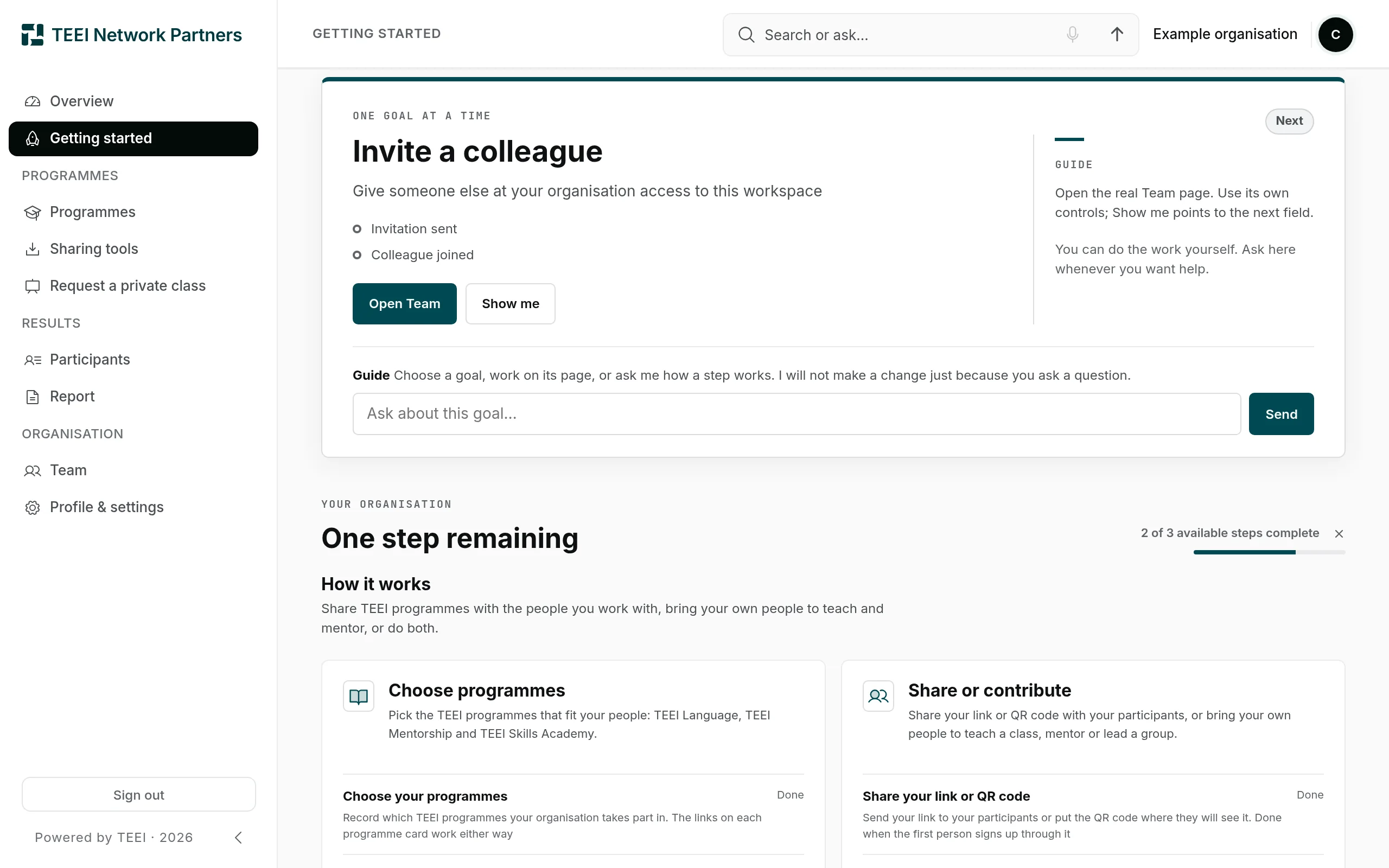
That serves experienced users as much as beginners. Sometimes the quickest route is a button. Sometimes it is a sentence. The product supports both.
The strongest onboarding leaves the organisation with something usable: a relevant link, an understandable invitation, a saved contribution or a clearly defined class request. People learn where everything is while they do useful work.
Sharing that leads to the right place
An organisation’s first contribution may be a message in a channel it already uses. That could be a newsletter, a community chat, a website, a noticeboard or a conversation at a local event.
The sharing tools support those different settings with programme links, suitable text, QR codes and materials that explain what the recipient can actually do. The practical test: a person moves from the invitation straight to the relevant opportunity.

A language invitation leads to language practice. A mentoring invitation explains the purpose of a mentor. A skills invitation distinguishes a live class from a self-paced learning route. A general introduction presents several options and gives each enough definition to be useful.
Language matters at two levels. The message is understandable in the recipient’s language, and so is the destination, with its next step. The whole journey is translated, including the important instructions.
The same principle applies to print. A QR code bridges a physical encounter and a digital action. Its value comes from the page it opens, the clarity of that page and a next step that works on the phone the person is holding.
For an organisation using its own materials, the referral information travels with the programme link. The system handles the organisational association behind the scenes, within the programme’s disclosure and sharing arrangements, and campaign codes stay invisible to the person.
Sharing public information is simple. An organisation introduces free opportunities in plain language. The organisational workspace comes in when that organisation wants continuity: its own sharing materials, contributions, team access and a view of participation connected with its activity.
Friction goes; context stays. The invitation is easy to act on and clear about what is being offered, by whom and what happens next.
Attribution that respects each person
When someone joins through an organisation’s link, there is a useful operational fact to keep: the organisation helped create that route into the programme.
That fact informs reporting, helps a coordinator see whether an invitation reached people and connects later participation to the original introduction. The person remains their own.
A participant may already know TEEI. They may meet several invitations. They may contribute through one relationship and participate through another. The system represents the relationships that actually exist, and a person can hold several.
This is also why attribution and visibility are separate concepts. Recognising that an introduction led to participation gives the organisation credit for the introduction. The organisation’s view follows the applicable access and sharing choices. An organisation code in a link records the introduction; names appear only under the participant’s sharing choices.[1]

The technical work is substantial. The original referral association survives the journey through programme entry and account creation. Repeated events resolve to one person. A return visit keeps a valid earlier connection even when the person arrives by a different route. An organisation can change its display name and keep its history.
Network Workspace handles this continuity. The organisation sees whether its introduction was recognised, with one record in place of registration lists from three different systems.
It also keeps ordinary interactions simple. A member who scans a printed card at a local meeting and a member who follows a newsletter link both arrive at a coherent programme experience.
The result is a more useful form of accountability: the organisation understands its role in creating access, and the person remains a participant with their own identity, choices and relationships.
Two views of the same network: participation and contribution
What an organisation does through TEEI takes more than one total to describe.
Suppose its members join language conversations, one volunteer mentors several people and an instructor teaches a group. The organisation sees what people accessed and what its contributors provided, with the programme and activity type kept for each.
The participation view follows the people introduced to opportunities. It answers questions such as: which programmes attracted interest, whether people booked something and whether an activity took place.

The contribution view follows the work provided through the organisation. It shows the contribution of conversation partners, mentors, instructors and hosts. An organisation can have activity on both sides at the same time.
The two views complement each other. They make different parts of the relationship legible.
A university may contribute many volunteer hours while a small number of its own eligible members use a programme. A community organisation may introduce many participants while contributing one specialist workshop. A senior association may have a more balanced pattern, with members moving between learning and helping throughout the year.
Every one of those patterns is valid. Reporting shows each relationship clearly enough for the organisation to use it, whatever its ratio.
The programme distinctions also support useful interpretation. Mentoring conversations keep their identity within the totals. Skills activity keeps its own stages. A reserved seat, attendance and meeting a class’s completion conditions are three separate records.[2]
For a coordinator, the report supports a practical conversation: People are joining the language programme, but the class we shared has no bookings yet, or, Our instructors are contributing regularly, and we should make that contribution easier to organise.
The data becomes a tool for improving the work.
Asking for a class and offering to teach are different jobs
An organisation may know exactly what its community needs and still need someone to teach it. Another may have an instructor with useful expertise and need help connecting that expertise with participants.
Network Workspace supports both directions. Requesting a class expresses a need. Contributing a class expresses an offer. They may eventually meet in the same activity, and the workspace keeps their starting points distinct.
A useful class request explains the audience, the subject, the intended result and the practical circumstances. We need digital skills is a starting point. Our members want to understand how to organise files, join a video meeting and tell a real programme invitation from an unrelated message gives a teaching team something concrete to work with.

The assistant helps the coordinator develop that description and shows the request’s actual state, including whether a teacher has accepted. It turns a loosely expressed need into a structured request and keeps the details already given.
A contribution works in the opposite direction. Someone may say, One of our members spent her career in recruitment and could help people prepare for interviews. The assistant helps identify an appropriate format, organise a description and prepare the relevant class contribution. A focused clinic is often the right format, and the assistant suggests it when it fits.
The useful unit is the activity that can be delivered well. It might be a single workshop, a recurring discussion or a class with preparation and follow-up. The format serves the purpose.
Keeping the two routes distinct also makes conversations between organisations clearer. One organisation brings an audience and local support. Another brings teaching. TEEI provides the shared programme structure and delivery infrastructure. Each contributor’s role is clear.
The result is a network in which a need becomes visible and an offer becomes usable, and the two meet in a real activity.
The assistant works inside the workspace
TEEI’s Network Assistant works directly inside the platform. It opens programmes, prepares class contributions, fills forms, saves work and helps coordinators complete tasks across Language, Mentorship and Skills Academy, in the context of their own organisation.
That begins with the information available to it. The Network Assistant works from relevant product information, organisational facts, the current page and the task the user is trying to complete. The documented foundation includes grounded answers, navigation, opening or highlighting relevant interface elements, form support, saved drafts and actions through existing application interfaces.[3]
Those capabilities form one coherent interaction.
A coordinator asks what their organisation can do, then moves from the explanation to the relevant programme. They ask the assistant to prepare a class contribution, see the actual form, change a field themselves and continue with the assistant. They return to a saved task and pick it up where they left it.
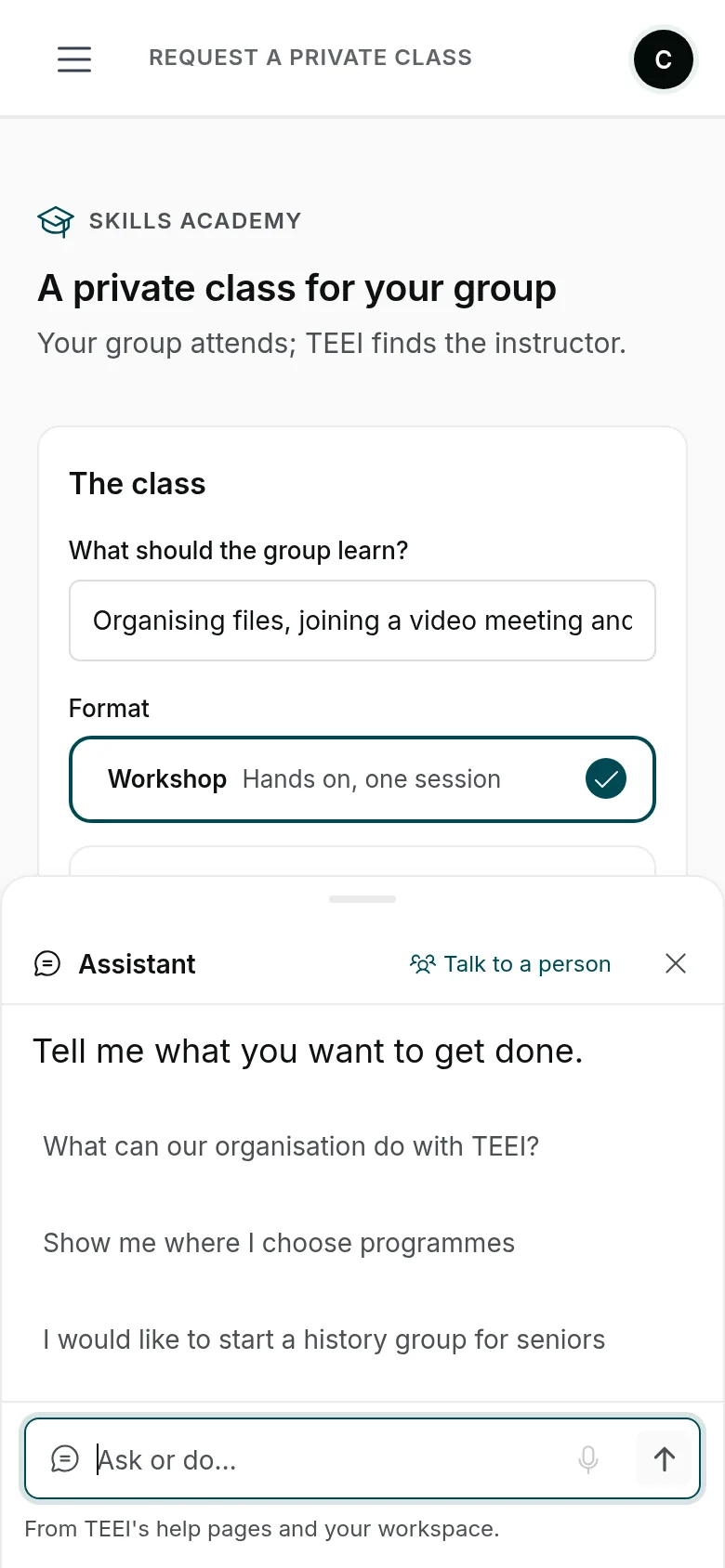
The assistant brings the relevant part of the product into view. Important work stays visible in normal pages, forms and records, alongside the chat.
This is especially valuable when the user knows the desired outcome and the platform’s vocabulary is new to them. I want to arrange something for our members may correspond to several different routes. The assistant explains the differences in terms of the person’s goal, then helps with the chosen route.
Information and action stay distinct. Explaining a class, creating a class, preparing a request, securing a teacher, saving a draft and publishing an invitation are separate steps. The assistant’s language follows what the application has actually done.
Small steps flow naturally. Reading information, showing a page and preparing a draft happen as part of the requested task. Actions follow the user’s instructions and the application’s established permissions. The assistance reduces work.
A strong assistant makes the existing product more usable, and the user leaves with the work done.
A history group, from one sentence to a usable activity
Consider an illustrative request from a senior community:
“One of our members would like to host a history discussion. Can you help us set it up?”
There is enough information here to start, and the rest comes in the conversation. The assistant recognises that the user is describing a group contribution.
It first helps establish the purpose. Is the group mainly about discussing history in a shared language? Is it an opportunity for language practice built around historical topics? The answer shapes how to describe the activity and which participants are likely to find it relevant.
The assistant explains the choice in ordinary language and shows the relevant contribution route. The host sees the options in plain terms.
The coordinator supplies the language, the intended date and the practical details. The assistant uses what has already been said. A proposed title and description appear in the real fields, where the coordinator can inspect and edit them. A suggestion about format is presented as a suggestion, and the organisation makes the decision.
The description becomes more useful as the conversation develops. “History group” might become a description saying that participants will discuss how everyday life changed across generations, that no specialist preparation is expected and that the host will bring a small number of questions to start the conversation. Those are illustrative editorial choices for this group.
The coordinator can change direction. Perhaps the member prefers an informal discussion to a teaching role. Perhaps the topic should be local history. Perhaps the first session should be shorter. The assistant updates the current draft with each change.
When the draft is saved, the workspace records it. The assistant reports that saved state and links back to the item. The host and coordinator see the latest title and every retained change in the record itself.
The next stages follow the programme’s normal lifecycle. The contribution is handled through the appropriate route; the activity is scheduled and made available when its real conditions are satisfied; participants join through the programme; attendance and completion are recorded using the relevant definitions.
Afterwards, the organisation sees the contribution in context. It can distinguish the activity it offered from the people it introduced to other programmes. It decides whether another session would be useful based on what happened.
The impressive part of this journey is the continuity between an ordinary sentence, a workable activity and a record of the result.
The assistant knows what is on the page
An assistant operating inside an application needs page context as well as product knowledge.
Two people can ask the same question while looking at different things. “Can you change the date?” means one thing in a saved class request, another in an unsaved contribution form and something else in a report filter. Page context lets the assistant act on the right object and describe the controls that are actually there.
The Network Assistant therefore works with structured page context.
That context identifies the relevant page, the current organisational role, the selected item and the actions available in that state. It also distinguishes saved values from edits the user has made in the browser and not yet saved. These are facts supplied by the application.
This creates a useful division of responsibility. The application supplies the operational facts. The model interprets the user’s intention and chooses an appropriate response or tool. The application owns the meaning and validity of every action.
For the user, the effect is simple: the assistant talks about the thing they are actually working on.
It points to the relevant field. It explains why the current report differs from another view by referring to the selected period or programme. It recognises exactly which information a draft is still missing.
Page awareness also makes the assistant easy to correct. A coordinator changes a field directly and keeps talking. The next assistant step incorporates that change. The page and the chat are both valid sources of input.
This interaction model goes well beyond a prompt box on an existing interface. The conversation and the interface work on the same task, and the conversation and page state stay connected as the task develops.
From a language model’s suggestion to an application action
An AI model proposes an action. The application decides whether that action is valid and performs it through the correct mechanism.
Amazon Bedrock’s client-side tool-use model illustrates this separation: the model requests a tool, application code executes it and the result is returned to the model for the response.[4] That is a strong foundation for the Network Assistant because the product already has meaningful operations: read information, navigate, prepare a form, save a draft or submit a supported request.
The Network Assistant treats those operations as explicit tools.
A tool has a defined purpose and structured inputs. The application checks the relevant identity, organisation, permissions and state. The tool returns a result that describes what happened. The assistant then explains that result to the user.

This is where the important distinctions become enforceable. The application enforces every boundary, whatever the model says: each organisation reaches only its own records, a read-only role stays read-only, and a form becomes a stored object only when the application stores it.
The same application rules apply whether a person uses a button or asks the assistant. Both run on one implementation.
That architecture also makes the experience maintainable. When a programme changes how a class request works, the authoritative operation changes in one place, and the assistant uses the updated operation straight away.
Anthropic’s discussion of agent design makes a related distinction between predefined workflows and model-directed use of tools, and emphasises clear tool interfaces.[5] Network Partners combines those ideas: flexible language at the point of intention, with explicit application behaviour where the user’s data and actions are concerned.
The model contributes interpretation. The software contributes operational authority. Keeping those responsibilities separate makes the assistant useful and keeps the application records as the source of truth.
A saved task is more valuable than a long conversation
A coordinator may begin a class contribution, answer a phone call, switch to another task and return the next day. The workspace keeps the useful work in a recoverable task.
Network Workspace distinguishes conversation from task state.
The conversation contains how the user described the goal, questions they asked and suggestions they considered. The task state contains the current object: the selected programme, saved fields, remaining information and the relevant record or draft.

That separation keeps the work accurate. A rejected suggestion stays rejected. The date entered in the form is the date that counts. An abandoned idea stays in the history and out of the commitments.
When the user returns, the assistant summarises the actual state: what is saved, what still needs a decision and where to continue.
This is particularly valuable for small organisations where coordination happens in short periods between other responsibilities. The person organising a group may also be answering member enquiries, arranging local activities or doing their normal job. The workspace fits that pattern and works in short sessions.
The same principle supports collaboration. A colleague understands the saved contribution from the record itself. The organisational object belongs in the workspace, with the relevant access controls.
A short interaction that produces a clear, recoverable task is often the most valuable kind.
The assistant’s memory is judged by whether it helps work continue accurately.
Recovery is part of the experience
A real organisation operates in the real world. A connection drops. A person presses a button twice. A colleague changes a record. A session fills up while someone is deciding whether to join.
Network Workspace handles those situations as part of normal use.
Suppose a save request reaches the server and the browser misses the response. The coordinator needs to know what happened. The application determines whether the operation succeeded and returns the user to the actual record, so the work is neither duplicated nor lost.
The same applies to a repeated submission. Duplicate protection turns two clicks on a slow connection into one class request. Every action that must happen once has a stable identity.
A changed record is handled too. The assistant may have prepared an action using information that was correct a moment earlier. Before changing something consequential, the application checks the current state. If the relevant conditions have changed, the user sees the specific difference.
Recovery also means keeping legitimate work. A missing field leaves the rest of a contribution intact. A saved draft survives a failed response from the AI service. A person who prefers to continue on their own uses the normal page.
The interface stays plain. The user sees clear states: saved or not saved, submitted or still a draft, available or no longer available, completed or requiring another step.
Reliability is part of the product story. It decides whether a coordinator trusts the product enough to use it with real people.
An assistant that helps the user recover is useful infrastructure.
Reporting begins with definitions
The most valuable report explains what happened and what the records actually support.
Network Workspace starts from programme activity. Registrations, bookings, attendance, completed activities and recorded hours stay distinct. Skills Academy keeps the differences between reserving a place, attending a meeting and completing a class. A language conversation and a mentoring conversation are identified as different programme activities.[1][2]

Those distinctions matter because each answers a different operational question.
Registration shows that someone took an initial step. Booking shows an intention to attend something specific. Attendance shows presence under the programme’s measurement rules. Completion shows that the relevant completion conditions were met. Each keeps its own meaning throughout the report.
The report also keeps people and activities separate. Ten completed sessions may involve ten people or fewer. A recurring participant may attend several times. Depending on the question, that continuity may be exactly what the organisation wants to understand.
The assistant makes a report easier to interpret. It explains a selected period, identifies which programme a figure belongs to and helps the coordinator describe the activity in ordinary language, using what the records show.
A useful sentence might say that members took part in recurring language conversations and that an instructor delivered a particular class. Claims about employment, loneliness or health rest on evidence for those outcomes, collected beyond the activity records.
Precision is how the report shows the value of the work.
An organisation that explains its contribution clearly is in a strong position. Its figures mean the same thing on the dashboard, in the export and in the board presentation.
In Network Workspace, the definition travels with the figure. The screen, the export and the assistant’s explanation describe the same underlying activity.
A person’s journey can cross programmes in any order
Imagine someone who first meets TEEI through a local organisation’s language invitation. She wants to become more comfortable speaking in professional situations. She joins a conversation, returns for another and begins to identify the situations she finds difficult.
Later, she wants advice on explaining her previous experience to an employer. Mentorship becomes relevant. A mentor helps her identify a concrete skill she would like to develop, and she finds a suitable Skills Academy opportunity.
The connection between those activities is valuable, and every person sets their own sequence.
Another participant may begin with a professional workshop and stay with skills. A retired specialist may enter as a mentor, then join a discussion group for the pleasure of meeting people with different experiences. Someone may attend a language group for months because the activity itself is worthwhile.
TEEI’s wider direction expresses this through four values: connection, language, skills and work. They reinforce one another, and a person can enter at any of them.[6]
Network Partners makes that flexibility useful to organisations. A coordinator introduces several relevant possibilities. The assistant explains how an opportunity relates to a goal and shows the route into it. The participant decides whether it is useful.
That also makes follow-up more humane. A person who skips a suggested step may have new circumstances, may have found what they wanted or may prefer a different format or pace. Each of those is a good outcome to understand.
The organisation still uses its knowledge of the community. It might offer help understanding an invitation or preparing for a first session. It might ask participants which topics would make a class useful. Each relationship keeps its own shape.
The practical advantage is adaptability. The same infrastructure supports someone rebuilding a career, someone learning for interest and someone contributing a lifetime of professional knowledge. What connects them is access to useful people and activities.
What this looks like for a university
A university is a collection of communities with different forms of knowledge, time and motivation.
Students may want practical experience. Educators may want to teach beyond their usual setting. Alumni may want an accessible way to contribute. Retired staff may want continued intellectual and social engagement. Researchers may see questions worth studying. Some members may also be eligible to use TEEI’s programmes themselves.
Network Partners gives those possibilities a common organisational home, and each keeps its own purpose.

Consider an illustrative language department. Its coordinator introduces conversation volunteering to students and shares a focused teaching opportunity with staff. Students who apply enter the appropriate programme process. A lecturer prepares a workshop. A retired educator offers to host a recurring discussion. The organisation sees those contributions in the relevant programme categories.
Programme records document the activity. Where students seek academic recognition, the university decides how that evidence relates to its own course, placement or service-learning requirements.[1]
That division works well for both sides. TEEI documents what happened, and the institution keeps authority over what it recognises academically. A record of contributed time has value of its own, and each institution decides the credit.
A different faculty might contribute specialist teaching. A data lecturer could lead a practical session that complements independent learning. A business professional among the alumni could provide mentoring. Each contribution can be focused and start right away.
Research forms another possible relationship. The programme environment raises questions about learning, participation, human support and AI-assisted coordination. Those questions can lead to specific collaborations. Research access to participant data follows its own research arrangements, separate from ordinary Network Partner participation.
The product’s value is the ability to connect these roles while keeping their meaning. Teaching, volunteering, learning, research and institutional reporting relate to one another, and each keeps its own label.
For the university, community engagement becomes something people can actually enter and sustain. For the wider network, academic expertise becomes available in forms that fit real participant needs.
What this looks like for a senior community
A senior association may have members who want more people to talk to, members interested in learning and members with expertise they would enjoy sharing. Often, those are the same people.
The coordinator’s challenge is to turn a broad conversation about possibilities into manageable choices.
One member might prefer a regular language conversation. Another might want a discussion group on history. A retired manager could help someone prepare for an interview. An experienced teacher might enjoy a focused class with a light schedule. Someone who has never volunteered formally might be comfortable welcoming people into a conversation group.
The assistant helps the organisation make those roles understandable and prepare the relevant activities. A coordinator can begin with a statement such as, Our members want to meet people, and some would like to share their experience. The system distinguishes joining existing opportunities, contributing to programmes and proposing a group activity.

The organisation starts with the people who are ready. It shares a relevant invitation, supports a first activity and learns which formats people actually want to repeat.
Members keep room to change their involvement. Someone can start by attending, become a host later and return to attending during a busy period. Every member can be a participant and a resource.
This creates a practical basis for intergenerational participation. A retired specialist and a younger learner meet around something concrete: a language task, a professional question or a shared interest. Their ages add to the richness of the exchange, and the activity gives it purpose.
TEEI Pathways develops this same idea from the person’s point of view. Network Workspace supports the organisation arranging access and contributions. TEEI Pathways helps the individual find and use those opportunities. The two connect through shared programmes as one service.
The association brings its relationships. The platform supplies more ways for those relationships to lead somewhere.
What this looks like for a local service or community organisation
A library, municipality, refugee-support organisation or local community group may already provide substantial support. Network Partners adds relevant opportunities around that work, and the local organisation keeps its identity and everything it does well.

Consider a local employment-support team. It may help someone understand the labour market, prepare documents and navigate local services. That person may also need regular opportunities to practise speaking or discuss a professional question with someone in their field.
The local team introduces those opportunities through TEEI. Its own service stays its own. Language practice and mentoring complement local expertise.
A library presents a different setting. A visitor may discover a printed invitation, ask a staff member what the activity involves and use a library computer to take a first step. The organisation’s contribution is partly the invitation and partly the familiar environment in which the invitation becomes understandable.
For a community group, the route may be a message in an existing chat. A short explanation in the right language, with a clear destination, often works better than an elaborate institutional announcement. Members care about the useful class, and the invitation leads with it.
The workspace keeps continuity behind these different entry points. The organisation keeps its materials together, understands its participation and coordinates contributions from its own members. The relationship stays intact through staff changes.
It also makes needs easier to articulate. A coordinator who hears the same question repeatedly prepares a class request around it. A local organisation with a useful teaching approach can discuss contributing it to a wider audience. The relationship can grow from sharing an opportunity into delivering something together, and the first step is open from day one.
The network becomes valuable because local knowledge stays local while connecting with broader programme capacity.
When several organisations contribute to one useful activity
Some of the most useful opportunities draw on several institutions.
A community organisation may know an audience that would benefit from a class. A university may know an educator who could teach it. A company may have a practitioner who can demonstrate how the topic is used at work. A senior association may have members who could support discussion afterwards.
Each connection brings coordination work: explaining the audience, agreeing the format, sharing the invitation, arranging the session and recording what happened. Network Partners gives the activity a shared operational home, so that work happens once, in one place.
The teaching stays specific. An educator leads a class. A practitioner contributes an example. A community organisation helps participants understand and access it. The platform supplies the programme route, booking and delivery context, while records keep the relevant activities and contributions.
A useful collaboration can be small. A workshop on presenting professional experience could be followed by optional mentoring. A practical data class could connect with a study group. A language discussion could help participants prepare for a subject-specific session. The combination matters because the pieces address different parts of the same need.
Shared infrastructure keeps a simple contribution simple, even when more than one organisation is involved.
The same principle applies to recognition. The organisation that introduced participants and the organisation that contributed teaching are both acknowledged for their actual roles. Network-wide totals count each activity once. Organisational perspectives and network-wide totals answer different questions.
The larger opportunity is a distributed teaching and support capacity. Expertise can sit with one organisation and audience access with another, and Network Partners brings them together.
Network Partners connects those resources around a real activity.
Shared infrastructure is what makes the breadth practical
A wide range of programmes works best on one shared operational foundation.
TEEI’s platform direction builds exactly that. Identity, programme access, booking, calendar handling, groups, sessions, activity records and reporting provide shared building blocks. Network Workspace is an organisational interface to those capabilities, while the programmes keep their own purposes and rules.[3][6]
The distinction matters for both engineering and user experience. A group runs on the same platform whether its members discovered it through a senior association or elsewhere. An instructor who arrives through a university uses the same attendance mechanism as everyone else. The definition of a completed session stays the same when the organisation views it in a report.
The documented technical foundation combines Cloudflare-hosted application infrastructure with AWS services, including model access through Amazon Bedrock. The Network Assistant uses that foundation to connect a conversational interaction with structured information and application actions.[3]
The useful architectural idea is the separation between presentation, programme operations, evidence and model interpretation.
The user-facing application presents the task and maintains the session. Programme services own the activities and their lifecycle. Reporting reads the relevant records. AI helps interpret requests, prepare work and explain results. The database stays the database, and the attendance system stays the single attendance system.
This also supports reuse across audiences. A senior-facing interaction may use larger controls, clearer guidance or voice. A university coordinator may work quickly through a desktop interface. The underlying booking or class operation stays the same.
Technical reuse is valuable when it keeps meaning. TEEI reuses components that understand a class request, and each audience gets the workflow it needs on top.
The result is a coherent operational foundation that supports different people with different interfaces, and does the work that makes their participation real once.
Accessibility belongs in the ordinary workflow
Accessibility lives inside the task itself.
The practical questions occur inside the journey. Can someone understand the programme explanation? Can they move through the page with a keyboard? Can they read the form comfortably at a larger text size? Can they recover from a mistake and keep what they entered? Can they tell whether an action has completed?
W3C’s accessibility guidance and WCAG 2.2 provide relevant design references, including consistent help, avoiding unnecessary repeated entry and more accessible authentication.[7] These standards guide the design work.
For Network Partners, accessibility also has an organisational dimension. Some coordinators use the workspace daily. Others return occasionally. Some prefer a detailed overview. Others arrive with a single task and little time. The assistant spares people from remembering where a function lives, and the normal interface gives a stable route to people who prefer to click.
Useful guidance appears at the point of action. A class form explains what a field is for. A report explains what a figure measures. A sharing tool shows what the recipient will see. Help sits exactly where the person needs it.
Accessibility also includes linguistic clarity. The interface explains product names in terms of the activity. A person understands “a conversation with a volunteer” and acts on it straight away.
The result is an interface that lowers the cost of participating for more people. It also lowers the cost of supporting those people for the organisations that introduce them.
Growing capacity means connecting demand with something deliverable
A larger audience is valuable when there are activities for people to join and contributors able to sustain them.
Network Partners gives TEEI a clear view of both sides. Organisations bring signals about what their communities want. Contributors bring time, knowledge and teaching offers. Programme activity shows which opportunities people actually use and return to.
These signals inform practical decisions. An organisation may discover that its members prefer small discussion groups to broad webinars. TEEI may see demand for a particular language at times when few volunteers are available. An instructor may find that a focused clinic is more useful than repeating an introductory presentation.
The assistant helps people express those needs and offers in a form the programme can use. It also helps a coordinator read their own activity with no specialist analytical skills required. The judgement about what to organise stays connected with real capacity and context.
This growth model matches people with activities. A well-matched invitation creates a strong starting point and useful participation, and keeps coordination work in proportion.
It is a way of reading the work: who wanted something, what was available, what they chose and what happened afterwards.
As those relationships accumulate, the network becomes better informed. It develops offers around repeated needs, helps contributors find appropriate formats and gives organisations clearer ways to take part.
The aim is growth in usable opportunity. Reach matters because it brings people to that opportunity.
The economics of coordination
There are several kinds of cost in delivering a programme. Technology has a cost. Teaching and support have a cost, even when people contribute their time voluntarily. Coordination has a cost: understanding requests, arranging activities, correcting misunderstandings and reconstructing records.
The Network Partners model addresses each of these costs.
Shared infrastructure spares every organisation from building a complete technical stack. Shared programmes let organisations introduce opportunities straight away. The assistant reduces the repetitive work involved in navigating the system, preparing information and continuing tasks.
These mechanisms improve capacity where it counts.
A well-prepared class request is matched with teaching capacity. A mentoring programme grows with suitable mentors. A group thrives when people choose to attend. AI makes the surrounding work easier, and people supply the human time that gives the programme its value.
This distinction helps direct investment. Improving a sharing flow helps when people are struggling to understand an offer. Recruiting contributors helps when suitable activities are scarce. Improving booking helps when interested people struggle to turn intention into attendance. Better reporting identifies which of those problems is actually occurring.
Free access is described precisely. TEEI’s existing programme model provides free participation, including access through Network Partners. A new, specially commissioned programme comes with its own delivery requirements, and extensions are agreed against the resources available.[1]
The proposition is practical: organisations connect their communities with existing programmes and shared capabilities, with no separate platform to purchase or assemble.
For supporters, the value of funding technology, coordination or teaching capacity is easy to explain. Those contributions turn existing willingness into more completed activity. The evidence then shows what that capacity made possible.
A foundation for organisations to do more together
The model develops in three related and distinct ways.
The first is wider access to TEEI’s programmes. More organisations introduce relevant opportunities, more contributors find usable roles and more people take part.
The second is delivery arranged together. Organisations contribute expertise, teaching materials, local support or an existing programme component around a defined audience and purpose. A collaboration combines those contributions, and TEEI operates the software.
The third is the broader platform: other organisations operating their own programmes on shared infrastructure, keeping responsibility for what they deliver while using common booking, rooms and records.[1]
These possibilities reinforce one another as distinct services. Introducing members to a TEEI programme and running an independent programme are different relationships. A shared teaching resource stays with its owner. A workshop contributor takes responsibility for the workshop.
The value of the architecture is that the common operational work supports these different relationships. The value of the organisational model is that the responsibilities stay understandable.
That combination creates room for substantial ambition. A small organisation reaches useful programmes and stays focused on its community. A university makes expertise available beyond its own classrooms. A senior community helps its members participate and contribute. A specialist organisation brings a strong teaching approach to people it could not easily reach alone.
The network becomes more capable as those contributions connect. Its strength is that different organisations work together on shared machinery, each one doing what it does best.
The real unit of progress
Return to the coordinator at the beginning.
She still knows her community better than a platform does. The retired teacher still chooses whether to host. The learner still chooses whether to join. A mentor still brings judgement that lives in people. A good group still depends on the people who turn up.
What changes is the distance between their intentions and a usable opportunity.
The coordinator explains the programmes, prepares appropriate invitations, connects contributors with relevant roles and follows the activity through one workspace. The assistant helps with the practical work while the programme systems keep the records. The organisation understands its contribution with exact definitions: a registration is a registration, a completed result is a completed result, and each person remains their own.
That is TEEI Network Partners: local relationships connected with shared delivery, supported by software that understands a task and helps carry it through.
A link shared is a beginning. A conversation held, a class attended, a mentor who helped or a group that people choose to return to is the reason for building the system around it.
Sources and editorial basis
[1] TEEI, Network Partners: participation, contribution and reporting, product and editorial documentation, 28 October 2026. Covers the organisational model, programme roles, senior and university participation, free access and the broader infrastructure vision.
[2] TEEI, Network Partners: integrated workspace requirements, 23 October 2026. Internal requirements source for organisation identity, participation and contribution, workspace modules and separate programme-reporting stages.
[3] TEEI, Technical platform and Network Assistant overview, 26 October 2026, especially the Network Assistant and shared infrastructure sections.
[4] Amazon Web Services, Client-side tool use, Amazon Bedrock documentation. https://docs.aws.amazon.com/bedrock/latest/userguide/tool-use-client-side.html
[5] Anthropic, Building effective agents, 19 December 2024. Used for the architectural distinction between workflows and agents and for tool-interface design. https://www.anthropic.com/research/building-effective-agents
[6] TEEI, TEEI AI First Strategy: Direction and priorities for 2026 and 2027, 20 October 2026. Internal strategic source for connected programmes, human contact as an outcome in its own right and shared operational infrastructure.
[7] W3C, Web Content Accessibility Guidelines (WCAG) 2.2. https://www.w3.org/TR/WCAG22/
Frequently asked questions
What is TEEI Network Partners?
The way organisations work with TEEI's programmes. A community organisation, university, senior community or local service can share TEEI Language, TEEI Mentorship and TEEI Skills Academy with the people it reaches, contribute conversation partners, mentors, instructors and group hosts, or do both, and move between them.
Can an organisation share TEEI's programmes without providing volunteers?
Yes. Free opportunities are open to every organisation's community, whether or not it provides volunteers. Reciprocity is an opportunity that people take up when they want to.
What does the organisation see about the people it introduces?
That its introduction led to participation, and in which programme. An organisation code in a link records the introduction; names appear only under each participant's own sharing choices. Attribution and visibility are separate.
What does the Network Assistant do?
It works inside Network Workspace. It opens programmes, prepares class contributions, fills forms, saves drafts and helps coordinators complete tasks across TEEI Language, TEEI Mentorship and Skills Academy. The application checks identity, organisation, permissions and state before every action, the same way it does for a button.
How is participation reported?
Registrations, bookings, attendance, completed activities and recorded hours stay distinct, and people and activities are counted separately. The definition travels with the figure: the screen, the export and the assistant's explanation describe the same activity.