
TEEI Pathways: A Better Way to Meet People, Learn and Contribute
An AI-assisted experience from TEEI for anyone with a goal: real conversations, useful learning and ways to share what you know, first for older adults.
The programme
On this page
- The person already has a life
- Every older adult arrives with their own purpose
- What TEEI Pathways makes possible
- A person can receive, contribute and change their mind
- The first conversation starts with a purpose
- The organisation introduces the opportunity; the person keeps the choice
- The first visit ends with a clear next step
- Meeting people through something worth talking about
- The second meeting matters as much as the first
- Language practice can be useful at any stage of life
- Mentoring makes experience usable
- A lifetime of knowledge fits into one focused session
- Learning continues after employment
- Learning about AI through using it
- Intergenerational participation needs a shared purpose
- An illustrative month: from attending to contributing
- Speak, type or click, and switch at any time
- Assistance that strengthens choice
- Human help remains part of the service
- A group is more than a video link
- The technology connects intention, context and action
- A clear result after every action
- Remember what helps, and keep it understandable
- The service can be quiet between activities
- What success looks like beyond the chat window
- What organisations gain from this model
- A larger ambition than making an interface easier
- The technology leads somewhere
- Sources and editorial basis
- Frequently asked questions
The platforms TEEI Pathways runs on are live today; the full assistant journey is what we are building next.
Live today. TEEI Language, TEEI Mentorship and TEEI Skills Academy are in use now. By TEEI’s sealed impact publication of 18 September 2026, learners and volunteers on TEEI Language and TEEI Mentorship had completed 11,984 one-to-one sessions and 9,070 conversation hours, and TEEI’s members lived in 148 countries.
The person already has a life
A retired engineer opens TEEI Pathways. He wants to use a few hours a week on something useful, starting today. He has experience that could help someone, enjoys talking to people and is curious about a subject he never had time to study.
A few streets away, a retired teacher wants a different kind of opportunity. She has taught for decades and would now enjoy being a beginner. A language conversation interests her. So does a group about history. She might host something later. For now, she wants to join, listen and learn.
Both want something worth doing and a straightforward way to take part.
That is where TEEI Pathways starts.
Older adults are the first people TEEI Pathways serves, and the examples in this article follow them. The service is for anyone with a goal: a newcomer who wants conversation practice, a professional with knowledge to pass on, a student looking for a mentor. The assistant starts from the goal, at any age.
The assistant helps people find relevant opportunities, understand what they involve and take the practical steps needed to join or contribute. It connects with TEEI’s language, mentoring, skills and group experiences. Organisations such as senior associations, universities, libraries and community services introduce the opportunities through Network Partners.
The AI understands intentions in the words people actually use: I would like to meet people, I used to teach, Could I help someone with an interview? or I want to learn something. Where do I start?
It turns that intention into an actual next step. A suitable activity. An understandable choice. A prepared contribution. A booking the person can find again. A group they can return to.
TEEI Pathways opens more of the world: more people to meet, more to learn and more ways to take part.
Every older adult arrives with their own purpose
Age tells a product very little about what a person wants to do next.
One person manages complex software comfortably and wants to move quickly. Another is capable with familiar tools and wants a new registration process to be short. Some people prefer to speak. Others prefer text because they are in a shared room, have difficulty hearing or simply want to read at their own pace.
Interests are just as varied: professional contribution, language practice, intellectual challenge, regular conversation, new friends or a practical class. A person can want several of these at once and pursue each in their own way.
The product therefore begins with the individual’s purpose.
This matters particularly for social connection. The World Health Organization’s 2025 account describes loneliness as a subjective gap between the connections a person has and those they want. Loneliness differs from living alone, and it occurs at every age.[1]
TEEI Pathways offers the group straight away. It treats retirement as time with its own purposes. An invitation to discuss a subject, practise a language or teach a useful skill stands on its own merits.
Digital confidence gets the same respect. The design is clear and the tone is direct. Assistance is there when the person asks for it. An experienced user moves straight to the task; explanations are one step away.
The result is a broad, adaptable experience. It supports different preferences and abilities and treats the person as the authority on their own intentions.
A senior-facing product earns respect by listening to what the person says. TEEI Pathways builds every suggestion on it.
What TEEI Pathways makes possible
“AI for seniors” can describe very different products. Some answer questions. Some offer conversation. Others help with one practical task.
TEEI Pathways is organised around participation.
The assistant helps someone discover an opportunity and follow it through. It is connected to programmes, activities, people and application actions, so a conversation leads straight into the service.
A person interested in language practice sees the available formats and the right route. Someone with professional experience explores mentoring or teaching. A member of a senior community joins an existing group or works with an organiser to prepare a new one. The assistant navigates, explains, prepares and continues the task.
Conversation with the AI has its own uses. A person can think through what they could teach, practise introducing themselves or ask a question privately before joining a group. Each of those conversations serves the wider experience.
The central achievement happens outside the chat: a real conversation takes place, a person learns something, a contribution becomes useful to someone else or a group becomes part of the person’s week.
That shapes how the assistant behaves. Once the user has enough information to act, it shows the relevant activity and lets the person continue. A short, successful interaction counts as a good result.
It also shapes what the surrounding organisation provides. The product connects people with real opportunities. TEEI’s programmes bring them into conversations, mentoring sessions, classes and groups with other people, and a delivery system makes each arrangement work.
TEEI Pathways combines those responsibilities. The assistant makes the route understandable. TEEI’s programmes provide the activities. Network Partners brings organisations that know the communities. The person decides what is worth their time.
A person can receive, contribute and change their mind
TEEI Pathways lets one person hold several roles and move between them.
The retired engineer may mentor someone in his field and join a language conversation himself. The teacher may take a class before offering to host a group. A person who first wants social contact may later realise that their experience could help someone else. Another may step back from contributing and keep attending activities they enjoy.
The TEEI organisational model already places older adults on both sides of participation: as people who learn and connect, and as conversation partners, mentors, instructors and group hosts.[2] TEEI Pathways makes that flexibility visible to the individual.
Every role has equal standing. Joining a group counts as fully as hosting one. Learning stands on its own, with nothing owed in return. People who offer expertise keep their own learning goals.
That guides how the assistant makes suggestions. It can point out that an interest fits a conversation group, or that a person’s experience would be valuable in mentoring. The person decides which to pursue.
People also choose what fits them. A group may be too large. Teaching may feel too close to work when the person wanted something lighter. A one-to-one conversation may be more enjoyable than a formal class.
TEEI Pathways helps the person find a better fit and treats every change as useful information.
This flexibility creates a richer community. People meet one another in different roles, each with something to offer and something still to discover. Helpers and the people they help are the same people at different moments.
The first conversation starts with a purpose
A person can arrive with a clear request: I want to practise Spanish. They can also arrive with something open: I would like to do something with other people during the week.
Both are good starting points.
For the second, the assistant helps the person explore just enough to make a useful choice. One question, whether they would prefer a conversation, a shared interest or something practical, does more than a long intake form.
The interaction stays concrete. Someone who likes discussing books finds a relevant group. Someone who wants to use professional experience looks at mentoring or a focused teaching contribution. Someone who prefers to begin quietly reads what an activity involves and then decides.
Uncertainty is welcome. “I am not sure yet” leads to a short selection of relevant possibilities, each with a clear explanation of how it differs from the others.
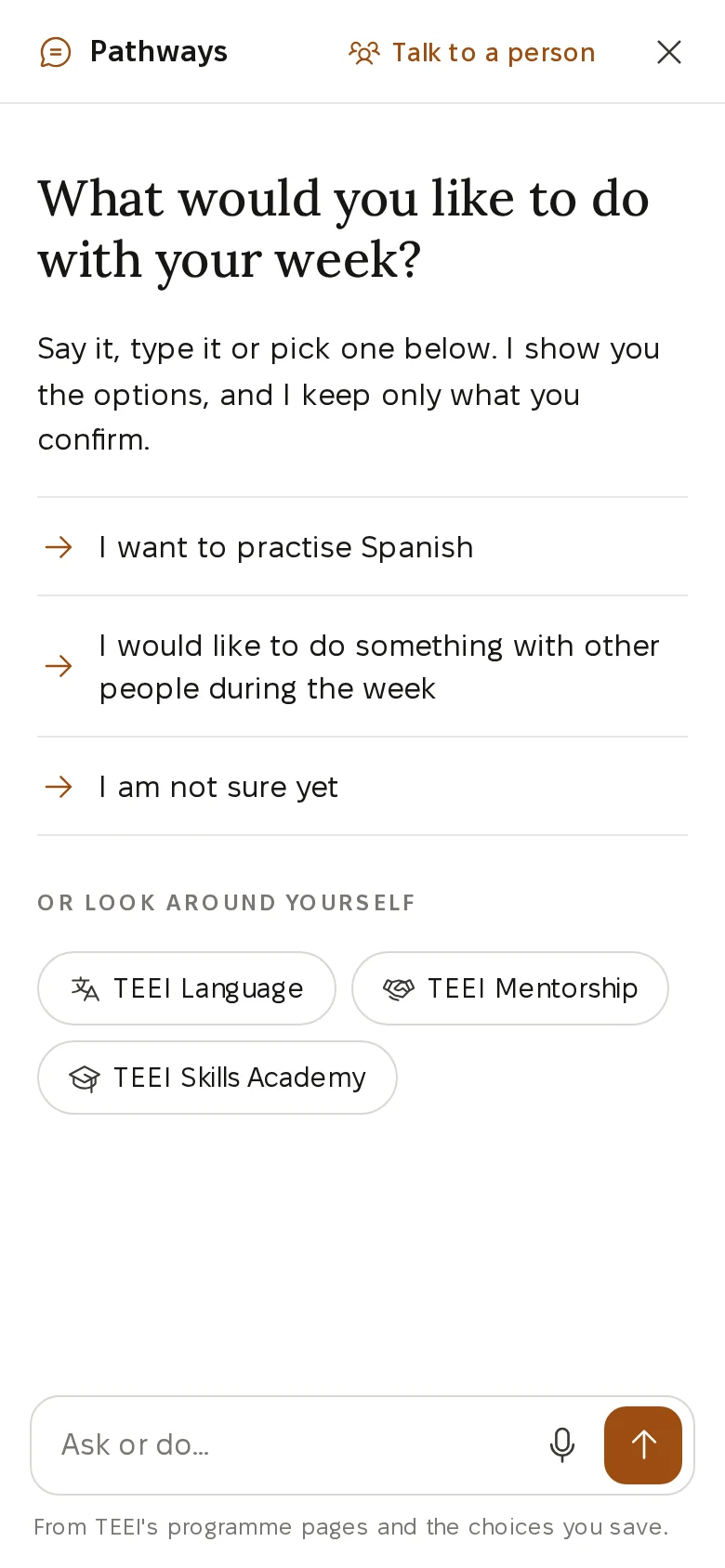
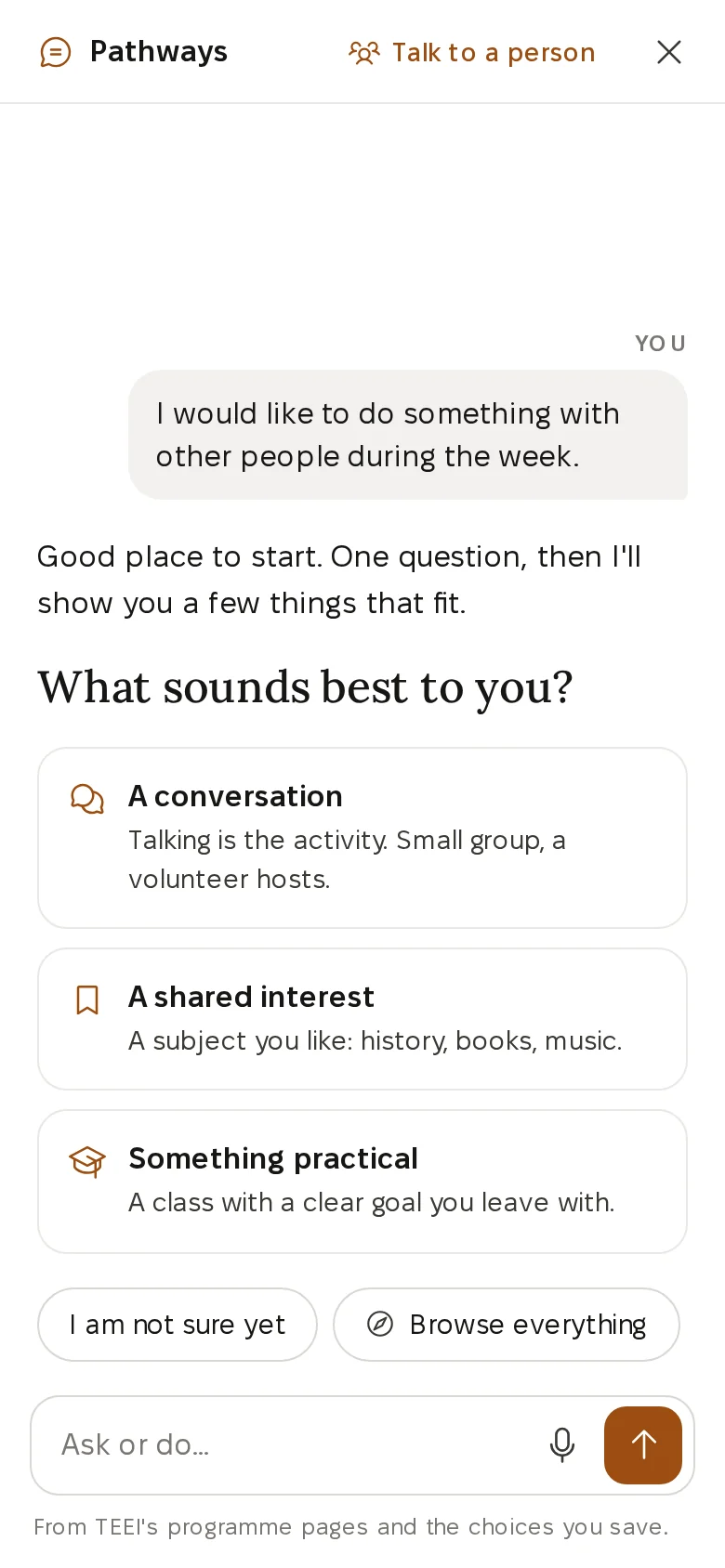
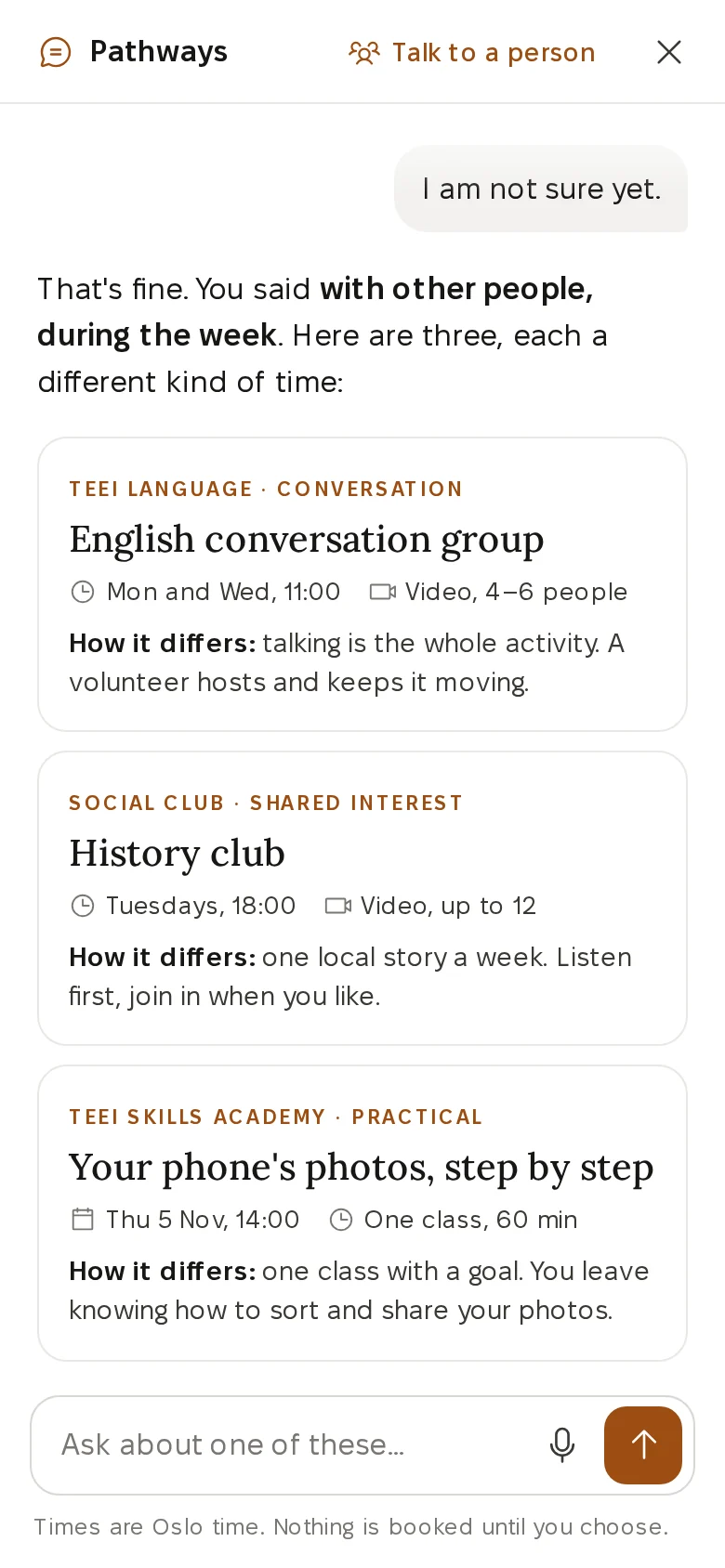
Discovery uses what the opportunity needs. The platform asks for the information relevant to the opportunity and its existing programme processes. The person adds more context where it helps and keeps control of what becomes part of their profile.
Browsing is always available. A person often knows what they want as soon as they see it. The interface offers ordinary ways to explore programmes and sessions, with the assistant ready when explanation or practical help would be useful.
The product’s job is to translate between human intentions and platform categories. People describe the life they want to lead. Software tends to offer menus that make most sense to the people who built them.
TEEI Pathways works between those two languages. It brings the person to an understandable option in their own words, from the first visit.
The organisation introduces the opportunity; the person keeps the choice
Imagine a senior association with eighty members. Some want more conversation. Some want to learn. Some have expertise to contribute. The coordinator knows those members and wants one simple way to reach all of them.
Network Workspace gives the coordinator a way to prepare relevant invitations, introduce the programmes and support contributions. The assistant helps translate the association’s broad interests into usable programme routes and group ideas.
Members of one association still choose one by one.
The coordinator might share a language invitation with people who have expressed interest, introduce mentoring to members with relevant professional experience and help a willing host prepare a discussion group. These are different opportunities, and each person picks the ones that appeal to them.
An invitation from a familiar organisation carries useful context. A member understands why the opportunity is being shared, knows whom to ask locally and feels more comfortable taking a first step. The organisation’s relationship stays part of the experience after the person follows the link.
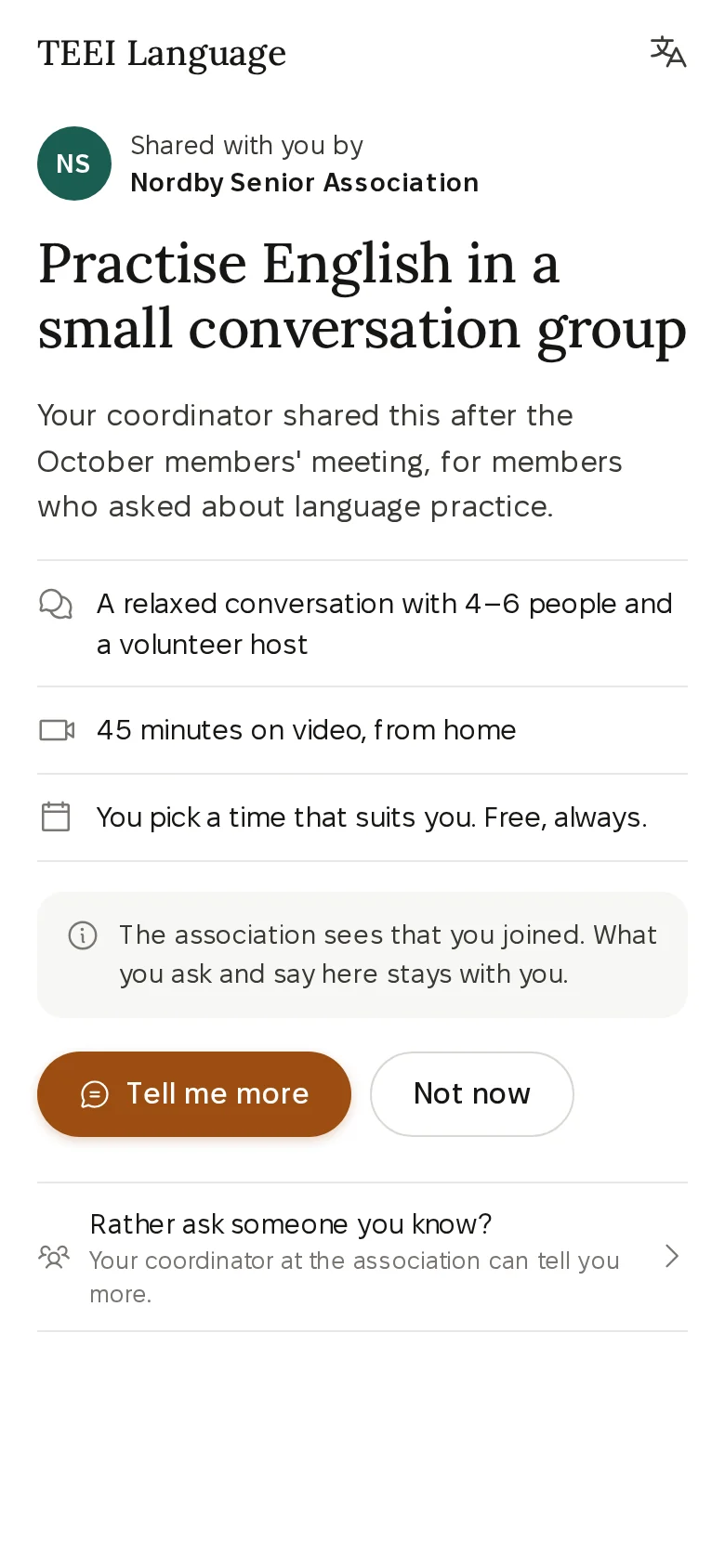
Each member keeps an individual account and their own decisions. The coordinator sees what the access and sharing choices allow, and those choices are visible to the member.[2]
This separation lets the organisation help while the person owns their participation.
It also makes the model practical for libraries, universities, local services and other community organisations. Each introduces opportunities in a way that fits its setting. A university’s retired-staff network may emphasise contribution and intellectual exchange. A local library may help someone take a first digital step. A senior association may organise an introductory session for interested members.
TEEI Pathways connects each organisation’s own relationships with the same underlying opportunities.
The first visit ends with a clear next step
The first screen has a demanding job. It tells the person where they are, what they can do and why the next step is worth taking.
A person arriving from a language invitation lands in the relevant programme. Someone exploring a group sees its subject, format and practical arrangements. A prospective mentor gets a clear account of the role: what the conversations cover and what they involve.

TEEI Pathways makes the activity concrete before asking the person to invest real effort.
What happens in the session? Who is it for? Is it a conversation, a class or a group discussion? How does the person join? What happens after they choose it? Those questions shape the explanation.
The assistant is available at the moment a question comes up. A person can ask whether a session suits a beginner, what preparation is involved or how the video meeting works. The answer comes from the actual programme and activity information.
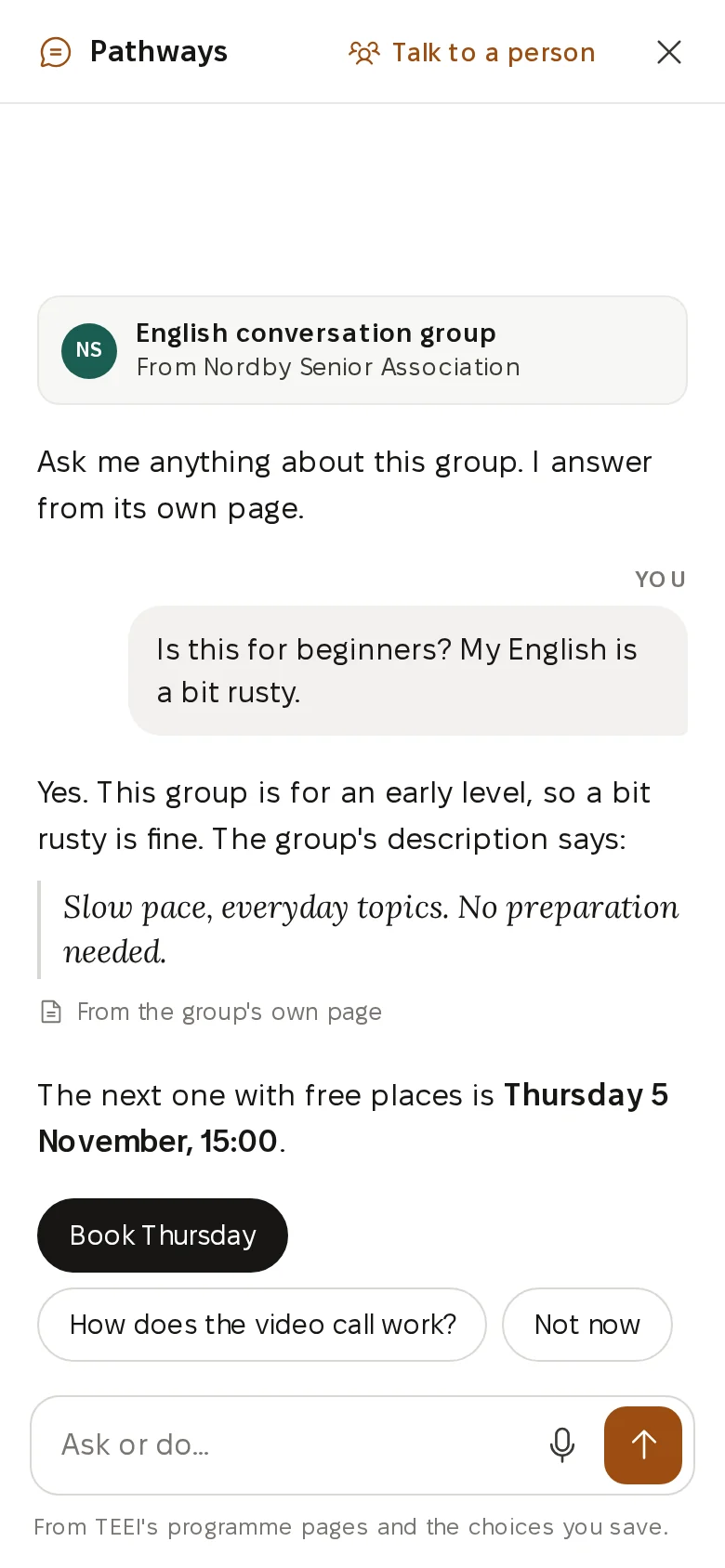
When the person moves into an account or booking flow, the destination stays connected to the original intention. Signing in returns them to where they were going. Information already given is reused where appropriate.
W3C’s accessibility guidance specifically addresses barriers in repeated entry and authentication.[3][4] TEEI Pathways turns those principles into a practical objective: the person spends their effort deciding whether the activity is right for them, and the login journey stays short and familiar.
The first visit can end in several good ways: a booking, a saved activity, a prepared contribution or a clear picture of the available routes. In each case, the person knows what they have done and how to return.

Clear small steps build trust.
Meeting people through something worth talking about
“Meet people” is a real goal, and it earns its own place in a learning platform.
TEEI’s broader strategy treats human connection as a value in its own right, alongside language, skills and work.[5] TEEI Pathways gives that principle a practical form through conversations and group activity.
An interest is a good starting point. A discussion about history, books, culture, professional experience or a shared learning task gives people something to do together. It also lets a new participant understand the group before joining it.
Shared interests bring people together. TEEI Pathways connects them with conversations, discussion groups and activities they can return to week after week. A person enjoys a thoughtful conversation at their own level of closeness. A regular group becomes familiar gradually. Someone who prefers a one-to-one exchange chooses that format.
The assistant handles the practical fit: subject, language, format and available time. It explains the difference between a conversation group and a structured class. It finds someone’s next session and shows how to join.
Belonging grows from the experience itself, and the person is the judge of it. The product creates better opportunities for contact and leaves the person to decide which contacts matter to them.
The opportunities extend across age groups. A shared interest brings together people from different generations and places. The connection can be the subject, the language or the wish to exchange experience.
Success is ordinary and substantial: a person has something to look forward to, a conversation they choose to repeat and people they recognise when they return.
The AI arranges the conditions. The people create the relationship.
The second meeting matters as much as the first
A strong first impression is the start. Usefulness in a person’s life comes from what happens next.
After the first activity, the practical questions change. Where is the next session? Is it the same group? How does someone continue a conversation? Can they change the arrangement when their week changes? What happens when an activity is cancelled?
TEEI Pathways supports continuity. Every visit picks up where the last one ended.
The person returns to a clear view of their activities, relevant bookings and saved work. The assistant finds the next step from the actual record and continues from there, with the first conversation about interests already behind them.
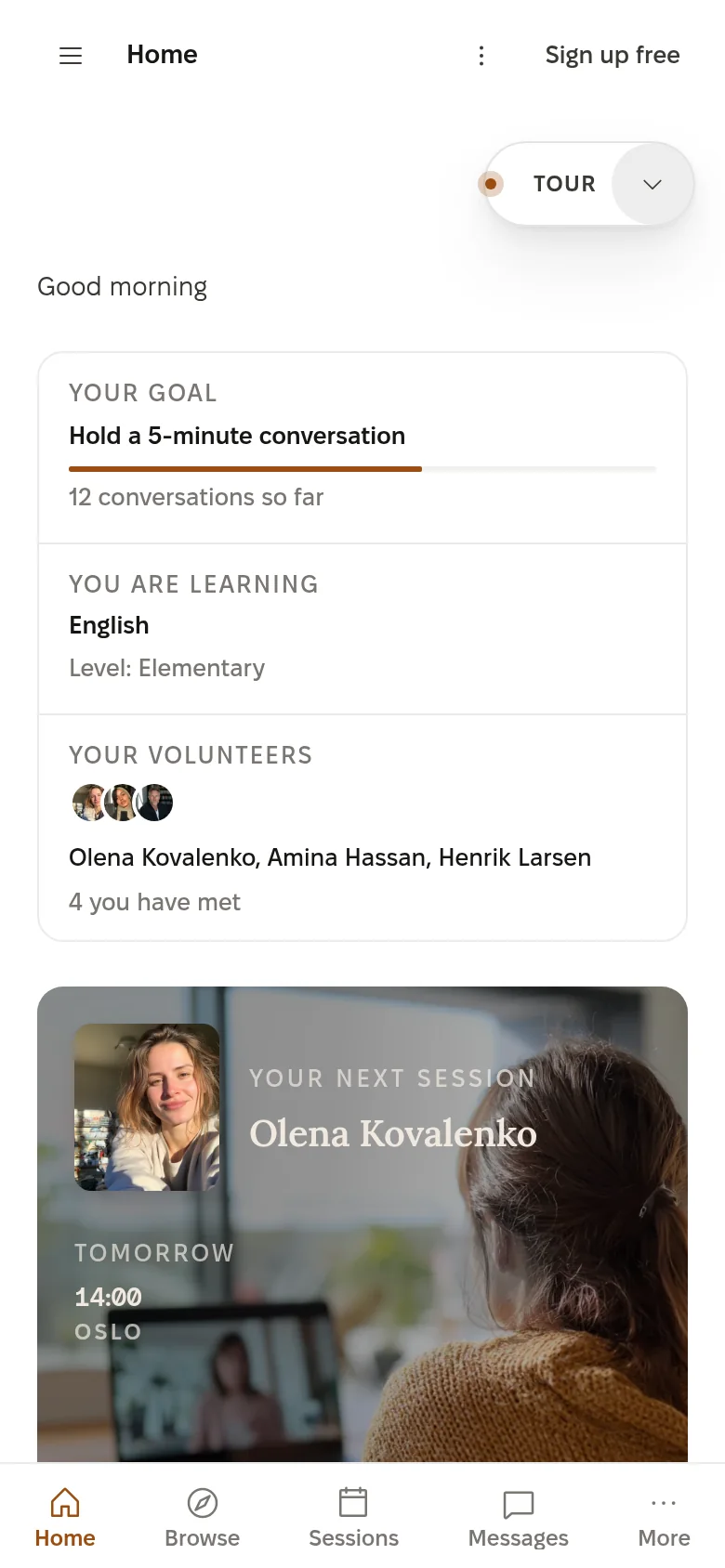
Recurring arrangements need care with time. People in different places need to understand the same event in their own local time. The scheduling system handles seasonal clock changes and shows the actual local time in the booking, so participants always see the correct time for where they are.
Continuity includes flexibility. A person may travel, take a break, change availability or decide that another format suits them better. The service keeps those changes understandable, and continuity stays a choice.
The assistant helps with those practical transitions within the programme’s supported actions. It explains what a change affects and shows the saved result. When an arrangement needs human help, it shows the route to the right person, and the booking changes there.
This support is easy to underestimate. A familiar group or recurring conversation becomes part of a person’s week when the surrounding arrangements stay understandable.
TEEI Pathways therefore treats return visits as a central experience. The first meeting opens the door. A reliable route back lets the person decide what the opportunity becomes.
Language practice can be useful at any stage of life
A person may want another language for travel, family, reading, friendship, volunteering or the pleasure of learning. Employment is one reason among many.
TEEI Pathways presents the language opportunities in those terms.
A one-to-one conversation offers one experience, a Speaking Café another. A discussion group organised around an interest creates a third way to practise. The assistant explains the differences and helps the person choose a suitable route through TEEI Language.[2]
The experience connects individual preparation with human interaction. Someone who feels unsure about a first conversation can use AI-supported practice to try an introduction, work through a topic or listen to an example. That practice leads into the human session and makes it easier to enter.
Practice Companion fits this wider design: individual practice and feedback sit alongside conversations with volunteers. The person explores a phrase privately, asks for another explanation and then uses what they have practised with someone else.
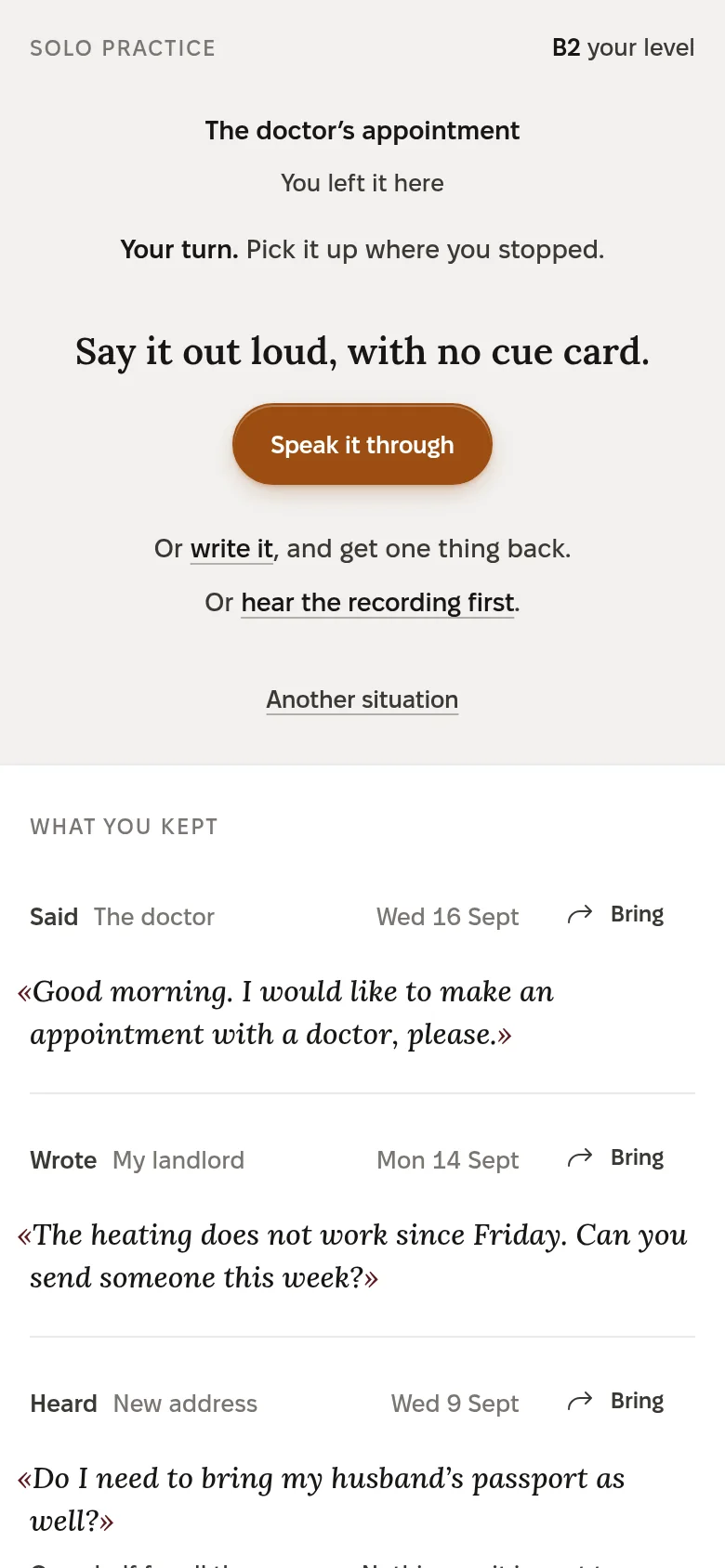
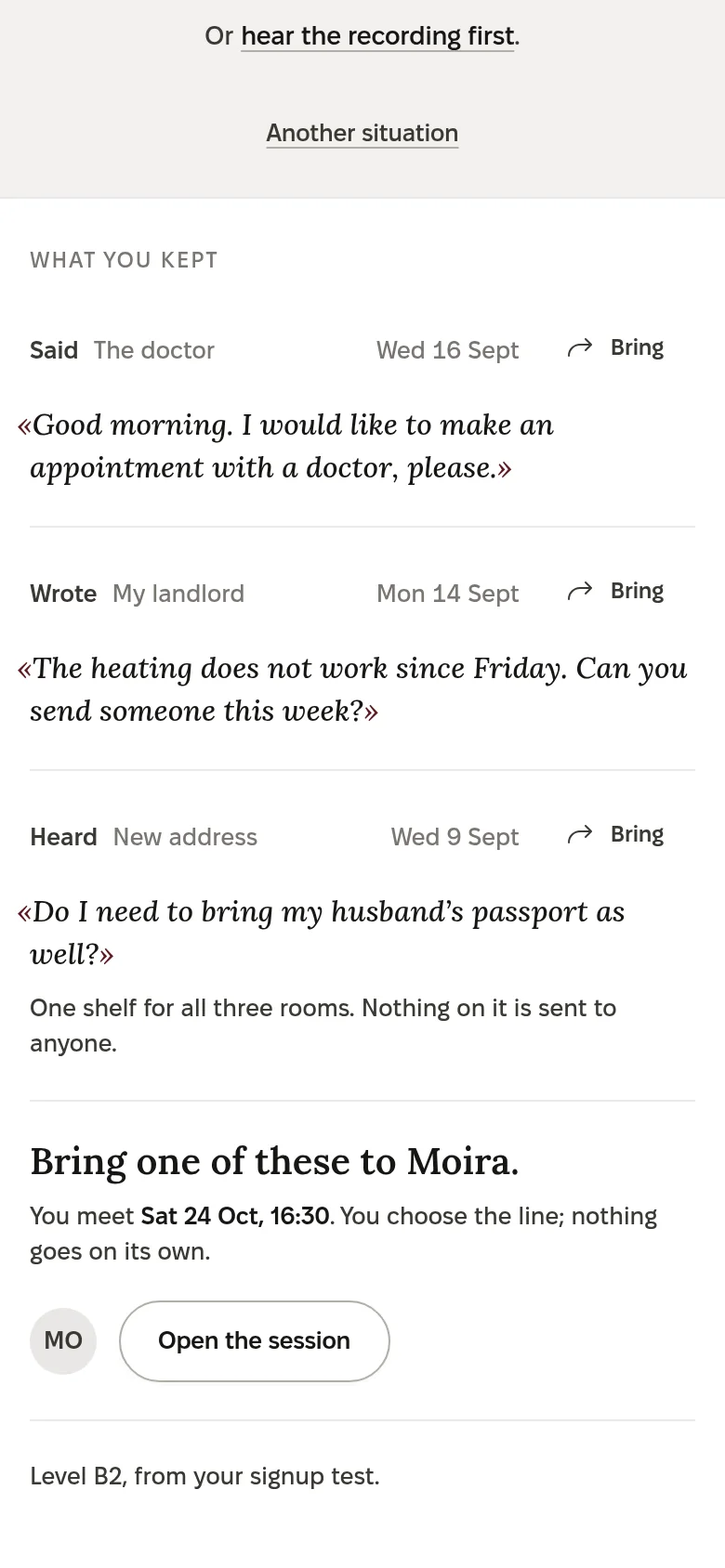
Practice and assessment stay distinct. Feedback suggests what to work on, and every conversation stays a conversation. A model’s estimate is feedback on one task at one moment. The activity stays responsive to what helps the learner take part.
An older adult can also contribute as a conversation partner. Fluency in a language and an interest in talking to someone make a useful role. A person might help someone practise English while learning another language themselves.
That reciprocal pattern is one of the strengths of the platform. Learner and volunteer are roles a person takes on in different contexts.
For the individual, the result is a richer reason to return: another topic to discuss, another person to meet and something learned that works outside the exercise.
Mentoring makes experience usable
Professional experience is often hard to package. A person may have spent decades dealing with customers, managing teams, teaching, designing systems or navigating an industry, and still struggle to describe what they could offer in a volunteer profile.
The assistant turns that broad experience into a concrete mentoring contribution.
It helps the person identify the questions they are well placed to discuss. Preparing for an interview. Explaining a career change. Understanding how a team works. Thinking through a professional decision. Presenting experience clearly to someone meeting them for the first time.
The resulting description is more useful to a potential mentee because it explains the kind of conversation on offer. The assistant describes the mentor’s experience exactly as it is, using only the qualifications and roles the mentor has given.
The mentee chooses whom to approach. The platform makes relevant experience easier to discover, and the people decide whether the relationship is useful.
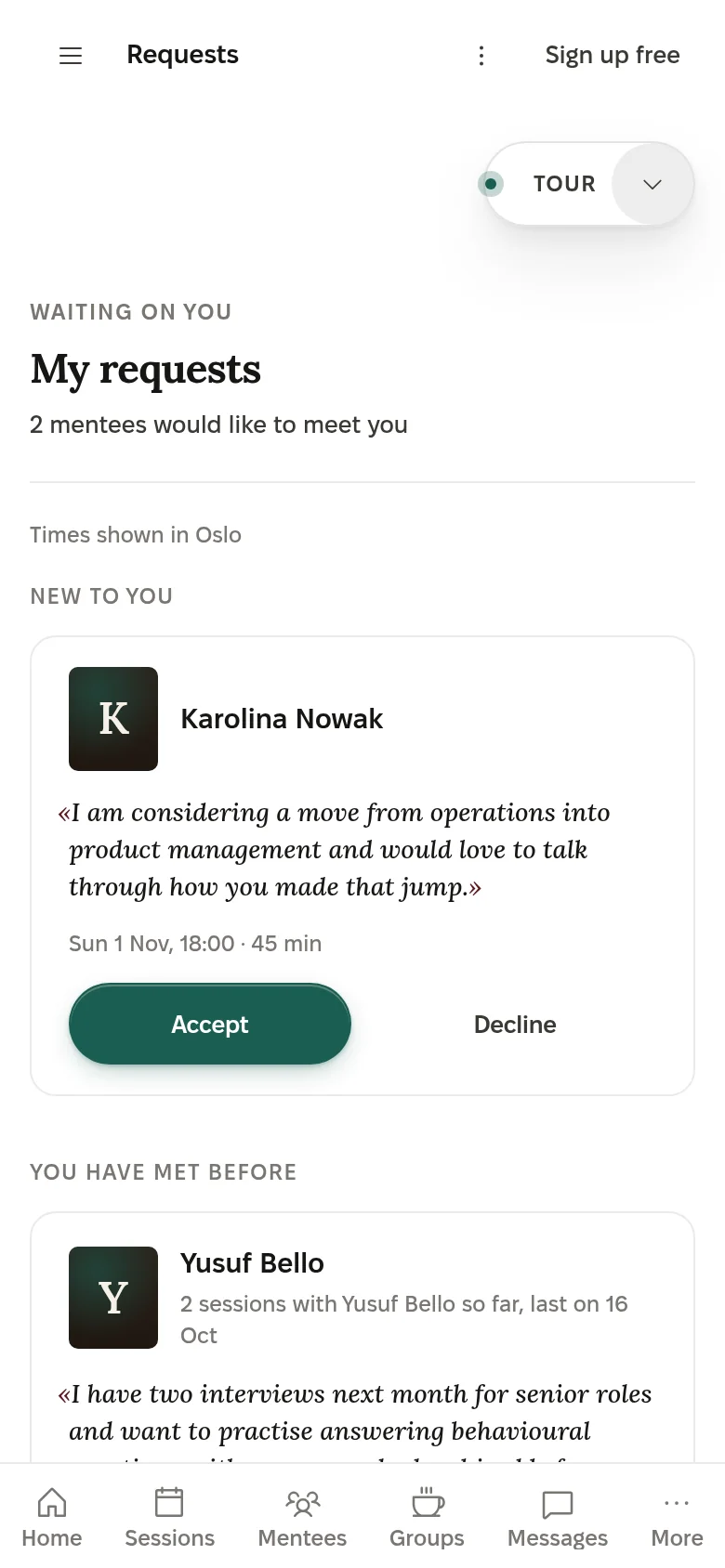
For the older contributor, the role is focused and manageable. A mentoring conversation can clarify one issue or prepare one next step. Continuity develops where both people find it valuable.
The exchange benefits from different perspectives. A mentor brings experience of organisations and decision-making. A mentee may bring current knowledge of a market, a tool or a professional environment that is new to the mentor. Experience flows both ways.
TEEI Pathways supports the surrounding work: understanding the role, preparing a profile, finding relevant information and navigating the programme process. The mentoring itself is a conversation between people.
The contribution is experience applied to a situation in which another person can use it.
A lifetime of knowledge fits into one focused session
An experienced person can teach something useful in one focused session. Designing a twelve-week programme is optional.
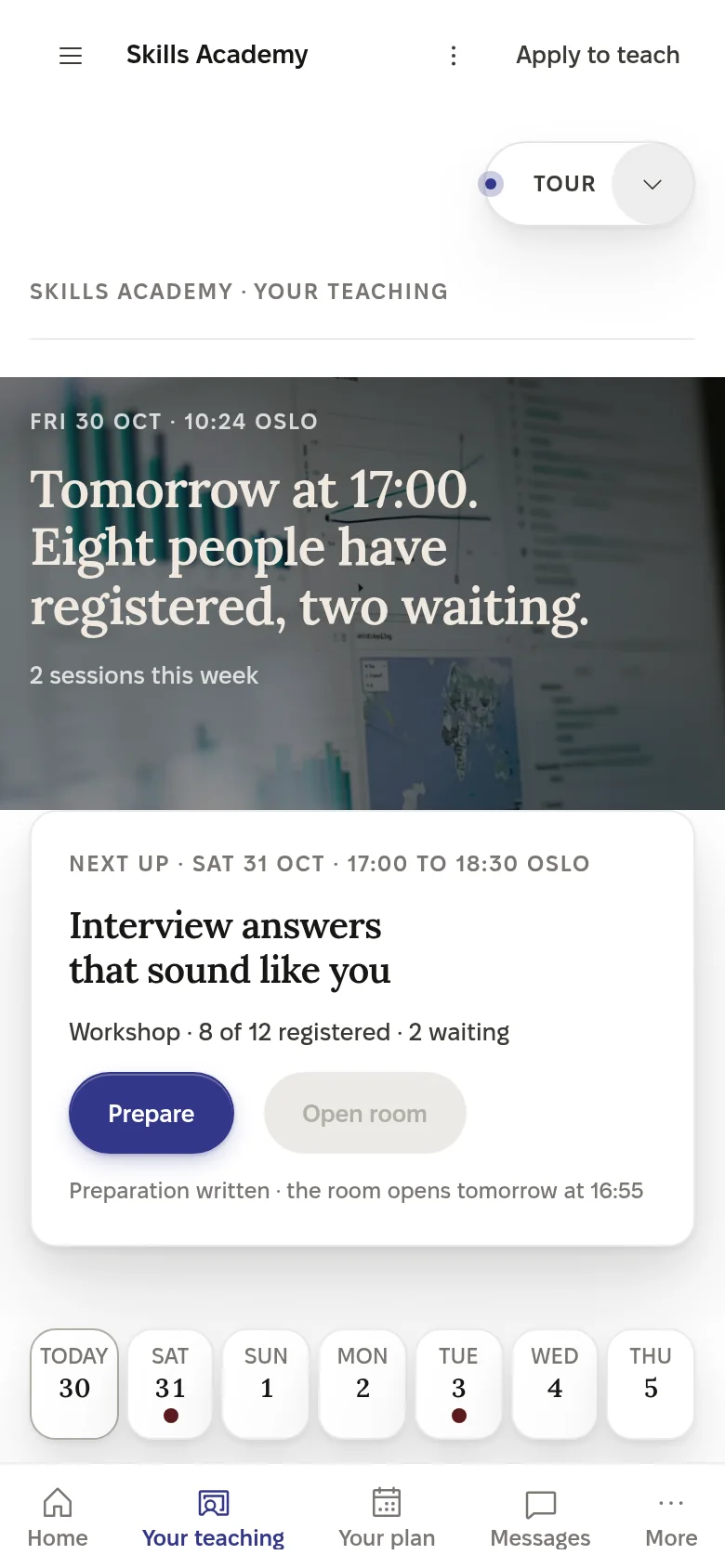
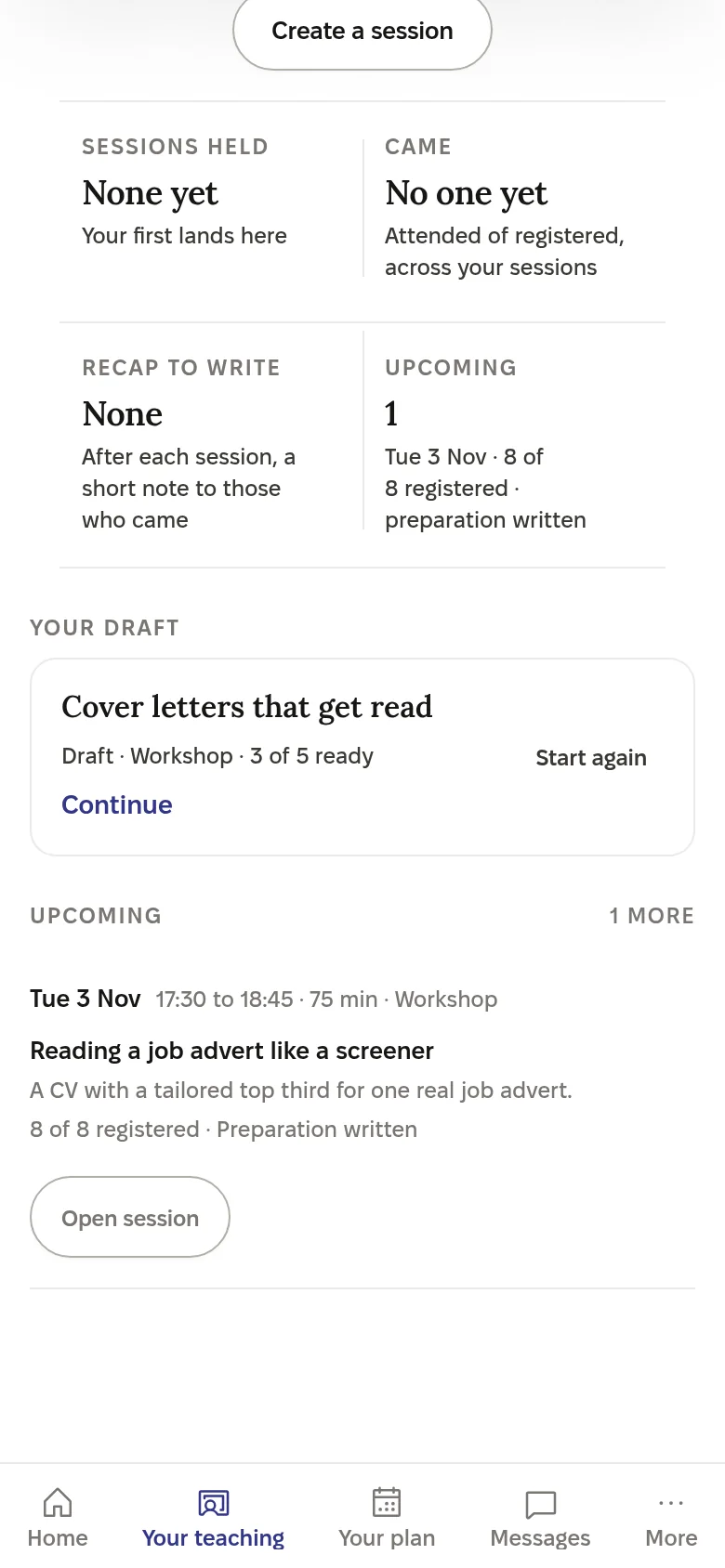
TEEI Skills Academy offers formats built for a focused contribution: a workshop, a clinic, a class or an expert question-and-answer session. Instructors come from senior communities as well as universities, companies and other organisations.[2]
The assistant shapes the contribution around a clear result.
A retired accountant can explain how to read a simple business statement. An experienced manager can help people prepare for a difficult workplace conversation. A teacher can show practical ways to structure a presentation. A technical specialist can lead a session on a concept people repeatedly find confusing.
TEEI Pathways helps the prospective instructor move from I know a lot about this to Here is what someone will be able to understand or do after our session. That step matters, because turning expertise into an activity takes design.
The assistant prepares a description, suggests an outline and identifies what participants need beforehand. The contributor edits those suggestions, removes what fits poorly and keeps the explanation in their own voice. The final content reflects what they can genuinely teach, with the contributor in control of its scope and claims.
A contribution can also start as a discussion. Someone with an interesting topic and a talent for hosting a thoughtful exchange can lead a group, which may suit them better than an instructor-led class.
The organisational route handles the practical surroundings. A senior association supports a member who wants to contribute. A university connects retired staff with suitable opportunities. TEEI provides the programme process and shared delivery infrastructure.
The person’s responsibility is clear. They bring the knowledge and the contribution they have agreed to make. The programme and the platform take care of the listing, the bookings and the technology, so that knowledge reaches people.
Learning continues after employment
Learning serves many purposes beyond a job: understanding something, making something and becoming more capable in daily life.
TEEI Pathways gives all those goals equal room.
Someone may want to organise family photographs, become more comfortable with spreadsheets, understand a digital service, explore a subject they have always found interesting or learn how an AI tool actually works. Another person still has a professional goal. The platform serves each reason on its own terms.
Skills Academy connects people with live expertise and structured learning. A person can take a focused session, continue independently where a suitable course is available or join a study activity with others. Each route has its own requirements and purpose.
The assistant makes the choice practical. It explains what an activity covers, separates introductory content from more advanced material and helps the person see what they need before starting. It also makes it easy to return to the relevant material or activity later.
Learning is most satisfying when it connects with a real use. A spreadsheet session leads to a personal project. A language conversation prepares someone for a visit. A digital-skills class makes another programme easier to use. An AI session helps a person understand the assistant they are already using.
TEEI Pathways makes room for changing direction. Someone may discover that they enjoy learning with a group more than studying alone. Another may prefer a self-paced route and use live sessions for specific questions.
Each choice is a way of learning, and every participant’s commitment counts equally.
The outcome can be modest and important: a person understands a tool, completes a project, asks a better question or discovers a subject they want to pursue. That is reason enough for a learning opportunity to exist.
Learning about AI through using it
Anyone can use TEEI Pathways from the first sentence. Along the way, it helps people build an accurate understanding of what the technology does.
The experience itself teaches.
When the assistant explains a programme, it shows the source. When it prepares a form, the person sees the draft. When it performs an action, it reports the result from the application. When information is missing, it asks.
These interactions make the difference between generated language and verified information visible inside ordinary tasks.
A practical learning activity builds on that experience. Participants compare a general question with a more specific one, ask an AI tool to explain a difficult passage or examine how a summary changes when the source material changes. They learn when a tool is useful and when to inspect the original information.
The point is agency. A person who knows that the assistant drafts descriptions and the booking system makes bookings uses both with confidence. A person who knows how to correct an assumption treats the first answer as a starting point.
This is also good ground for intergenerational contribution. Someone with practical experience of an AI tool helps another person learn it. Experience decides the roles, whatever the ages. An older participant may be the most experienced person in the room; a younger participant may be meeting the subject for the first time.
The platform supports AI literacy for everyone who wants it, from the first visit. People learn enough to use the tools that matter to them, in connection with an activity they already care about.
TEEI Pathways shows its actions and its limits through the work itself, in plain results. That is how the technology becomes clear.
Intergenerational participation needs a shared purpose
People of different ages exchange the most when they have something to do together.
TEEI Pathways builds that shared purpose through TEEI’s programmes.
A language conversation gives two people a reason to speak. A mentoring session gives them a professional question to explore. A workshop gives them a task or concept. A discussion group gives them a subject they can approach from different experiences.
Age adds to the exchange as one perspective among several. A retired professional may have seen several changes in an industry. A younger participant may know a new tool or the current job-search process. A person from another country brings a different perspective on both.
The activity puts those perspectives to practical use, and each participant can teach and learn in the same session.
A discussion about work can cover how recruitment has changed, which skills remain useful and what different participants find difficult now. A session on digital tools becomes a two-way exchange between technical familiarity and practical judgement. A history group connects personal memories, questions and learning resources, and every participant can be a learner on the topic.
The host’s role matters. An accessible format, a clear subject and room for different contributions help the group work. The assistant supports preparation by suggesting questions or helping the host organise an outline, and the host adapts it to the people present.
The outcome is an exchange in which the participants found something useful or enjoyable.
That is the basis for continuity. People return because the conversation matters to them.
An illustrative month: from attending to contributing
Consider an illustrative participant, Ingrid. She has recently retired from a role in training and team development. She is comfortable with email and video calls and wants the platform to stay simple.
She meets TEEI through a senior association. The invitation mentions conversation, learning and opportunities to share experience. She can start as a participant, a contributor or both, and decide later.
On her first visit, Ingrid asks about language practice. The assistant explains the relevant formats and helps her understand an available activity. She chooses a suitable route and sees the booking information in the normal interface. The assistant’s job is straightforward: make the offer understandable and help her use it.
After the first conversation, she returns. She knows more about what she enjoys and asks about a group discussing a subject that interests her. TEEI Pathways finds the relevant information straight from her existing account and her first visit.
Later, she notices an opportunity to contribute professional knowledge. She asks whether her experience helping colleagues prepare presentations could be useful. The assistant explains the relevant teaching route and helps her sketch a focused session.
The first draft is too broad. It promises public-speaking confidence, persuasive communication and leadership development. Ingrid removes those claims. She wants to teach something narrower: how to organise a five-minute presentation around one main point.
The assistant adapts the description and outline. The contribution now sounds like something Ingrid can deliver. The programme process handles the teaching role and activity. Her association supports her practical involvement, and her individual account stays hers.
By the end of this imagined month, Ingrid has taken part in one kind of activity and prepared a contribution in another. She may continue with both, choose one or take a break. TEEI Pathways has made those choices easier to explore.
The assistant’s value shows in the transitions: invitation to participation, curiosity to a group, experience to a specific teaching contribution. It steps in when Ingrid has a task and steps back when she is with other people.

The person supplies the purpose. The platform makes the routes usable.
Speak, type or click, and switch at any time
Voice makes an assistant easier to use when speaking is more convenient than typing. In a noisy room, in a shared space or when the person prefers to read, text and visible controls serve better.
People can speak, type or click, and switch whenever they like. All three work within the same task, and every mode stays available.
A voice interaction needs more than speech recognition. The person sees when the microphone is listening, whether their words were understood and what the assistant is doing. A date, a person’s name or a proposed class title stays visible and correctable within the task.
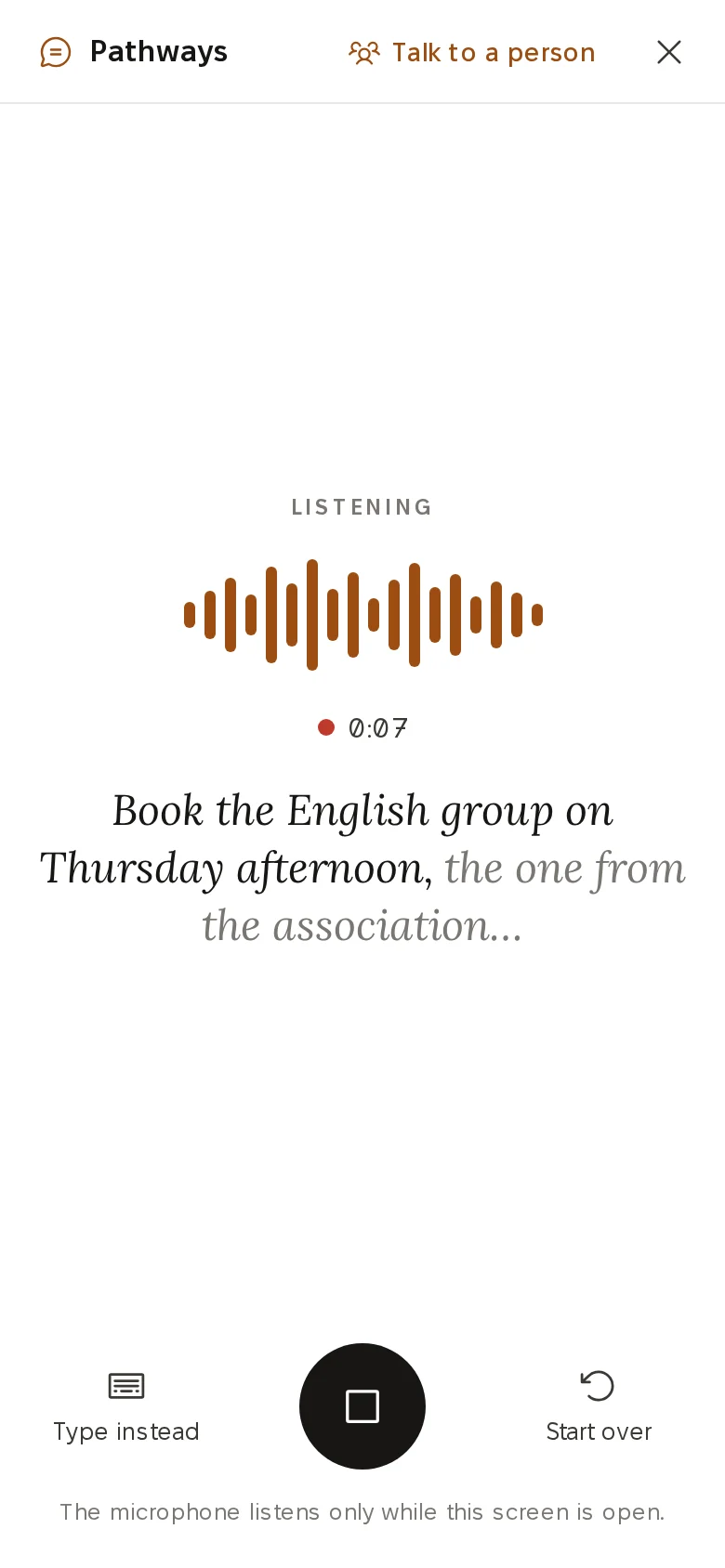
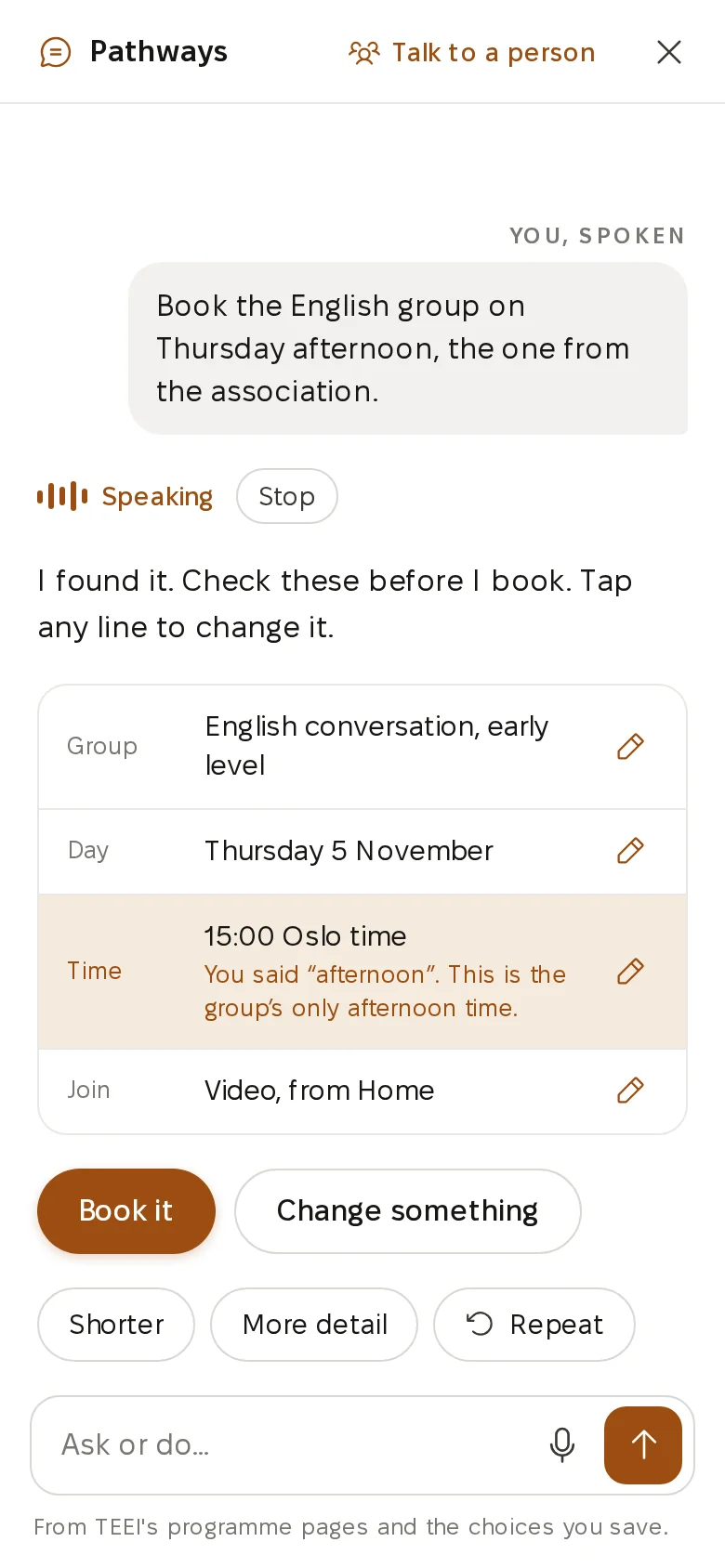
The assistant speaks an explanation while showing the important information on screen. A person can interrupt, correct a detail or switch to typing. The visible task stays on screen after the spoken response ends.
That persistence is particularly valuable for practical arrangements. Every spoken explanation comes with a booking record the person can revisit, with the date, local time and joining route.
Voice also keeps an ordinary pace. The user asks for a shorter explanation, more detail or a repetition, and the assistant follows those stated preferences. It draws no conclusions about ability from speech speed or accent.
W3C’s work on older users connects many age-related accessibility needs with existing web accessibility standards.[6] The implication reaches beyond voice: adaptable presentation, understandable controls and alternative ways to interact serve people’s needs better than a single “senior mode”.
Speaking is one convenient route into the same product. The microphone listens when the person asks it to, and the clear visual interface is always there.
Assistance that strengthens choice
Good assistance completes the task and leaves the person understanding what happened.
TEEI Pathways delivers useful assistance with visible results.
When the assistant opens a programme, the person sees it. When it prepares a form, the fields stay editable. When it explains an activity, the information is available outside the chat too. When it carries out a supported action, the application shows the resulting state.
This gives the user several ways to take part in the task. They can ask the assistant to do more, change something directly or continue on their own. They can ask why a choice was suggested and weigh it themselves.
That control is part of ordinary use. A user can choose a different group, and no reason is needed. They decide which details in a suggested teaching outline to keep. A correction is useful information for the assistant.
This matters most for recommendations. A helpful suggestion explains its link to the person’s stated interest: the subject, format, language or time. That explanation lets the person judge whether the match makes sense. Every recommendation shows its reasons.
The interface supports different levels of detail. Someone joining their first video session gets a clear explanation. Someone returning for the tenth time gets the joining control immediately. The familiar route stays in place, with help one step away.
W3C’s guidance on designing for older web users includes clear labelling, understandable navigation and support for different accessibility needs.[7] Here, those principles produce a practical form of independence: a person understands their options and acts on their own preferences, with assistance available when it adds value.
The assistant earns its place by making that process easier. People use it when it helps and go straight to the task when they prefer.
Human help remains part of the service
Sometimes the most useful next step is a conversation with another person about how the service works.
A member may want to ask a local coordinator what a group is like. A prospective host may want to discuss whether a contribution fits the programme. Someone having trouble joining a session may need practical support from a person.
TEEI Pathways works alongside those forms of help.
The organisational route gives people a familiar place to begin. A senior association introduces the opportunity in person. A library helps someone understand a first step. A programme team handles questions that need human judgement or access beyond the assistant’s.
The assistant makes that hand-over coherent. It identifies the relevant support route, explains what information is needed and keeps the task intact, so the person continues from where they were. Where the product supports sharing a task summary, the user sees exactly what is passed on.
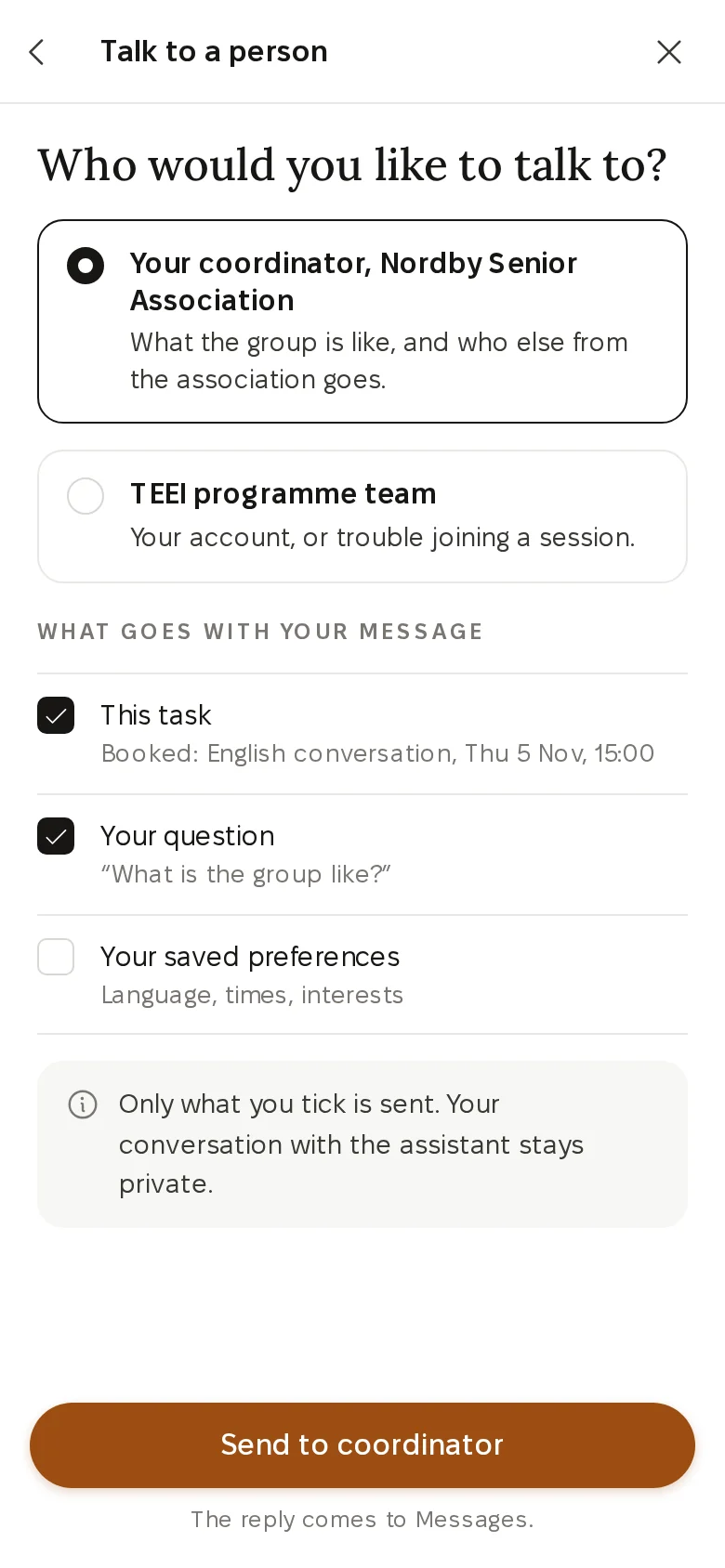
The person stays in charge of their own account. Some people want help from someone close to them; others prefer independent use or support from an organisation. Help is arranged according to their preferences and the supported access model.
Every form of assistance follows the relevant access arrangement. The person helping sees the information the task requires, and private interactions and preferences stay private. A coordinator’s organisational role and a participant’s individual account stay separate.
Human help also carries the social side of participation. A host welcomes a new member into a group. A volunteer explains how a conversation usually works. A coordinator knows which activity has the atmosphere a person is looking for.
The AI supports those relationships, and the people give them their value. A complete service offers a clear path to people as well as a clear path through software.
A group is more than a video link
Putting people in the same room is one part of a group experience.
A strong group also has a purpose participants understand, a host who knows what they are offering and a rhythm that makes it easy to return. New members know what to expect. Existing members recognise the activity as the same group from week to week.
TEEI Pathways helps with the work around those conditions.
A prospective host develops an idea into a clear description. The assistant helps distinguish a discussion from a class, turn a broad subject into a usable first session and prepare questions that fit the host’s intention. The host edits and owns that contribution.
A participant can ask what the group involves and whether preparation is expected. The answer refers to the actual activity. A person whose expectations differ finds another opportunity before the first session and starts in a group that suits them.
The shared programme infrastructure keeps the practical record: the activity, the booking, the session and the attendance information. Resources and follow-up live in one place, within the programme.
The group develops over time. Participants suggest a related topic. A host adjusts the format after seeing what leads to a better discussion. The assistant helps prepare the next session, building on how the group has actually developed.
This is where AI is useful at the edge of the room. It reduces preparation and coordination work, so more of the human effort goes into the activity itself.
The lasting value comes from the people: someone asks a thoughtful question, a participant offers an unexpected perspective, a familiar face returns. The platform gives those moments a place and a time.
The technology connects intention, context and action
The technical task in TEEI Pathways is to connect a loosely expressed human intention with the right part of a functioning service.
The foundation is TEEI’s Network Assistant and shared programme infrastructure. The documented implementation direction includes grounded product answers, organisational context, navigation, interface guidance, form support, saved drafts and actions through application interfaces. Model access runs through Amazon Bedrock within the broader AWS and Cloudflare architecture.[8]
TEEI Pathways extends that foundation to a more personal journey.

At the interaction layer, the person uses text, voice and visible controls. The system keeps what the person says and what is on the screen in step. A spoken correction to a date changes the same draft as a typed correction in the date field.
At the context layer, the assistant works with the relevant facts: the current page, available programme information, the selected activity and the user’s task. It tells an idea mentioned in conversation apart from a field actually saved in the application.
At the action layer, the platform exposes defined operations. The model requests an appropriate operation, and application code performs it with the relevant identity, permissions and validation. AWS’s documentation for client-side tool use describes this general separation between model-requested tools, execution by application code and returning the result to the model.[9]
At the programme layer, the existing service is the authority. Bookings, groups, classes and records live in the programme, and the conversation reads from them. The assistant helps the user work with the service that actually delivers the activity.
That separation supports different interfaces over one shared reality. A coordinator using Network Workspace and a participant using TEEI Pathways interact differently, and both work with the same authoritative class or booking information.
The architecture also lets the product evolve. Speech services improve. Models can be changed. The interface becomes more accessible. Stable programme actions and records keep the meaning of a booking or contribution constant through every improvement.
The strategic advantage is a reusable interaction layer over real opportunities. TEEI makes the service easier to use for a particular audience and reuses every programme underneath it.
A clear result after every action
A conversational interface needs to show the actual result.
“I have helped you with that” tells the person little. A useful receipt names what happened: the assistant has explained something, prepared a draft, saved information or completed a supported action.
TEEI Pathways makes those distinctions visible in the task.
A prepared draft appears as a draft. Saved information can be retrieved again. When a booking or request exists, the user has a route to the corresponding record. The assistant’s explanation follows that result and points to it.
This matters most when something interrupts the interaction. A slow connection may leave the person wondering whether to try again. A spoken instruction may be misunderstood. A session may fill up by the time the person decides to join.
The product responds with the specific state and the useful next step. It keeps work that is still valid. It recognises a repeated action and creates one request. It tells information that needs correcting apart from work that must start again.
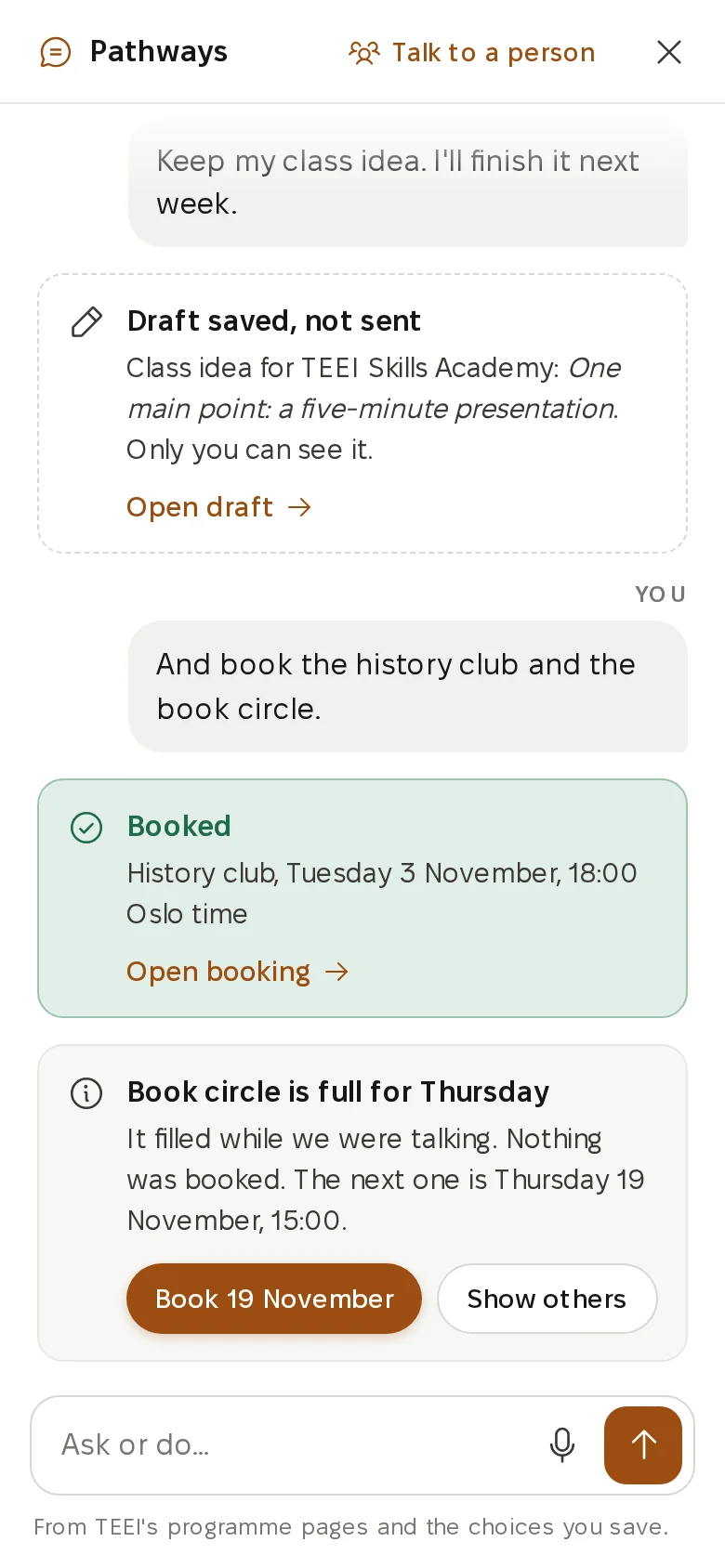
The normal interface is always a route through the task. Programme bookings and saved contributions stay accessible if an AI service fails, and the person continues through the product.
This reliability builds confidence directly. Someone who knows they completed a task uses the service again on their own. Clear results build independence.
The goal is a system whose problems stay understandable and recoverable, and whose successful actions are shown accurately.
The user finishes an interaction knowing where they stand.
Remember what helps, and keep it understandable
Continuity comes from keeping useful context and telling different kinds of information apart.
A preferred language differs from a one-off request to translate a message. An interest in history differs from a decision to join every history activity. A saved class contribution differs from an idea the person considered and rejected. A change to availability differs from a passing remark about a busy week.
TEEI Pathways treats those differences as part of the product.
The person sees and corrects the preferences used to help them. Saved activities and contributions live in the relevant programme records. The assistant summarises where a task stands, and the conversation itself stays a conversation.
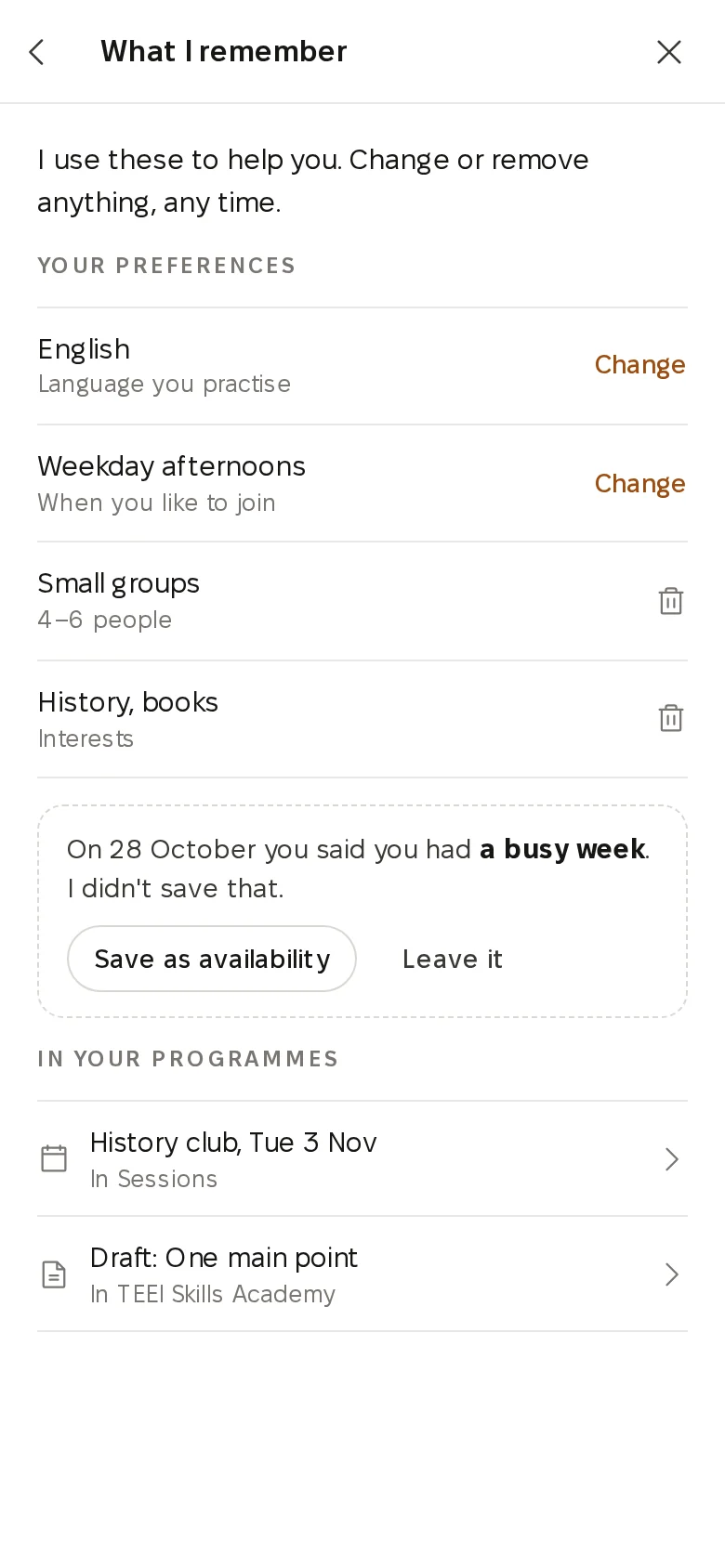
This makes return visits more useful. The assistant helps someone continue a draft, find an upcoming activity or revisit a relevant opportunity. It goes straight to the task and uses remembered details when they help.
The person’s current intention comes first. A person who once preferred one-to-one conversations can decide to try a group. Someone who mentored last month may want only to learn this month. The system adapts to the new choice.
The organisational relationship is separate again. A senior association sees participation at the level it needs, and a member’s private dialogue with the assistant stays private.
Memory earns its value in practice: less repetition, easier continuation and suggestions that make sense. Useful context helps the person return to their own work, and it stays understandable and open to correction.
The service can be quiet between activities
A person stays part of a community at their own rhythm, with messages that matter.
TEEI’s strategy separates programme arrangements from general Community chat, which sends no in-app, push or email notifications.[5] That matters for TEEI Pathways because participation fits into a person’s life on their terms, with digital attention when they choose to give it.
A booked session has a clear time and joining route. Changes to that session go through the relevant programme arrangements. General conversation and optional activity stay separate from those session arrangements.
The assistant is useful when the person opens the product with a purpose. It finds the next session, continues a task or explores another opportunity. Each return starts calmly, at the person’s pace.
This makes room for different rhythms. One person joins a weekly conversation. Another attends occasional classes. A third contributes intensively for a while and then pauses. The service stays available and treats quiet periods as a normal part of participation.
A return visit is welcoming and practical: here are the activities and saved items relevant to you.
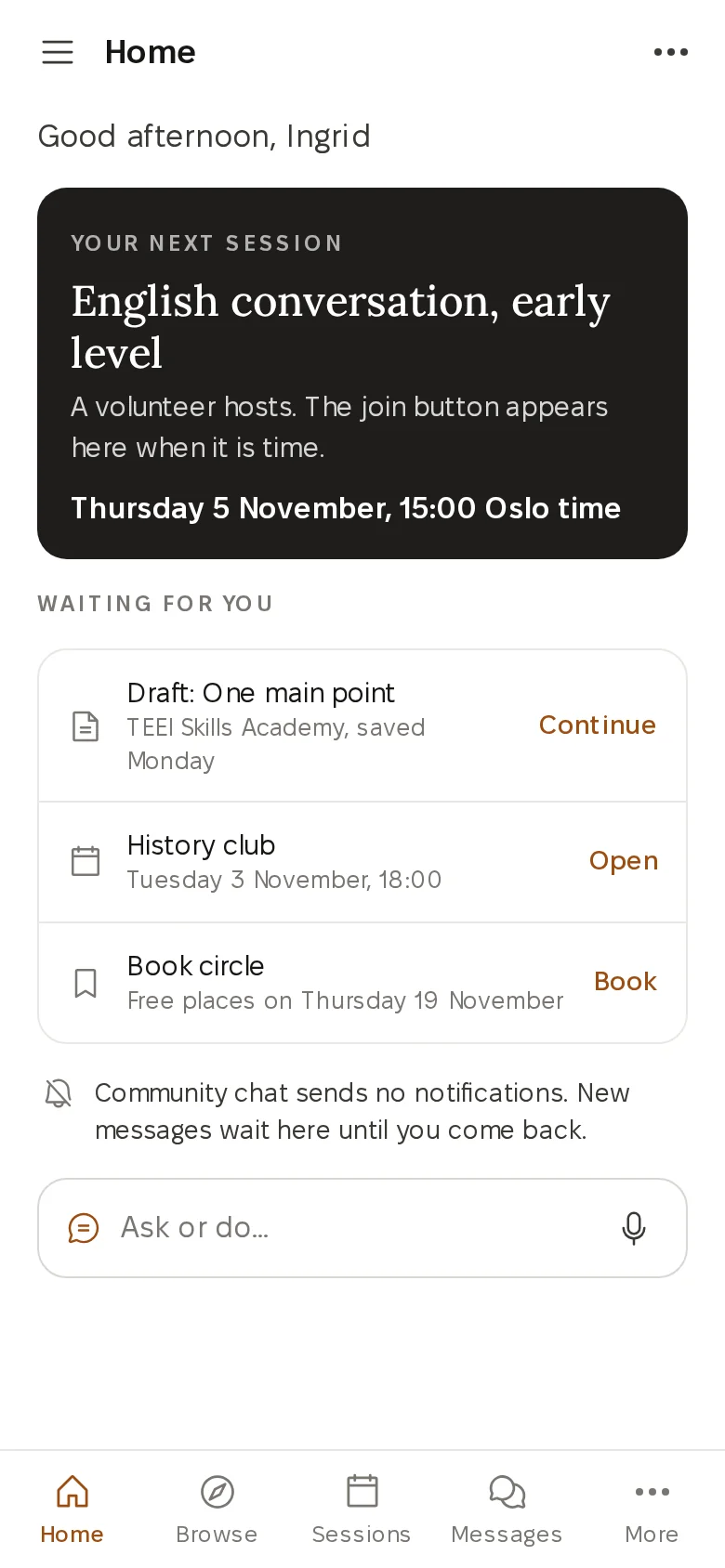
The measure of the relationship is whether the service is worth returning to when the person chooses to use it.
What success looks like beyond the chat window
TEEI Pathways is evaluated at several levels, because the assistant, the programme and the human experience are related and distinct.
The first level is task success. Did the person understand the opportunity? Could they find the relevant activity? Did the action they requested produce the right application result? Could they correct a misunderstanding and continue with their work intact?
Those questions reveal more than a polished demonstration conversation. Fluency counts when it sends someone to the right place. A shorter response that gets the person into the intended activity is the better interaction.
The second level is programme participation. Did someone book an activity, attend it and return where they wanted continuity? Did a contribution move from an idea to a delivered session? Were relevant opportunities available at practical times?
These records have clear definitions. TEEI records each stage separately, from registration and booking to attendance and completed activities. Attendance shows presence; learning is a separate outcome. A repeated session can show valuable continuity, and reports keep repeated sessions and unique participants apart.
The third level is the person’s experience. Did the activity feel relevant? Did they meet people they wanted to meet? Did they learn something useful? Did they feel able to contribute on terms that suited them?
WHO’s description of social connection distinguishes the structure of relationships, the support exchanged and the quality of interactions.[1] A count of sessions describes one of those dimensions; the experience of the people in them needs its own evidence.
TEEI Pathways collects appropriate feedback and studies these questions with the evidence each one requires. A booking log shows participation. Loneliness, wellbeing and health are different outcomes, and each needs its own evidence.
Evaluation covers the different ways of using the product: typing, speaking, keyboard navigation, larger text, interrupted tasks and return visits. It includes the full variety of people the experience serves.
The result is a chain of evidence: understandable access, successful tasks, real participation and a human experience worth continuing. Each link shows whether the service is doing what it exists to do.

What organisations gain from this model
For a senior association or local organisation, TEEI Pathways shortens the distance between an idea and something members can use.
A coordinator introduces relevant opportunities with a programme platform already in place. Members follow individual interests. Contributors turn experience into specific roles. The organisation understands participation through Network Workspace and respects each person’s individual choices.
The assistant also makes informal knowledge usable. A coordinator may know that several members enjoy discussing history, that one person has teaching experience and that another would like to practise a language. TEEI Pathways turns each of those observations into action, with the service already built.
The organisation’s role matches its capacity. It may simply share opportunities. It may help with first steps. It may coordinate contributors or request an activity around a recurring need. Access comes with no volunteer requirement.[2]
For TEEI, these relationships create more ways to connect people with delivery. Community organisations contribute reach and context. Universities contribute students, educators and experienced alumni. Senior communities contribute participants, knowledge and potential hosts. The programmes give those contributions a shared place to become activity.
This is also a practical proposition for technology and funding supporters. Support improves the infrastructure, accessibility, coordination and programme capacity that make participation possible. Its value shows in the work it helps deliver.
The strongest organisational story is simple: more people find a suitable opportunity, more contributions get organised and more good intentions turn into activity.
A larger ambition than making an interface easier
An accessible interface is the foundation, and TEEI Pathways builds on it.
It connects the ability to use a service with something worth using it for. It brings together conversations, learning, professional contribution, group activity and the organisations that introduce those opportunities.
That combination matters because participation meets friction at several points. A person may be unaware of what exists. They may underrate how useful their experience is. They may understand the offer and struggle with joining. They may complete the process and find the activity a poor match for their interests. They may enjoy the first meeting and then lose the route back.
A connected product addresses each of those points where it occurs.
The assistant interprets intention and reduces practical effort. The programme supplies a real activity. The organisation provides context and a trusted introduction. The interface preserves choice. The records show what happened and help improve the service.
The same foundations serve everyone who benefits from clearer routes into learning and contribution. Resuming an interrupted task, correcting an assumption and understanding a booking matter at every age. TEEI Pathways gives TEEI a focused reason to get those interactions right.
TEEI Pathways makes a growing set of human opportunities easier to enter, continue and contribute to.
A person brings an ordinary sentence about what they want to do next and finds a route into something real.
The technology leads somewhere
The retired engineer at the beginning wants his experience to be useful, in a few hours a week that leave the rest of his life his own.
The retired teacher wants room to be a beginner again: to learn, meet people and decide what interests her now. Teaching can wait until she chooses it.
A good experience respects both, and everyone else who arrives with a goal.
It makes language practice easier to enter, mentoring easier to understand, teaching easier to organise and groups easier to return to. It helps organisations offer more while TEEI’s programmes carry the delivery. It uses AI where AI reduces effort, explains choices and connects intention with action.
The people remain the point: the person learning, the person contributing, the host making room for a new voice and the participant who finds a conversation worth repeating.
That is TEEI Pathways: technology that helps someone take a next step into the world, with their own interests, experience and choices intact.
Often the best outcome is a short conversation with the assistant. It has done its job, the person has joined the session, and another human being is there to say hello.
Sources and editorial basis
[1] World Health Organization, Social connection, questions and answers, 30 June 2025. Used for the distinction between loneliness and social isolation and the structural, functional and qualitative dimensions of social connection. https://www.who.int/news-room/questions-and-answers/item/social-connection
[2] TEEI, Network Partners: participation, contribution and reporting, product and editorial documentation, 28 October 2026. Source for senior participation and contribution, programme roles, organisational access and the distinction between activity records and outcomes.
[3] W3C, Web Content Accessibility Guidelines (WCAG) 2.2. https://www.w3.org/TR/WCAG22/
[4] W3C, Understanding Success Criterion 3.3.8: Accessible Authentication (Minimum). https://www.w3.org/WAI/WCAG22/Understanding/accessible-authentication-minimum.html
[5] TEEI, TEEI AI First Strategy: Direction and priorities for 2026 and 2027, 20 October 2026. Internal strategic source for connection, language, skills and work as values of equal standing, human support, programme operations and Community notification policy.
[6] W3C, Older Users and Web Accessibility: Meeting the Needs of Ageing Web Users. https://www.w3.org/WAI/older-users/
[7] W3C, Developing Websites for Older People: How Web Content Accessibility Guidelines (WCAG) 2.0 Applies. Used as older-user design guidance alongside WCAG 2.2. https://www.w3.org/WAI/older-users/developing/
[8] TEEI, Technical platform and Network Assistant overview, 26 October 2026, especially the Network Assistant and shared infrastructure sections.
[9] Amazon Web Services, Client-side tool use, Amazon Bedrock documentation. https://docs.aws.amazon.com/bedrock/latest/userguide/tool-use-client-side.html
Frequently asked questions
What is TEEI Pathways?
An AI-assisted experience from TEEI for anyone with a goal, starting with older adults. It connects people with real conversations, useful learning and opportunities to share what they know. The assistant helps people find relevant opportunities, understand what they involve and take the practical steps to join or contribute.
Can one person both learn and contribute?
Yes. The same person can join a language conversation, mentor someone in their field, take a class or host a group, and move between those roles. Every role has equal standing.
How do organisations fit in?
Senior associations, universities, libraries and community services introduce the opportunities through Network Partners. Each member keeps an individual account and their own decisions; the coordinator sees what the access and sharing choices allow.
Can I use TEEI Pathways without talking to the assistant?
Yes. Browsing is always available. The interface offers ordinary ways to explore programmes and sessions, and a person can speak, type or click and switch at any time.
How does TEEI know whether it works?
At three levels: task success, programme participation and the person's experience. Booking and attendance records show participation; loneliness, wellbeing and health are different outcomes, and each needs its own evidence.