TEEI LanguageGroup conversation Sample
 HostIngridVolunteer · speaking
 Olena21:04 · Kyiv
 TomasVolunteer
 HalynaKharkiv
A conversation with others.
Join a Speaking Café or another group session. Meet people while using the language together.
GuideSkills & Training
Live classes by working professionals, self-paced learning on DataCamp and Coursera, AI feedback that quotes the learner, credentials anyone can verify.
Free for participants. One account for Skills Academy and TEEI Mentorship, no password.
Free for learners and volunteers. Sign in with a secure email link, no password to remember.
Free for mentees and mentors. One account for TEEI Mentorship and Skills Academy, no password.
Skills Academy is where working professionals teach live in TEEI’s own video rooms, participants hand in work and get feedback that has to quote them, and every completed class ends in a certificate anyone can check. Companies, technology companies and the organisations that already know the learners bring their people in and use the classroom TEEI already runs, free, instead of building their own.
Skills Academy teaches fifteen fields, from career development to personal effectiveness, with 663 concepts in its skills taxonomy. AI and data is one of the fields, and the Skills Academy page puts the rest in one line: professional learning, with AI in every field of it. The AI curriculum starts from the courses the providers publish openly or give free, and TEEI puts four things beside them: a live session with a professional, a task in the participant’s own field that a person reads, a mentor who works in that skill, and a study room shared with the others on the same course.
Working professionals teach in five formats: workshop, clinic, expert Q&A, webinar and the weekly class. A participant finds a session on Discover, by topic, day, format and language, and every live session happens in a TEEI room, on Amazon Chime SDK, the same rooms TEEI Language and TEEI Mentorship use. Attendance is counted from time in the room, not from a tick on a list. Between 1 July and 31 October 2026, AWS measured 184,131 participant minutes in TEEI’s rooms, and anyone can open the rooms themselves in TEEI’s test room.
Between live sessions, participants study on DataCamp, through DataCamp Donates, and on Coursera, where Google Career Certificates reach them as scholarships through Grow with Google. By 1 November 2026, TEEI learners had spent 78,942 hours on DataCamp and completed 16,259 courses, and 449 people had joined the Google certificates. Study rooms in Messages mean nobody has to study alone. The same account opens TEEI Language, to practise the language of the same work with a volunteer, and TEEI Mentorship, to work with a mentor from the same field, and each programme keeps its own record.
The people who teach do the work they teach: recruiters, analysts, accountants, product managers, engineers and marketers, giving an hour of their own field. An AI model reads each application first, and a person at TEEI decides, whatever the model says. A participant who completes a class receives a class certificate, and an instructor receives a Teaching Contribution credential for the meetings they taught. Every certificate has a public check page that opens without an account and answers valid, revoked, expired or not found, and Add to LinkedIn fills in the credential with TEEI as the issuing organisation.
A company has four ways to take part, all free: employee volunteering, teaching as professional development, its product taught by the people who build it, and a series in AI and digital skills taught by its people. The provider is named on the session and on the certificate, the session is about learning, not selling, and participants’ details are not passed to the company that teaches. A company starts at Propose a class, and nothing is published until the instructor accepts. The hours its employees give arrive in Evenhall overnight as verified hours, and Evenhall is free.
Many of the people Skills Academy serves first hear of it from an organisation they already trust. Through TEEI Network Partners, a community group, university, senior community or local service shares the three programmes with the people it reaches, contributes its own people as conversation partners, mentors, instructors or group hosts, and asks for a private class in any of the five formats. A track for organisations teaches their own staff and volunteers the work of running them, from eight areas of documented need, with each course built around the organisation’s own work.
The AI in Skills Academy follows one rule above the others: it may not judge work without showing where in the work its judgement comes from. First feedback runs on Claude on Amazon Bedrock, through the same signed bridge and the same function as Practice Companion, with the model, the prompt version and the rubric stored beside every score. The AI trainer has a field for a hint and a field for the next move, and no field for a solution, and a person on the class team has the last word.
The same platform does different work for each kind of reader, from a person learning for work to a community organisation, and a table says where each of them starts. TEEI’s platforms are built by an organisation of coding agents: in 18 measured repositories, 25,302 commits, 91.5 percent of them with a Claude or Codex marker, and 212 production deploys in the month to 27 October 2026. That is why the rules that matter in Skills Academy are written as code and tested like code. Every session starts with one person who decides to teach it, take it or ask for it, and every figure in the article can be checked against TEEI’s public endpoints.
A complete AI-first learning platform: live classes taught by working professionals, self-paced learning on DataCamp and Coursera, AI feedback that has to quote the learner, credentials anyone can verify and add to LinkedIn, and a way for technology companies to teach their own tools. Technology companies bring the tools and the expertise. Organisations bring the people and what they need to learn. TEEI connects them.
A person rebuilding a career after war or displacement needs three things a course on its own rarely gives. They need someone who does the work to look at theirs. They need a room where they can practise with other people. And they need proof that an employer can check.
Skills Academy is where The Educational Equality Institute (TEEI) brings those three together. Working professionals teach live, in five formats, in TEEI’s own video rooms. Participants hand in work and get feedback that quotes what they wrote, first from AI and then from a person who has the last word. Between sessions they study on DataCamp, and on Coursera, where Google Career Certificates reach them as scholarships, and they study together in rooms of their own. When they complete a class, they receive a certificate that anyone can check on TEEI’s own domain and that they can add to LinkedIn, with TEEI as the issuer. Companies send employees to teach. Technology companies teach the skills behind their own tools. Organisations bring their people in and ask for the classes they need. Alongside a class, the same account opens TEEI Language, to practise the language of the same work with a volunteer, and TEEI Mentorship, to work with a mentor from the same field.
AI runs through all of it. AI and data is a field of its own, and in every other field AI is part of how people learn and how their work is read.

From submitted work to verifiable learning. A participant hands in a task and scores their own work first. The model reads it against the class criteria, and every judgement has to quote the participant’s own words. A person on the class team reviews the work, and completion goes into a learning record that can become a TEEI certificate anyone can check. Each step below opens the screen it happens on, and the AI engine chapter has the detail.
 TaskThe instructor sets the task and the criteria on the class desk. The participant hands in text, a link or files.
 Self-assessmentThey score their own work first, 1 to 5 on each criterion, before anyone else has.
 AI first feedbackThe model reads the work against the criteria and must quote it for every score, or the reading is refused.Evidence-linked feedbackEvery comment points to a numbered sentence in the participant’s own work, so they can find the place it is about.
 Human reviewA person on the class team scores and comments before seeing the participant’s scores, and has the last word.
 Learning recordAttendance and reviewed work are recorded. The class certificate follows, with a public page anyone can check.
Your product, taught by the people who build it. For a technology company, the shortest way in is one class. The company brings the people who build its product and the material they teach from. TEEI provides the rest: the class page and the registration, the video room, the task, the attendance, the certificate with the company’s name on it, and the LinkedIn record that each instructor and each participant can show. The whole path, from proposal to published class, is in the companies chapter. Follow the whole journey, step by step, in the company journey.

TEEI is a nonprofit registered in Norway, with US 501(c)(3) status. Its programmes serve people from Ukraine, women from Latin America and women from Afghanistan. Skills Academy is free for learners, for instructors and for the organisations that take part. We keep it free because the people we work with are starting again, often in a new country and a new language, and a fee would decide which of them get to learn.
Skills Academy runs on the same platform as TEEI Language and TEEI Mentorship, with one account for all three. At 11:53 UTC on 2 November 2026, TEEI’s public counter showed 12,930 completed conversations and 9,755 hours of conversation across TEEI Language and TEEI Mentorship, with volunteers and learners from 148 countries. By then TEEI had issued 865 certificates across TEEI Language, TEEI Mentorship and Skills Academy, and each one has a public page that says whether it is valid. The board below reads the live figures when it can reach the site, so its numbers can be newer than this sentence.
A live record of completed conversations across TEEI Language and TEEI Mentorship.
Country figures: snapshot 23 Jul 2026
Measured only while both participants were present on video. No estimates. No projections.
The same record is what a company’s Evenhall report is built from.
Updated automatically each month from actual AWS delivery costs and verified conversation hours. No estimates.
Matching, scheduling, verification and impact reporting are handled by software. Volunteers deliver the sessions.
Safeguarding reports are reviewed by people, not software.
Made possible by people and technology.
Thank you to our volunteers for every hour of time and expertise they contribute, and to AWS for supporting the infrastructure through cloud credits.

Start with what matters to you, and combine the support you need.
Contact & belonging
Talk about everyday life. Meeting people can be the reason to take part.
Social connection is a reason of its own.These are different offers. Each programme explains who can take part.
HostIngridVolunteer · speakingOlena21:04 · KyivTomasVolunteerHalynaKharkivJoin a Speaking Café or another group session. Meet people while using the language together.
Women Buddy Programme
A distinct programme for women, built around human contact.
Illustrated examples
Groups
Four ways to practise and meet with others, in TEEI Language and TEEI Mentorship. Every group keeps its own chat.
TEEI Language
Press once. TEEI finds another learner, a small group or a free volunteer, and prepares the room.
TEEI Language
Learners at a similar level pick the same time. The third seat confirms the table, and the three can keep it every week.
TEEI Language
Volunteers set up and lead groups in five formats: Speaking Café, Discussion Group, Workshop, Social Club and Study Group.
TEEI Mentorship
A mentor and a small group around one topic, from two to twelve mentees.
In every group
It opens when you get a seat. Photos, voice messages and pinned notes, and any message can be reported to the TEEI team.
Illustrated examples · sample data
The reason to meet
Group sessions and Women Buddy are different ways of meeting people.
The volunteer side
Volunteers share their experience in a community of their own.
A company can contribute
Employees contribute through programmes. Evenhall reports associated employee activity.
Free to take part. Each programme explains who it is for.
A complete learning experience
A teacher, independent practice and conversations with other people. Three complementary ways to learn a language.
Choose the combination that helps you. There is no required order. TEACHER-LED CLASSTalking about your day.
Structured classes give your learning shape.
Bring it into conversation
Guided AI practice between conversations.
Keep practising between meetings IngridVolunteer
 Olena21:04 · Kyiv
Have a conversation with a volunteer, one to one or in a small group.
Use the language with peopleProduct screen and illustrated examples · sample data
Credentials
Level 3 of 8Dedicated Language Learner · 12 verified conversations
Each level gives a badge and a LinkedIn entry under Licenses & certifications, with TEEI as the issuer. A printable hours statement and a public page anyone can check by its code come with it.
Story cards and story videos
After a conversation, a card is ready in the app: a line on the map from your city to your partner’s, how many conversations you’ve had, or a sentence in your own words. You can also record a story video in the app, on your own or together during a session in TEEI’s video room.
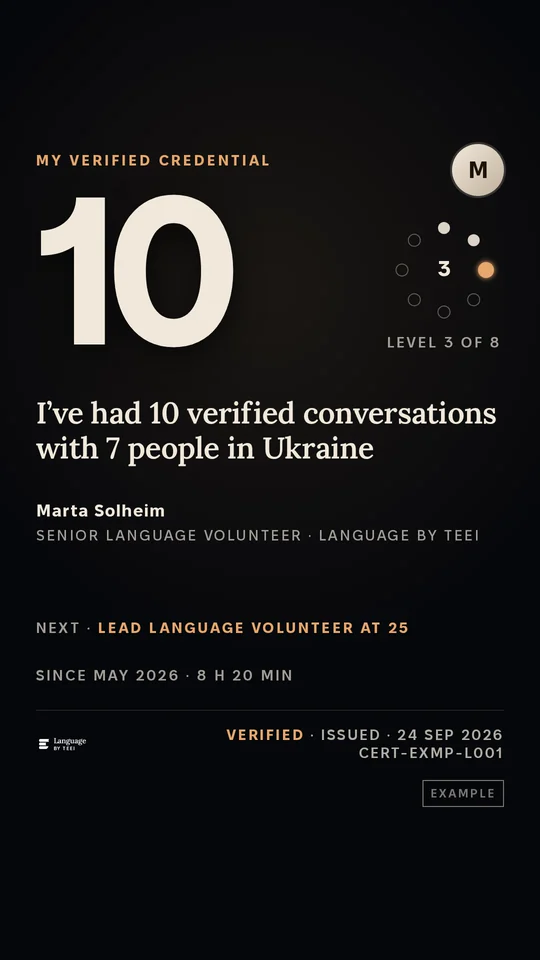
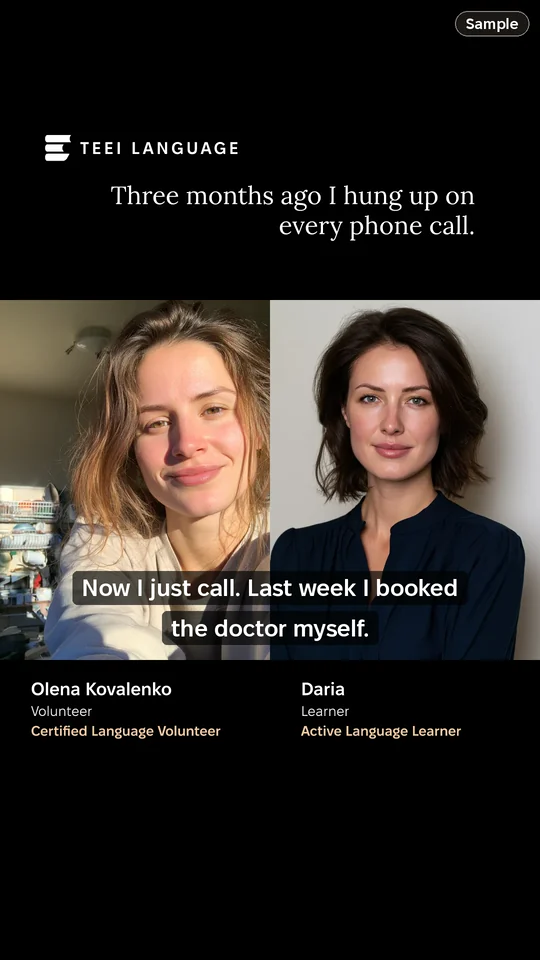
Instagram Story, as a follower sees it
People make this possible
Employees can contribute their time through TEEI programmes.
From the session record
Shared attendance is settled before the contribution reaches company reporting.
The company connection
Company records cover the contributions of associated employees.
Volunteer CommunityVolunteers share their experience in a community of their own.Free to take part. Each programme explains who it is for.
Self-paced resources
Courses, learning resources and certificates.
Ideas to work withSelf-paced resources and live learning can be combined in the way that helps you.

Courses, learning resources and certificates.
Ideas to work with Live learning
Workshop · Clinic · Expert Q&A · Webinar · Class
Bring your questions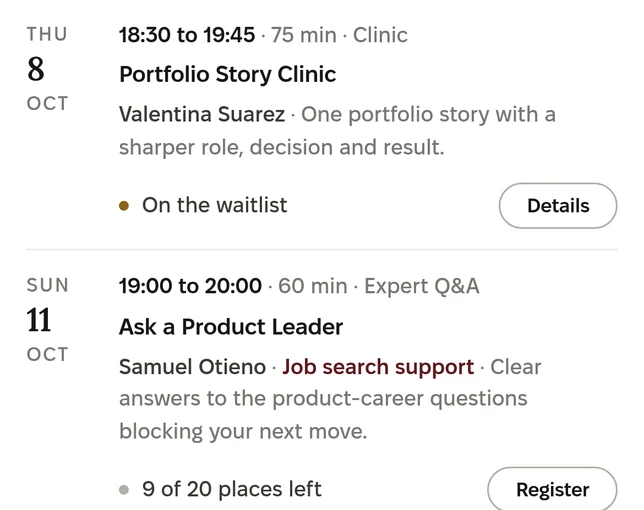
Use a task or a small project to work with what you have learned.
Put it into practiceProduct screens and illustrated example · sample data
Credentials
A class runs two to six sessions with the same group. When the teaching team confirms the completion, TEEI issues the certificate, with a badge and a LinkedIn entry under Licenses & certifications.
People make this possible
A practitioner teaches through Skills Academy. The associated company can see that contribution in Evenhall.
TeachingCompany record
Hannah Walsh Sales Manager
One session, Tue 6 Oct✓ Verified
1.00hour
Volunteer CommunityVolunteers share their experience in a community of their own.Free to take part. Each programme explains who it is for.
One possible career question
Your CV. An interview. A change of direction.
Work it through togetherChoose the support relevant to you. There is no fixed sequence or promised job outcome.
 TomasMentor · speaking

Meet a mentor with relevant experience and decide what to work on.
Language + Skills
Use language practice or Skills Academy where it helps your goal.
Illustrated demo
Credentials
Level 2 of 8Career Fellow · 6 verified mentoring sessions
Each level gives a badge and a LinkedIn entry under Licenses & certifications, with TEEI as the issuer, and a public page anyone can check by its code.
Story cards and story videos
A story video is recorded in the app on your own, or together with your mentor or mentee during a session in TEEI’s video room. The TEEI mark, the sentence you chose, and each person’s name and role are set into the file itself.
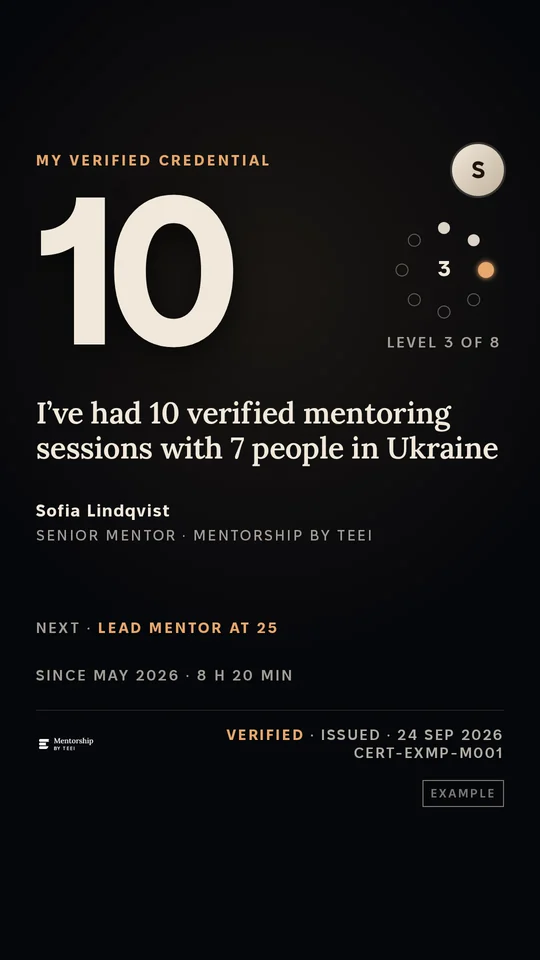
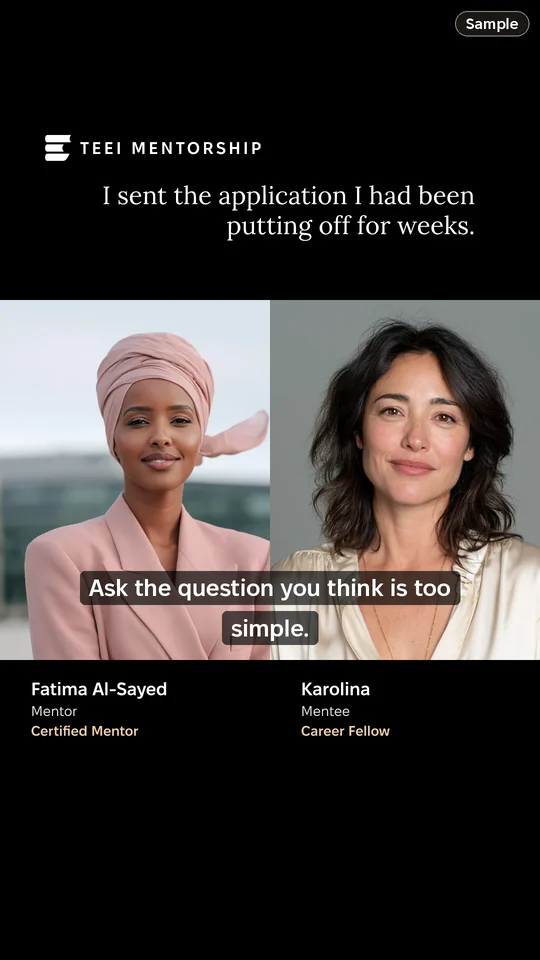
LinkedIn post, dark mode
People make this possible
Employees can contribute their time through TEEI programmes.
From the session record
Shared attendance is settled from the session record, separately from any career outcome.
The company connection
Company records cover the contributions of associated employees.
Volunteer CommunityVolunteers share their experience in a community of their own.Free to take part. Each programme explains who it is for.
Try it. You can open the rooms yourself. TEEI’s test room opens every room in its roles with one press, signed in as one of the demo personas: the sample learners, volunteers and hosts from TEEI’s public tours. It runs in a test environment with its own database, so no participant’s data is in it. Open a Skills Academy class as a participant or as its host, a webinar as a listener, an Expert Q&A, a TEEI Language conversation as the learner or a mentoring session as the mentee. The test room’s own page lists every room, with the code behind each.
The research behind the AI side, and the measure TEEI calls the crutch gap, has an article of its own: Can AI help people learn without making them dependent on it?
The Skills Academy page puts it in one line: “Everything in Skills Academy is professional learning, with AI in every field of it.”
Fifteen fields. The Skills Academy skills taxonomy has fifteen fields and 663 concepts. The fields are career development; HR and recruitment; leadership and management; project and programme management; product and design; AI and data; software and cloud; marketing and communications; finance and business; law and compliance; education and facilitation; languages and intercultural communication; sales and customer service; digital and office tools; and personal effectiveness. The same concepts connect a class to the mentors who work in that skill, so a participant can go from one to the other.
AI as a field. AI and data runs from AI foundations and prompt practice to responsible AI, and it goes in three directions. Each one ends in work a person can look at.
| Direction | What a participant makes |
|---|---|
| AI at work and in a profession | A briefing with its sources checked, a spreadsheet analysis or a campaign brief, made with AI and checked by the person who will put their name to it |
| Data and automation | A workflow that sorts incoming enquiries, sends the uncertain ones to a person for review, and is tested on a case where it fails |
| AI application development | A small document assistant with retrieval, source references, evaluation cases, error handling and a limit on what it may cost |
AI in every other field. In the other fourteen fields, AI is part of how people learn and of how their work is read. A participant in finance checks a budget with it, a recruiter drafts a job description and then tests it against the role, a marketer asks it to argue against a campaign brief. Their submitted work gets AI first feedback, and a person on the class team reads it before any score counts. The engine chapter explains how.
When AI is allowed. One rule decides it. When using AI well is the skill being learned, the AI tool is allowed in the assessment. When the assessment is of understanding without help, it is not. The rule plays out differently in different kinds of learning. In AI literacy, using the tool well is the skill, so the tool is open throughout. In AI at work, the tool is open for the task, and the question afterwards is what the participant understood of the result they put their name to. In agent development, the agent is the work, and the participant explains what it does and where it fails. In a professional skill such as finance, recruitment or marketing, the instructor decides for each task, because a budget checked with AI and a budget checked without it teach different things. The rule comes from the evidence: open access to a strong model can raise practice scores and lower what people can do once it is gone. How much of a skill survives without the tool is the question our research article sets out, with the studies behind it and the measure TEEI calls the crutch gap.
What is on. On 1 November 2026 the public programme listed four upcoming sessions. One is about working with AI, and three are in other fields:
A focus of their own. On their profile, participants choose what they want Skills Academy sessions to help them with. Sessions that match come first and are marked for them.
The AI side of Skills Academy is built from two things: the AI training that the providers publish openly or give free, and what TEEI puts around it. The providers publish the courses. TEEI puts four things beside them, and they combine as the learning needs: a live session with a professional, a task in the participant’s own field that a person reads, a mentor who works in that skill, and a study room shared with the others on the same course. One person takes a course alone. Another takes it in the study room, with people who are on it at the same time. A third takes it with a professional, in a class with a task each week. A path for a group combines several of the parts, and an organisation can ask for the one its people need.
What the providers publish, and how it is used.
| Provider resource | What it is | How a participant uses it | What TEEI puts around it |
|---|---|---|---|
| DataCamp: Generative AI Concepts, Understanding ChatGPT, Understanding Machine Learning, and the data courses | Interactive courses with exercises in the browser. The licences come to TEEI learners through DataCamp Donates: 2,933 allocated by 8 October 2026. | Requests DataCamp from Learning resources with one tap and takes the course between live sessions. | The DataCamp study room, a workshop on the same subject, and a task that AI reads first and a person reviews. |
| Google AI Essentials and Google Prompting Essentials | Google’s courses on working with AI tools, on Coursera, where TEEI learners hold Grow with Google scholarships: 449 had joined by 1 November 2026. | Requests Google Career Certificates from Learning resources and takes the course on Coursera. | The Coursera study room, a clinic on the participant’s own prompts, and the Gemini Notebook workshop on 17 November. |
| Anthropic’s AI Fluency course | A framework in four parts, delegation, description, discernment and diligence, by Rick Dakan, Joseph Feller and Anthropic, published under CC BY-NC-SA 4.0. Its badge is Anthropic’s own. | Follows the course on Anthropic’s site, and works through the four parts on a task from their own field in class. | A class taught from the framework in free sessions, with its authors credited and TEEI’s adaptations shared under the same licence. The task, the reading and the certificate are TEEI’s. |
| OpenAI Academy | Free courses and live events, open with a ChatGPT account. A badge follows a test, and OpenAI’s own words are that it is not a certification. The content stays on OpenAI’s site. | Follows the course on OpenAI’s site, linked from the path. | A live session that practises the same skills on a task from the participant’s field, read by a person. |
| Microsoft’s open courses: Generative AI for Beginners (21 lessons), AI Agents for Beginners (18 lessons), and the beginners’ courses in machine learning, data science and MCP | Open courses under the MIT licence, with Ukrainian and Norwegian among the translations, and links back to Microsoft Learn. | Takes the lessons as the reading for a weekly class. | A weekly class with a task each week, taught from the lessons with Microsoft credited, in the instructor’s language. |
| AWS Skill Builder and AWS Skills Centers | Free courses on cloud and AI on Skill Builder. AWS Skills Centers runs a cloud fundamentals programme for groups of twenty or more adults from a nonprofit, taught by an AWS instructor. | Follows a Skill Builder course from the path. A group of twenty can ask for the Skills Centers programme. | The AI application direction: a small document assistant on Amazon Bedrock, with sources and a cost limit, built in a class. |
| Hugging Face Agents Course | A free course on building agents, under the Apache 2.0 licence, with Hugging Face’s own certificate of completion. | Takes the course as the reading and builds the agent in a class. | A class with a task each week, and a person who reads the work. |

Two kinds of record. A provider’s badge or certificate is the provider’s. The TEEI certificate is for the class a person attended and the work a person reviewed, and it is the one anyone can check on TEEI’s domain and add to LinkedIn with TEEI as the issuer. The credentials chapter shows the whole chain.
Who the providers are to TEEI. DataCamp’s licences come through DataCamp Donates, and the Google certificates come as Grow with Google scholarships on Coursera. The other resources are published openly or given free, and TEEI uses them as their licences allow, with credit. When the people who build a tool teach it themselves, they come in as instructors, through the companies chapter.
Beside every course. Whatever the course, the same four parts are there to combine. A live session with a professional, in a TEEI room. A task in the participant’s own field, scored by the participant first, read by AI under the quote rule, and reviewed by a person. A mentor from the directory who works in that skill. A study room shared with the others on the same course. Nobody has to take all four: a participant who wants the course on its own takes the course, and a class that wants a task each week gets one. The engine chapter shows how the reading works.
A participant’s week in Skills Academy starts on My Academy, the home page that shows what they have booked and what they have been invited to. The menu has five places: Home, Notifications, Discover, Your plan and Messages.
Finding a session. Discover shows the coming days as a strip, with the sessions of the chosen day listed below. Search takes a topic or an outcome. A filter sheet narrows the list by focus, by when the session is, by commitment (one session or a series) and by the language it is spoken in. A session page says who teaches it, in which format and language, for how long, how many places are left, and what participants will leave with.
Five formats. Every format is one live session online, except the weekly class.
| Format | What happens | Group | Task |
|---|---|---|---|
| Workshop | Guided practice with exercises and something to take away | 2 to 12 | Can have one |
| Clinic | People bring what they are working on, and the instructor helps them with it | 2 to 20 | Can have one |
| Expert Q&A | An expert answers the questions the group brings | 2 to 50 | None |
| Webinar | A talk, then questions | 2 to 50 | None |
| Class | Meets weekly for 2 to 6 weeks, with a task each week | 2 to 50 | Each week |
The group sizes are the limits an instructor chooses within. A workshop stays small enough for everyone to practise. An expert Q&A can take a larger room, because the work is asking.

Registering. A participant registers with one tap. When a session is full, they can join the waiting list, and when a place opens, the first person on the list gets it and is told. If the instructor moves or cancels a session, everyone registered hears about it, with the instructor’s reason. An hour before a session, each participant gets a reminder. Once a week, a digest lists what is coming.
Your plan. Your plan lists the sessions a participant registered for, the meetings of their classes and the deadlines of their tasks, in date order. A whole class goes into their own calendar with one file.
Before, during and after. Before a session, the participant picks what they want from it, from six goals. The instructor sees how many chose each goal, never who. Afterwards the participant is asked whether it happened: yes, partly or no. Once attendance is counted, the instructor writes a recap for the people who came, with what they covered and one thing to try next, and it appears on the session page under “After the session”. Every session and every class has a group chat in Messages, so the conversation carries on between meetings.
A class from week to week. A class has its own page with every meeting, the agenda for each one, the readings and the task for the week. The participant hands in an answer, a link or files, and scores their own work first against the class criteria. Then come AI first feedback and a review from a person on the class team. The participant completes the class when they have attended and the instructor or an assistant has approved their work. The certificate follows.

Where it leads. After a class, a participant can go straight to the mentor directory, filtered to mentors who work in the skill that was taught. A participant whose next barrier is the language can book a TEEI Language conversation about the same work. Every session has a public page at its own address, with a card for sharing, so a participant can invite a friend or a colleague.
Asking for a class. When the class someone needs does not exist, they can ask for it at Request a class. They need no account: they confirm the request by email, and TEEI finds a volunteer instructor to teach it.
Every live session happens in a TEEI room. The rooms run on Amazon Chime SDK, reached through a signed bridge from TEEI’s platform, and they are the same rooms TEEI Language and TEEI Mentorship use for conversations and groups.
Who is in the room. The instructor hosts. Before the room opens, participants wait in a waiting room, where they set up their camera and microphone. Nobody sees or hears them before the host lets them in. Participants join muted and unmute when they want to speak. In a session built around a talk, they listen and can raise a hand, and the host can invite them to speak. A dropped connection reconnects on its own, and when the session is over, the host ends it for everyone.
Attendance from the room. Attendance is counted from time in the room, not from a tick on a list. A participant’s attendance at a session that has just ended shows as being calculated, not as absent, until the room events are settled. An instructor’s teaching time is the measured time in the room, capped at the scheduled length of the session. Anyone in a room can report abuse from inside it.
How much the rooms are used. Between 1 July and 31 October 2026, AWS measured 184,131 participant minutes in TEEI’s rooms across all its programmes. Verified volunteer hours are counted from the same room events: How TEEI Turns Amazon Chime SDK Events into Verified Hours shows how a room event becomes a verified hour, and What TEEI Runs on AWS shows the rest of the infrastructure. How TEEI Runs Its Platforms on Cloudflare Workers shows the platform the rooms are reached from.
Open a room yourself. TEEI’s test room opens every room in its roles with one press, signed in as a demo persona, in a test environment with its own database: a Skills Academy class as a participant, as its host, a webinar or an Expert Q&A.

Live sessions are a few hours a week. The learning between them happens on DataCamp and Coursera, in courses TEEI learners receive free.
DataCamp. Through DataCamp Donates, TEEI learners study data, programming and AI on DataCamp. By 8 October 2026, DataCamp had allocated 2,933 licences to TEEI learners, and 2,300 of them had been started. Counted from DataCamp’s daily data on 1 November 2026, TEEI learners had spent 78,942 hours on the DataCamp platform and completed 271,611 learning units and 16,259 courses, and 2,434 people had recorded learning time. The AI courses include Generative AI Concepts, Understanding ChatGPT and Understanding Machine Learning. A participant requests DataCamp from Learning resources with one tap. How TEEI Connects DataCamp Learning with Live Teaching explains how the courses and the live sessions fit together, and DataCamp in TEEI’s Programmes: A Thank You tells the story of the partnership.
Google Career Certificates on Coursera. Google Career Certificates reach TEEI learners as scholarships through Grow with Google, on Coursera. Google AI Essentials and Google Prompting Essentials are among the courses. By 1 November 2026, 449 people had joined, 284 had started a course and 93 had completed at least one, with 402 courses completed in all. These are course figures, as Coursera counts them.
Study rooms. So that no one has to study alone, Skills Academy has study rooms. They are part of the shared rooms in Messages, beside the community rooms for the social club and for volunteers, and today there are two of them: participants who have requested DataCamp share the DataCamp room, and those who have requested Google Career Certificates share the Coursera room. A room for another course or another learning community is built on the same room. In a room they write in the chat, use Find a time to agree a study session with a poll, or press Study now to be matched with someone who wants to study at the same moment, for 30, 45, 60 or 90 minutes. Planned study sessions appear for everyone in the room. Each room belongs to the members who requested that learning.
Kept apart. A DataCamp course completion and a Google Career Certificate are the provider’s records. A TEEI class certificate is TEEI’s record of a class a person attended and work a person reviewed. Course completion, a provider’s certificate and a piece of work TEEI has reviewed are three separate records, shown side by side. What a Course Certificate Shows, and What It Doesn’t goes into the difference.


Skills Academy is one of three TEEI programmes on one account. In the same weeks as a class, a participant can practise the language of the same work in TEEI Language and work with a mentor from the same field in TEEI Mentorship. She can take one, two or all three, in any order, and each keeps its own record.
Why they belong side by side. A skill gets someone a job when they can show it, explain it in the language of the workplace and reach the people who hire for it. A class builds the skill and the certificate that shows it. The other two programmes carry it the rest of the way.
The language of the work. An analyst who can build the dashboard still has to present it in an interview, in the language of the country she now lives in. In TEEI Language she books a one-to-one conversation with a volunteer about the same work, and writes what she wants to practise when she books: explaining an analysis, answering the questions an interviewer asks.

Between conversations, Practice Companion lets her rehearse a short job interview with a voice on the other end, and a line she keeps can travel into her next conversation. How Learners Get Sentence Feedback in Practice Companion shows how it corrects one sentence at a time, Inside Practice Companion: Rooms, Evidence and Level how it reads a level from her own answers, and AI Writing-Level Estimate: What TEEI Tested and Learned which AI models TEEI tested for that level.

Language carries much of the weight. In a study of refugees assigned to Swiss cantons on either side of the language border, speaking the local language more than doubled employment in the first five years (Schmid, American Economic Review: Insights, 2023). TEEI Language runs in twelve languages.
A person in the field. Research on mentoring separates role models, advisers, coaches, sponsors, introductions and practical help with a job search, and finds that the last three drive employment effects. TEEI Mentorship is built around them. A mentor who works in the skill reviews her CV, practises interviews with her, plans the job search and knows what employers in that field look for. In a field experiment in Munich, an NGO that found suitable vacancies and sent refugees’ CVs to employers raised employment after twelve months, most among those with the least formal education (Battisti, Giesing and Laurentsyeva, Labour Economics, 2019).


How the three connect.


The people who give their time move too. The same person can teach in Skills Academy and mentor in TEEI Mentorship. A conversation partner can apply to teach from inside TEEI Language. A company’s employees can do all three, and their verified hours reach Evenhall from every programme.
An example. This one is illustrative. Olena takes the class Data storytelling with spreadsheets, which meets weekly for three weeks. In the same weeks she books two conversations in TEEI Language about presenting an analysis in English. After the last meeting she opens the mentor directory filtered to data analysis and books a mentor who reviews her CV and prepares her for an interview. The class gives her a certificate an employer can check. The conversations give her the words for her work. The mentor gives her the route to the people who hire for it.
The people who teach in Skills Academy do the work they teach. They are recruiters, analysts, accountants, product managers, engineers and marketers, giving an hour of their own field to people moving into it. Some come on their own. Others come through their company, which sends employees to teach. Those who apply on their own are approved by TEEI before their first class. An AI model reads each application first and returns a verdict, and instructors and mentors always go to a person at TEEI, whatever that verdict says. A colleague a company sends creates and holds classes without manual approval. What they teach is open: their own skills, or how they use them at work.
Joining. An instructor applies through Teach on Skills Academy, or follows a personal invitation link from TEEI. Their profile says what they do, what they teach and which languages they teach in.
Publishing in three steps. The instructor publishes a session themselves, in three steps. First comes what it is: the format, the title, what participants will leave with, what the group will work on and anything to prepare. Then comes when and how many: the date and time, shown in participants’ own time zones, every weekly meeting of a class, and the number of places. Last comes who it is for. A preview shows how participants will see it. An instructor teaching for their organisation chooses it when publishing, and the class then carries the organisation’s name. A second instructor can be added: they get a request in the app, the session is published when they accept, and the time is then reserved in their calendar too. Assistants can help with the class work.
The class desk. Each class has a desk for its team. It shows the participants, attendance for every meeting, the work handed in and who has completed. The instructor sets the agenda and the task for each meeting and adds readings. Once a session is published, its result, shape, day, time and places are locked, so participants can rely on what they registered for. “Change time” moves a session, and cancelling it asks for a reason; everyone registered is told, with the reason. The desk’s page called First readings shows the AI first feedback and the classmates’ reviews beside the instructor’s own scores, with how far each reading sits from theirs. It has no threshold, no verdict and no total: it helps the team see where the AI and the classmates read the work differently.
Teach again. When a session is over, Teach again repeats it with one tap, so an instructor who taught once can teach the same thing next month without starting from the beginning. Two instructors from the same company can teach a class together.
A page that can be shared. Every published session has a public page at its own address, with a card that shows the title, the instructor and the date when the link is shared. The instructor can also tick one box when publishing: “Post it as an event on TEEI’s LinkedIn page”. The credentials chapter explains what happens then.
What the instructor receives. Each instructor receives a Teaching Contribution credential for the sessions they taught, with the meetings taught, their role in each and the recorded teaching time. It is a TEEI credential like the class certificate, and it goes to LinkedIn the same way.


How Corporate Volunteering Works at TEEI and TEEI Pathways: A Better Way to Meet People, Learn and Contribute describe the other ways volunteers contribute.
A certificate is only worth what someone else can check. Skills Academy issues its own credentials, puts a public check page behind each of them, and connects them to LinkedIn, where employers and colleagues already look.
Two credentials. TEEI issues two credentials in Skills Academy. A participant receives a class certificate when the class team confirms they completed a class: they attended, and the instructor or an assistant approved their work. An instructor receives a Teaching Contribution credential, “Teaching Contribution · TEEI Skills Academy”, for the meetings they taught. Both are issued by TEEI and appear on the person’s Certification page.
Credentials
A class runs two to six sessions with the same group. When the teaching team confirms the completion, TEEI issues the certificate, with a badge and a LinkedIn entry under Licenses & certifications.
What a certificate shows. A class certificate names the class, the person, the date and the certificate code. When the provider has said yes, it carries the line “Class provided by” with the provider’s name and logo. When the instructors have agreed, it carries “Taught by” with their names. Each instructor decides that for themselves, and the setting says exactly where the name will appear: “When this is on, learners who complete a class you taught see your name, as “Taught by”, in four places: their certificate (in Skills Academy and on its public check page), the printed certificate, the share image, and the suggested text for a LinkedIn post, which they can change before they post it.” Each certificate also carries a QR code that opens its check page.
Three forms. The certificate exists as a badge in three sizes, as a share image sized for LinkedIn at 1200 by 627 pixels, and as an A4 page to print. The participant downloads the PDF or the image from Certification.
Checking it. Every TEEI certificate has a public page at theeducationalequalityinstitute.. It opens without an account and answers one of four things: valid, revoked, expired or not found. An employer who sees the certificate on LinkedIn, on paper or in an application can scan the QR code or type the code and see TEEI’s answer. The check page also has a card of its own, so a link to it shows the certificate when shared.
Adding it to LinkedIn. From Certification, the participant presses Add to LinkedIn. LinkedIn opens the Licenses & certifications form on their profile, already filled in: the name of the credential, TEEI’s official LinkedIn page as the issuing organisation, the month and year it was issued, the expiry date when there is one, the credential ID and the address of the check page. They save it on LinkedIn, and the credential appears on their profile with TEEI’s logo. Anyone who opens it lands on TEEI’s check page.


LinkedIn · Licences & certifications
Posting it. Post on LinkedIn opens a post with the share image and suggested text, which the participant can change before posting. When the instructors have agreed, the text names them. When the provider has agreed, it names the company that provided the class. The certificate also arrives by email.
Story cards and story videos
After a conversation, a card is ready in the app: a line on the map from your city to your partner’s, how many conversations you’ve had, or a sentence in your own words. You can also record a story video in the app, on your own or together during a session in TEEI’s video room.
Instagram Story, as a follower sees it
A statement of hours. Volunteers, instructors among them, can download a statement of their verified hours from Certification. Each statement has a public link, so a university, an employer or a funder can open the same figures the volunteer sees. How TEEI Counts a Verified Volunteer Hour explains what counts, and From a Verified Hour to a Report You Can File follows an hour into a company report.

The public profile. A volunteer can turn on a public profile. It opens without signing in, at its own address, under the heading “Public volunteer profile”. It shows their roles (conversation partner, mentor or Skills Academy instructor), when they started volunteering, the languages they speak, their TEEI certification, and a link inviting others to “Teach on Skills Academy”. The volunteer decides whether their photo appears. The foot of the page says: “Volunteering with TEEI. This page contains the information this volunteer chose to share publicly.” When the profile is on, the settings page tells them: “Anyone with this link can open your public profile without signing in. You can add it to LinkedIn.” Reviews, contact details and bookings stay private.

Sessions on TEEI’s LinkedIn page. When an instructor ticks “Post it as an event on TEEI’s LinkedIn page”, TEEI’s page announces the session. Every five minutes, the platform compares each request with the session’s public page. It creates a LinkedIn event and a post for a new session, updates the event when the session moves, and takes the event down when the session is no longer public. A session starting within five minutes is skipped. A weekly class goes on LinkedIn with its first meeting. A model writes each class post once, from the facts of the session, and the text is then fixed; if the model fails three times, a template writes it instead. Consent is read again before every call to LinkedIn: a post that names a person who has since been erased, or a company that has since said no, is taken down. When a session has a co-host, the event is requested only after the co-host has said yes.

One LinkedIn page. Everything goes through TEEI’s official LinkedIn page. Skills Academy has no separate page. Credentials, events and posts all point to the same organisation, so that a person’s credential, the session they took and the organisation that issued it can be found together.
Why it matters to each person. For a participant, the certificate is evidence for an application: a class with a named provider and a named instructor, and a check page an employer can open. For an instructor, the Teaching Contribution and the “Taught by” line are a public record of teaching they can show their own employer. For a company, “Class provided by” puts its name on the work its people did, in the place where its future employees and customers look.
A company’s people know things TEEI’s learners need to learn, and teaching them is good work for the people who do it. Skills Academy gives a company four ways to take part. All four are free.
Four ways.
| Way | What the company does | What it sees |
|---|---|---|
| Employee volunteering | Its employees teach in their own field, mentor, or give conversations in TEEI Language | Verified hours in Evenhall |
| Teaching as development | It treats teaching as professional development for its people, who plan a session, teach it to a real group and receive a credential for it | Teaching Contribution credentials and verified hours |
| Product taught by builders | The people who build its product teach the skills behind it | Its name on the class and the certificate |
| AI and digital skills | It runs a series in AI and digital skills for TEEI’s learners or for a community it works with, taught by its people | Attendance, completion and verified hours |
Product taught by builders. TEEI’s own words for this are: “your product, taught by the people who build it. Hands-on use is teaching; a sales pitch is not.” A company that builds a coding agent, a cloud platform or a productivity tool has people who know the craft behind it: how to plan work for an agent and review what it returns, how to go from an idea to a working tool, how to know when not to use AI. Those are skills TEEI’s learners need for work, whatever tool they end up using. The provider is named on the session and on the certificate. The session is about learning, not selling. Participants’ details are not passed to the company that teaches.
Classes a company could teach. These are examples of classes a technology company’s people could teach, and an open invitation to each of them.
| Example company | A class its people could teach |
|---|---|
| OpenAI | Planning a task for Codex and reviewing the change it proposes |
| Anthropic | Writing a brief for Claude Code and checking its work before it is merged |
| Microsoft | Using GitHub Copilot in a real repository, and reading what it suggests |
| Building a personal study notebook with Gemini | |
| AWS | A small document assistant on Amazon Bedrock, with sources and a cost limit |
| Cloudflare | Putting a first small application online with Workers |
| Cursor | Running several coding agents in parallel and reviewing what each one changes |
| ElevenLabs | Giving an app a voice in the learner’s own language |
From proposal to published class. A company starts at Propose a class, under the heading “Propose a session your organisation can teach”. It chooses “I will teach it myself” or “Someone else from your organisation”, and describes the session. Sending needs an account. TEEI invites the instructor, and the page says what happens next: “Nothing is published until the instructor accepts.” The instructor accepts, the session is published with the company named, and when two people from the company teach it, both are on it. After the session, the instructors receive their Teaching Contribution credentials, participants who complete receive class certificates with “Class provided by”, and the session can go out as an event on TEEI’s LinkedIn page. A company can also ask for a private class for its own staff.
 Company proposes a classA company describes one session its people can teach, at Propose a class, and names who teaches it.
 Instructor invitedTEEI invites the instructor the company named. An instructor new to TEEI meets the people they will teach, then registers.
 Instructor acceptsNothing is published until the instructor accepts. A second instructor from the company accepts in the same way.Class publishedThe session is published with the company named on it, and participants register from Discover.Participants attendThe class meets in TEEI’s own video room, with host tools, conversation cards and raised hands.Work reviewedParticipants hand in work between meetings, and the instructor reviews it with a score and a comment.Credentials issuedParticipants who complete receive the class certificate with Class provided by. Instructors receive a Teaching Contribution.
 Teaching recorded in EvenhallThe hours arrive in the company’s Evenhall workspace overnight as verified hours, by named employee.
Evenhall. Evenhall is TEEI’s workspace for companies. A company opens a workspace, which TEEI approves, and invites its employees by email, through single sign-on, from its HR system or from a list. Employees have a page of their own in Evenhall, where they find Skills Academy, TEEI Language and TEEI Mentorship and join with their company. The hours they give in TEEI’s rooms arrive in Evenhall overnight as verified hours. A company’s CSR manager sees each named employee’s hours and session records. Employees never see each other’s records. Participants’ names stay out of the company’s reporting, and so does what was said in a session. The company sees the hours in views for ESRS S1, VSME, GRI and IFRS reporting, and AI drafts the text of a report, which a person at the company approves and which locks once approved. Evenhall is free: no licence fee, no setup fee, no limit on employees and no donation required, and a donation unlocks nothing. Why Our CSR Workspace Is Free, and How to Check It sets out what free covers. How Evenhall Drafts Company Reports with the Vercel AI SDK shows how a report is drafted, and the Evenhall demo shows a workspace with example data.
Your employees teach in Skills Academy, mentor professionals and help people practise a language. Evenhall brings their participation and reporting together.
Free for companies. No licence, setup or per-employee fees. No donation required.
Why it’s free: Software handles matching, scheduling, attendance verification and impact reporting. Volunteers contribute their time and expertise. In September 2026, the included AWS video and platform cost was just $0.78 per verified hour, calculated from actual AWS costs and measured session hours. See how we calculate the cost
TEEI is a registered US 501(c)(3) nonprofit.
Already using Evenhall? Sign in.
Have a community in mind?

Your expertise. TEEI’s programmes. One company workspace.

Share a practical skill or your company’s own tools. Workshops, clinics, expert Q&A, webinars and classes.

Guide a career decision, prepare for an interview or work through a professional question.
Explore mentoring
Help someone practise a language, one to one or in a small group.
Explore language
Contribute courses, learning materials or technology, or shape a programme with TEEI.
Explore partnershipsExplore the experience, from teaching to your company report.


Illustrative company data · Excerpts from Evenhall Open the Evenhall demo
On track. 58% of the annual goal reached, with 811 contributors active.
Horizon Technologies, demo company data
Choose a framework
A sustainability statement by standard: S1 own workforce and S3 affected communities, each disclosure with its method and the evidence behind the figure.
Read-only view, opens the public demo
The link opens the public Horizon Technologies demo: demo company data, no login.
From a class to the company’s report. A colleague teaches a Skills Academy workshop on a Tuesday evening. By the morning, the measured time in the room, capped at the scheduled length, is in the company’s Evenhall workspace as verified hours with the colleague’s name on it. Where nothing was measured, such as a host’s own time in a group session, Evenhall credits no hours rather than estimating them. The CSR manager sees the hours by programme and by day, no participant is named, and hours a volunteer entered by hand are listed apart and stay out of the total. At the end of the quarter the manager asks for a report, reads the draft, approves it, and it locks. The screens below are the demo workspace with sample data.
Attendance is recorded with each session you teach. Your company’s activity report shows the sessions you teach and the time you spend teaching online. Three things come from that record: your participants’ certificate, your own teaching certificate with the meetings you taught and your measured time, and the report.


What each team gets. Teaching does different work for different parts of a company. Developer relations reaches people who learn its tools properly, in a session with no sales pitch. Learning and development gets a real group, a plan and a credential for each person who teaches. The people who run volunteering get verified hours they can report. Each instructor gets public recognition for teaching: the “Taught by” line, a Teaching Contribution credential and a public profile they control.
Who does what. TEEI runs the programmes, reviews every employee’s profile before anyone can book them, runs the video room, counts the hours and looks after the participants. The company chooses the programmes, decides whom to invite, gives people room in the week, and reviews and approves the report. How Corporate Volunteering Works at TEEI sets out the split.
Many of the people Skills Academy serves first hear of it from an organisation they already trust: a community group, a university, a senior community or a local service. TEEI Network Partners is how those organisations work with TEEI’s programmes.
TEEI Network Partners
TEEI Network Partners are the institutions and organisations that work with TEEI. They share TEEI Language, Mentorship and Skills Academy with the people they know, and their own members teach, mentor and hold conversations. Registration takes minutes and needs no approval.
Register your organisation Already a Network Partner? Sign in
Where do you want to start?
TEEI Network Partners
Connect the people you support with language practice, professional mentoring and practical skills. Work with TEEI to extend your existing programmes, plan opportunities with other organisations or bring your own programme and expertise to new groups.
Your programme, with TEEI beside itSample
Start with TEEI’s existing programmes, which are free for participants.
Introduce suitable language practice, mentoring or skills opportunities alongside your existing services.
Help participants identify what comes next before a course or support programme finishes.
Connect participants with similar needs through a focused workshop, clinic or expert session.
A class for your own group: ask Skills Academy for a private class. You choose the topic, the format, the week and the size of the group.
Explore delivering a programme you already run to additional participants through collaboration.
We agree who teaches, how materials may be used and what support is needed. Your organisation retains ownership of its programme and helps shape how it reaches new groups.
Tell us about a need that current opportunities do not meet.
Imagine several organisations each supporting a few people who need the same help. Another organisation has a suitable short programme, a professional can lead the session, and each local team can help its own participants join. Working with TEEI, they could combine those contributions into a shared group that none would have arranged alone.
Send the message in the channels you already use. Everyone who registers through your link is credited to your organisation, programme by programme, and so are the sessions your own people give. The counts are in your workspace, under Through your link.
Your messageas received, in Ukrainian
Рекомендує · Ваша організація
Вітаю! Ділюся інформацією про можливість безкоштовно практикувати мову онлайн у TEEI Language.
TEEI LanguageПрактикуйте мову у відеорозмовах із волонтерами. Самостійно обирайте співрозмовника та зручний час серед доступних варіантів.
Перейти до TEEI LanguageМовна практика онлайнlanguage.theeducationalequalityinstitute.org14:02
Програми проводить неприбуткова організація The Educational Equality Institute (TEEI) в межах ініціативи «Разом для України» (Together for Ukraine). Участь безкоштовна для людей з України віком від 18 років – в Україні та за кордоном. Інтерфейси платформ доступні українською.
Your name on what you shareYour name and a few words of your own in every message, and your logo on the print sheets.
Ask for a private classTalk to the partnerships teamMore about working together
Network Workspace · AssistantSample
One message
Four tasks, four places
TEEI Network WorkspaceYour organisationSample
Getting started
Assistant · one conversation
ProgrammesTEEI Language and TEEI Mentorship marked for your participants. Check and save.
Contribute a classYour staff’s CV writing class, drafted from what you wrote. Check and send.
TeamInvitations for your two colleagues. Add their addresses and send.
ReportEmail me once, when there is something to show. Turned on when you confirm.
Through your link
From your people
2 conversation partners · 1 mentor · 1 teacher
Certificates
SampleEvery certificate has a code anyone can checkCERT-7K4M-2QXD
Your organisation’s certificateThe classes your people taught and the hours they gave, under your organisation’s name.
In your workspace
ProgrammesMark the programmes your participants take part in, each with a link for participants and one for your volunteers.
Sharing toolsThe messages, posters and PDFs you share, with your name, your logo and your own link.
Request a private classYou choose the topic, the format, the week and the size of the group.
Contribute a classA class your own people teach, drafted from one sentence. Check it, then send it.
ParticipantsOne row per person, with names when they agree. Download it as CSV.
ReportPrint it, save it as PDF or present it in a meeting.
Report studioChoose the blocks and the period, with participation programme by programme. Download PDF or CSV, or export the data package.
TeamInvite colleagues by email into the same workspace.
Profile & settingsYour name, a few words of your own and your logo, used in the messages, posters and PDFs you make in Sharing tools.
Counted per programme, as of today.
TEEI Network Partners
Your students, faculty, researchers and alumni teach, mentor, hold conversations and gain practical experience in TEEI’s learning community. TEEI provides the programmes, the assistant that coordinates, and the record of every hour.
Conversation partners, mentors and instructors. One-to-one conversations with TEEI learners, 30 to 60 minutes on video each week, online, when the student wants: international experience without travel, and every service-learning hour on a verified statement anyone can check, for a CV or LinkedIn.
Verified hours of teaching practice with TEEI learners, for education and TESOL students.
Teach live in Skills Academy, in your own field. A coordinator sets up your first session with you, and curriculum creators build the material the hours teach.
Teaching and mentoring are two roles: an instructor teaches a room, a mentor works one to one.
Student projects, theses and research on learning, learning technology, AI and evaluation, with TEEI’s programmes as the field. Each one starts as a conversation with the partnerships team.
Invite students and staff through your own link, propose teaching, and ask for a private class for your own group: you choose the topic, the format, the week and the size of the group. Follow it all in your workspace. Free classes and practical skills training for adults who are not your students, verified and public: the kind of evidence THE Impact Rankings ask for under SDG 4.
Alumni and retired staff: Senior communitiesLive teaching in five formats, each one given by a volunteer in their own field. A Class ends with a completion record, confirmed by the teaching team from the work handed in.
Beside it, for learners: the TEEI DataCamp Room, the Google Career Certificates room, and Mentorship one to one.

Service-learning hours
Sample14.0 verified
Statement anyone can check
Teach in Skills AcademyAsk for a private classService-learning hoursResearch and institutional collaboration
Network Workspace · AssistantSample
One message
Three tasks, three places
TEEI Network WorkspaceYour institutionSample
Getting started
Through your link
From your people
2 conversation partners · 1 mentor · 1 teacher
Certificates
SampleConfirmed by the teaching team from the work handed inCERT-3HWQ-9TZN
Your institution’s certificateThe classes your teachers taught and the hours your students gave, under your institution’s name.
In your workspace
ParticipantsOne row per person, with names when they agree. Download it as CSV.
ReportPrint it, save it as PDF or present it in a meeting.
TeamInvite colleagues by email into the same workspace.
Assistant · one conversation
Sharing toolsYour students’ link as volunteers in TEEI Language, with the message ready to paste.
Contribute a classYour lecturers’ class, drafted from what you wrote. Check and send.
Handed overYour research question goes to a person at TEEI, together with what you wrote.
Counted per programme, as of today.
TEEI Network Partners
Your members teach, mentor and hold conversations on video, 30 to 60 minutes at a time.
Speaking Café
Everyday Norwegian
Seats 4 of 6 · 2 still open
The assistant sets up your first café with you, and a person steps in whenever you want.
TEEI Language · TEEI assistantSample
Your group is up
Everyday Norwegian
TEEI Network WorkspaceYour communitySample
Getting started
A coordinator follows up after your first session
Assistant
Tell me what you want to get done.
Your next group
From your people
2 conversation partners · 1 mentor · 1 teacher
Certificates
SampleEvery certificate has a code anyone can checkCERT-5RJD-8VAP
Your community’s certificateThe cafés your members hosted and the hours they gave, under your community’s name.
Counted per programme, as of today.
Share TEEI with the people you reach
The message is ready to paste in Ukrainian, Spanish or Portuguese. QR codes and print sheets are in the full sharing kit. Register your organisation to get your own links in the kit, so registrations through those links are attributed to your organisation.
Вітаю! Ділюся інформацією про три безкоштовні можливості від TEEI: мовну практику, підтримку ментора та курси. Оберіть те, що вам зараз потрібно.

TEEI Language
Практикуйте мову у відеорозмовах із волонтерами. Самостійно обирайте співрозмовника та зручний час серед доступних варіантів.
Перейти до TEEI Language: https://language.theeducationalequalityinstitute.org/signup?role=learner&lang=uk

TEEI Mentorship
Попрацюйте над резюме, підготуйтеся до співбесіди або обговоріть із ментором свої професійні цілі та подальші кроки.
Перейти до TEEI Mentorship: https://mentorship.theeducationalequalityinstitute.org/signup?role=learner&lang=uk

TEEI Skills Academy
Розвивайте навички на курсах DataCamp, у програмах Google Career Certificates на Coursera та на онлайн-заняттях наживо. Обирайте навчання відповідно до своїх цілей.
Перейти до TEEI Skills Academy: https://skills.theeducationalequalityinstitute.org/signup?role=learner&next=%2Fskills-academy&lang=uk

Програми проводить неприбуткова організація The Educational Equality Institute (TEEI) в межах ініціативи «Разом для України» (Together for Ukraine). Участь безкоштовна для людей з України віком від 18 років – в Україні та за кордоном. Інтерфейси платформ доступні українською.¡Hola! Te comparto tres programas gratuitos de TEEI para practicar idiomas, recibir mentoría y aprender nuevas habilidades. Elige lo que te interese.
TEEI Language
Practica un idioma en conversaciones en línea con una persona voluntaria. Elige con quién conversar y el horario que más te convenga entre los disponibles.
Abrir TEEI Language: https://language.theeducationalequalityinstitute.org/signup?role=learner&lang=es
TEEI Mentorship
Trabaja en tu CV, prepárate para una entrevista o conversa sobre tu próximo paso profesional con una mentora o un mentor.
Abrir TEEI Mentorship: https://mentorship.theeducationalequalityinstitute.org/signup?role=learner&lang=es
TEEI Skills Academy
Desarrolla habilidades con cursos de DataCamp y Coursera y sesiones en vivo. Elige lo que quieres aprender.
Abrir TEEI Skills Academy: https://skills.theeducationalequalityinstitute.org/signup?role=learner&next=%2Fskills-academy&lang=es
TEEI, una organización sin fines de lucro, ofrece estos programas gratis a mujeres de América Latina y el Caribe de 18 años o más, vivan donde vivan.Olá! Quero compartilhar com você três oportunidades gratuitas da TEEI: prática de idiomas, mentoria de carreira e cursos. Escolha o que faz sentido e esteja alinhado com os seus objetivos.
TEEI Language
Pratique um idioma em conversas por vídeo com uma pessoa voluntária. Escolha com quem conversar.
Acessar TEEI Language: https://language.theeducationalequalityinstitute.org/signup?role=learner&lang=pt
TEEI Mentorship
Aprimore seu currículo, prepare-se para uma entrevista ou planeje o próximo passo na carreira com um/a mentor/a voluntário/a.
Acessar TEEI Mentorship: https://mentorship.theeducationalequalityinstitute.org/signup?role=learner&lang=pt
TEEI Skills Academy
Desenvolva habilidades com cursos da DataCamp, certificados profissionais do Google na plataforma Coursera e aulas ao vivo.
Acessar TEEI Skills Academy: https://skills.theeducationalequalityinstitute.org/signup?role=learner&next=%2Fskills-academy&lang=pt
A organização sem fins lucrativos The Educational Equality Institute (TEEI) oferece esses programas gratuitamente a mulheres da América Latina e Caribe a partir de 18 anos, onde quer que morem hoje.TEEI Language: https://language.theeducationalequalityinstitute.org/signup?role=learner&lang=uk TEEI Mentorship: https://mentorship.theeducationalequalityinstitute.org/signup?role=learner&lang=uk TEEI Skills Academy: https://skills.theeducationalequalityinstitute.org/signup?role=learner&next=%2Fskills-academy&lang=uk
TEEI Language: https://language.theeducationalequalityinstitute.org/signup?role=learner&lang=es
TEEI Mentorship: https://mentorship.theeducationalequalityinstitute.org/signup?role=learner&lang=es
TEEI Skills Academy: https://skills.theeducationalequalityinstitute.org/signup?role=learner&next=%2Fskills-academy&lang=es
TEEI Language: https://language.theeducationalequalityinstitute.org/signup?role=learner&lang=pt
TEEI Mentorship: https://mentorship.theeducationalequalityinstitute.org/signup?role=learner&lang=pt
TEEI Skills Academy: https://skills.theeducationalequalityinstitute.org/signup?role=learner&next=%2Fskills-academy&lang=pt
Share. An organisation can share Skills Academy, TEEI Language and TEEI Mentorship with the people it reaches, with no registration needed for sharing. A code in the link records that the organisation made the introduction.
Contribute. It can contribute its own people as conversation partners, mentors, instructors or group hosts. Free opportunities are open to every organisation’s community, whether or not it contributes anyone.
Request a class. It can ask for a private class for its own group, in any of the five formats, and TEEI reviews the request and finds the instructor. This is the route for an organisation that has a need and no one to teach it.
Offer a class. It can offer a class taught by its own staff, through the same proposal as a company. This is the route for an organisation that has someone with something to teach.
Network Workspace. Each partner has a workspace at Evenhall, where it can, in the workspace’s own words, “Share TEEI programmes with your community, follow participation, contribute teachers, mentors and volunteers, and request classes.” It has a getting started page, its programmes, its team, its requests and contributions, its participants with an export, a report it can print and its sharing tools. Network Workspace is part of Evenhall, on the same platform and the same record of verified hours as a company’s workspace.
Network Assistant. The workspace has an assistant that works inside the product. A coordinator tells it what the organisation is trying to make possible, and it opens programmes, prepares class requests and contributions, fills in forms and saves drafts. The model proposes and the application decides: before every action, the application checks identity, organisation, permissions and state, just as it does for a button.
Attribution without exposure. An organisation sees that its introduction led to participation, and in which programme. Names appear only under each participant’s own sharing choices. Registrations, bookings, attendance, completed activities and recorded hours stay distinct, and people and activities are counted separately. The live page says what the arrangement is: “You share the offer. TEEI runs the platforms and looks after the programmes.”

Inside TEEI Network Partners: From Community Reach to Real Participation goes through the programme in full.
Skills Academy also teaches the organisations around the people it serves: the staff and volunteers of a Network Partner, learning the work of running it. The track starts from eight areas of documented need:
Each course is built around the organisation’s own work. It can combine structured learning, a live workshop, a clinic on the organisation’s own case, a mentor, a professional from Evenhall, a template or a workflow put into use, and follow-up once it is in use.
An example. An illustration of how the track works. A coordinator at a small organisation writes to the Network Assistant: “We want to use AI and need a place to start.” The assistant asks what work repeats every week, which tools the organisation already uses and who will own the result. The coordinator answers that three volunteers answer the same questions from families by email. The assistant proposes a route, and the coordinator confirms it. The coordinator joins a workshop on AI at work. A clinic built on the organisation’s own emails follows, with an instructor from a technology company. An AI specialist from Evenhall then sets up one workflow that drafts answers to common questions for a volunteer to check, and a mentor stays with the coordinator for the next two months.
Four records stay apart. The workshop, the clinic and the specialist’s hours are activity. The workflow and its instructions are output. The volunteers using it every week is adoption. The outcome is measured with comparable evidence, such as the time the answers took before and after.
A neutral classroom for AI training. AI companies train nonprofits to use AI, and Skills Academy is built to be a neutral classroom for that training. An AI company can bring its courses into it as short live sessions, with attendance and a certificate, taught by its own people, who come through Evenhall as other employees do. The rule from the companies chapter applies: the provider is named, the session is about learning, and participants’ details are not passed to the company that teaches.
The AI in Skills Academy follows one rule above the others: it may not judge work without showing where in the work its judgement comes from. This chapter is the technical part of the article.
One engine, two programmes. Skills Academy runs on the engine built for Practice Companion, TEEI’s language practice. Both reach Claude on Amazon Bedrock through the same signed bridge and the same function, and both keep the same rule: no score without a quote from the person’s own work, with the model, the prompt version and the rubric stored beside it. The feedback runs on Claude Sonnet 4.6 through Bedrock’s EU cross-Region inference profile. Inside Practice Companion: Rooms, Evidence and Level describes the engine in the language programme, How Learners Get Sentence Feedback in Practice Companion shows a correction from the learner’s side, and AI Writing-Level Estimate: What TEEI Tested and Learned shows how one of its scorers was tested.
For every task the engine runs the same way, in six steps: the task, the participant’s own assessment, AI first feedback, feedback linked to evidence in the work, a person’s review, and the learning record. The rest of this chapter follows that order.

The task. Each meeting of a class has a task, which the instructor sets on the class desk together with the criteria the work will be read against. A participant hands in an answer, a link or files: PDF, Word documents, spreadsheets, slides, text and code, up to ten files and 20 MiB each.
Self-assessment. They score their own work first, on each of the class criteria, from 1 to 5. They can edit the submission until someone has reviewed it.
AI first feedback. The participant can then ask for AI first feedback, which has been on in Skills Academy since 23 October 2026. The function is forced to call one tool, record_first_feedback. For each criterion, the tool’s schema requires a key, a score, a quote and a comment, and a status of feedback or insufficient. The quote must appear in the submission exactly once. If one row fails, the whole reading is refused rather than partly kept. The participant’s text goes to the model inside a guard-content block, so the guardrail judges only their words, and the model reads them as data, not as instructions. A submission under fifteen words gets insufficient without a model call. Each reading is stored with the model ID, the prompt version, a hash of the system prompt, the schema version, the temperature and the rubric version. The participant sees it labelled “AI · not an assessment”.
Guardrails and receipts. Two guardrails are in use, each pinned to a numbered version, and the infrastructure refuses a draft guardrail. The content filters run on the standard tier because TEEI’s learners write in Ukrainian, Polish and Norwegian. In Practice Companion, the level scorer cannot be deployed without a green evaluation receipt that fingerprints the code, the rubric, the model, the temperature and the guardrail. The functions log outcomes, counts and token numbers rather than text, and each one has a per-person hourly limit.
Feedback linked to evidence. Every comment the participant sees stands on a quote from their own work, so they can go to the place the comment is about. The participant sees the comments and quotes at once, and the scores after a person on the class team has read the reading.
Human review. A quote shows what a judgement rests on, and a person on the class team decides whether it is right. A reviewer does not see the participant’s own scores until they have saved their own, so the participant’s view does not steer theirs. The instructor’s scores then appear beside the participant’s. There is no total, no grade and no pass or fail. The AI’s reading keeps its label, “AI · not an assessment”, with the date the class team saw it, and the team’s review is the one that counts.
Classmates, if the instructor wants it. Reviews by classmates are off unless the instructor turns them on for the class. Then a participant can ask a classmate for a review, anonymous both ways and never a requirement. Only a review by the instructor or an assistant counts towards the class certificate. AI readings and classmate reviews never do.
First readings. On the class desk, the team’s First readings page puts the AI’s readings and the classmates’ reviews beside the team’s own scores, with the average difference and how often the scores are the same. It is there so the class team can see how the AI reads their kind of work before they rely on it.
The learning record. A participant completes a class when they have attended and the instructor or an assistant has approved their work. Registration, attendance, instructor hours and reviewed work are recorded. Enrolment, logins and videos watched are operating data, not learning. The class certificate in the credentials chapter rests on that record.
The AI trainer. The next part of the engine is an AI trainer for practice between sessions, designed and not yet built. It will give hints and never the answer, and the rule will live in the tool, not only in the prompt: a field for a hint, anchored in the participant’s own text and kept short, a field for the next move, and no field for a solution. A task set with known answers will catch any solution that leaks. A day, a week and a month later, the participant will get a new task of the same kind without hints. The difference between what someone does with help and without it is the measure TEEI will watch most closely, and calls the crutch gap. Our research article, Can AI help people learn without making them dependent on it?, sets out the design of that measure and invites AI companies and researchers to build it with us.

The same platform does different work for different readers. This is where each of them starts.
| Who you are | What you can do with Skills Academy | Where to start |
|---|---|---|
| A person learning for work | Take live sessions with professionals, study on DataCamp and Coursera with others, hand in work and get feedback, practise the language of your field in TEEI Language, work with a mentor in TEEI Mentorship, and show a certificate an employer can check | Join Skills Academy |
| A professional who wants to teach | Teach one live hour of your field, or a weekly class, and receive a Teaching Contribution credential | Teach on Skills Academy |
| A company’s volunteering or CSR team | Send employees to teach, see verified hours in Evenhall and report them | Evenhall |
| Learning and development | Use teaching as development for your people, with a real group and a credential | Propose a class |
| Developer relations and education at a technology company | Teach the skills behind your product to people who will use them, with your name on the class | Build with TEEI |
| Research at an AI company or a university | Study AI assistance and independent skill in a live classroom of adults, in several languages and many fields | The research article |
| Product and engineering | See how quote-or-refuse feedback, provenance and a person’s last word work in production | The AI engine |
| Cloud and AI infrastructure | See a nonprofit’s learning platform running on Bedrock, Chime and edge workers | What TEEI Runs on AWS |
| Social impact and philanthropy | Support a free, working platform with public figures and checkable certificates | Verify this |
| A community organisation, university or local service | Share the programmes, contribute people, request or offer classes, and follow participation | Become a Network Partner |
TEEI’s platforms are built by an organisation of coding agents. Claude Code and Codex work in the same repositories under one shared set of instructions and check each other’s work. In TEEI’s 18 measured repositories, 25,302 commits were recorded, and 91.5 percent of them carry a Claude or Codex marker. The marker shows which agent made the commit, not who wrote each line. Between 28 September and 27 October 2026 there were 212 production deploys to 12 TEEI Workers, and 188 of them were recorded as run by Claude Code.
That is why the rules that matter in Skills Academy are written as code and tested like code: quote or refuse, a person with the last word, no field for a solution, consent read again before every post. How TEEI Works: One Platform, Many Programmes shows how the programmes share one platform. In front of the platforms sits Cloudflare: between 22 September and 16 October 2026 its Managed Ruleset blocked about 1,771 requests at Skills Academy’s address, and the Worker that answers Skills Academy and TEEI Mentorship handled about 239,000 requests in the 30 days to 16 October, as How Project Galileo Protects TEEI’s Platforms shows.
TEEI’s homepage shows what a verified hour costs to deliver: in September 2026, USD 0.78 per verified impact hour, from USD 343.14 in AWS video and platform costs before credits across 439.2 verified hours in TEEI Language and TEEI Mentorship. Skills Academy hours are not part of that figure.
Skills Academy grows one session at a time, and every session starts with one person who decides to teach it, take it or ask for it.
If your company builds the tools people now need for work, we would like your people to teach the skills behind them. One session is enough to start, and TEEI does the rest: the page, the registration, the room, the attendance, the certificates and the record of the hours your people gave.
https://language.theeducationalequalityinstitute.org/api/lc/public-stats (conversations, hours and countries; no login).https://theeducationalequalityinstitute.org/api/datacamp/partner-stats (counted from DataCamp’s daily data).https://theeducationalequalityinstitute.org/verify/<code> answers valid, revoked, expired or not found.Figures were read on 1 November 2026, between 17:42 and 17:45 UTC, unless another date is given. DataCamp licences are from DataCamp’s dashboard on 8 October 2026, and room minutes are AWS usage from 1 July to 31 October 2026.


 +